




Museo de Arte de la SHCP. Antiguo Palacio del Arzobispado Ventana 4
Museo de Arte de la SHCP. Antiguo Palacio del Arzobispado Ventana 4
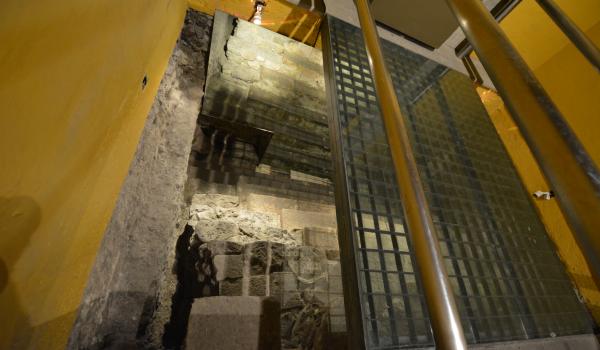
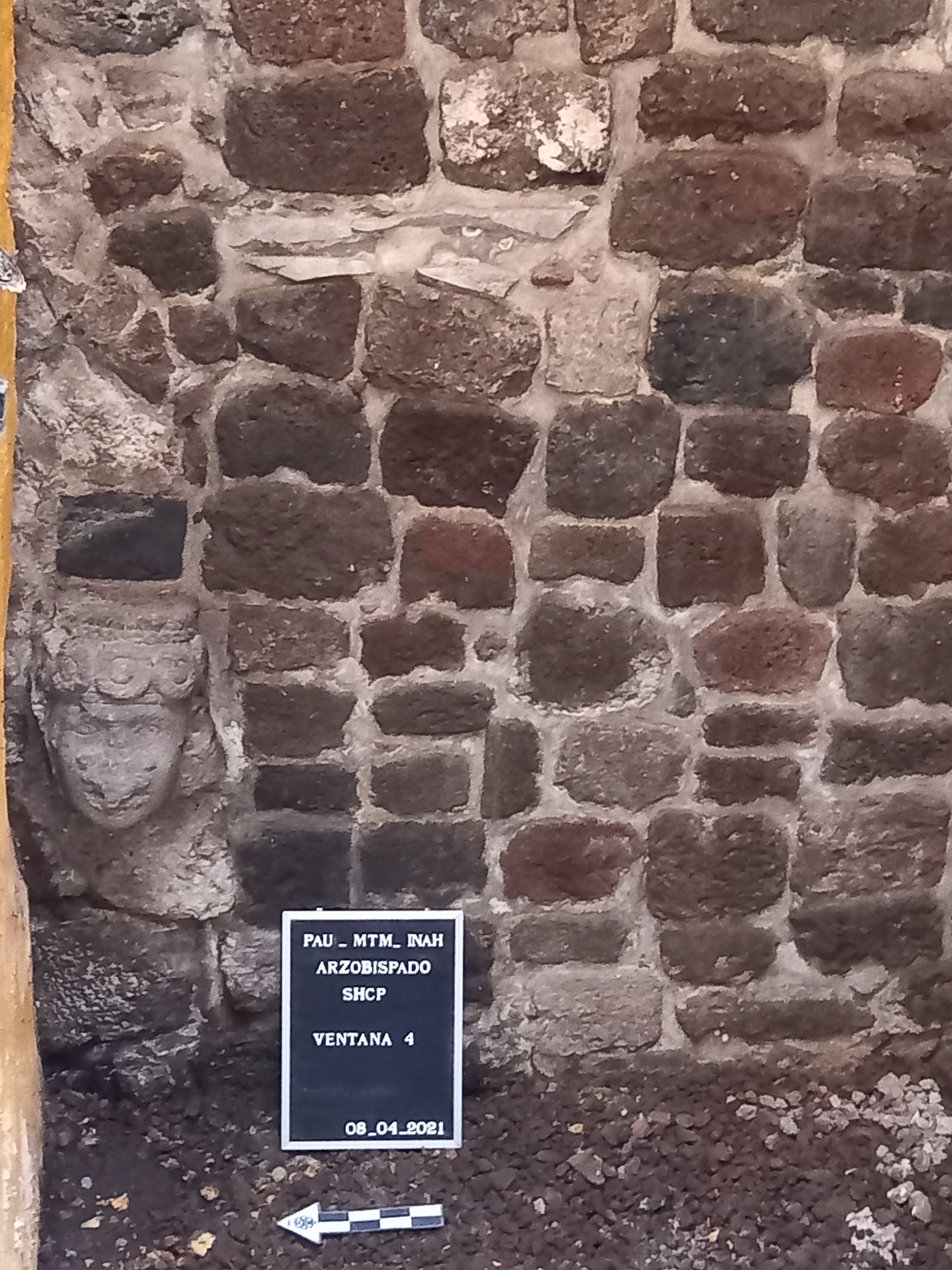
This window, which is not open to the public, shows the first architectural section of the Temple of Tezcatlipoca with an anthropomorphic sculpture embedded in the wall.
At the end of the 20th century, the Secretariat of Urban Development and Ecology carried out remodeling work on the Old Archbishop's Palace, now the Art Museum of the Secretariat of Finance and Public Credit. This work caused some damage to the building, so the Subdirectorate of Archaeological Salvage, through archaeologists Guadalupe de la Peña Vilchez, Judith Padilla Yedra, and Pedro Francisco Sánchez Nava, conducted research and safeguarded the heritage in 1987.
Thanks to this work, a sloping wall was identified on the north and east sides of the first architectural section of the Temple of Tezcatlipoca. On July 1, 1988, in the adjoining courtyard under an oval fountain, a monolithic sculpture was found, a Temalácatl painted red with the representation, on the edge, of eleven triumphs of Moctezuma Ilhuicamina over other peoples, and a solar deity at the top. In its center is a hollow where there may have been a ring to which prisoners were tied before facing the Mexica warriors. These types of gladiatorial sacrifices were performed in honor of Xipe, the red Tezcatlipoca.
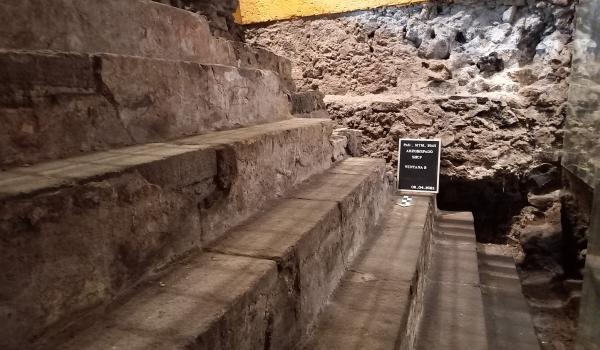
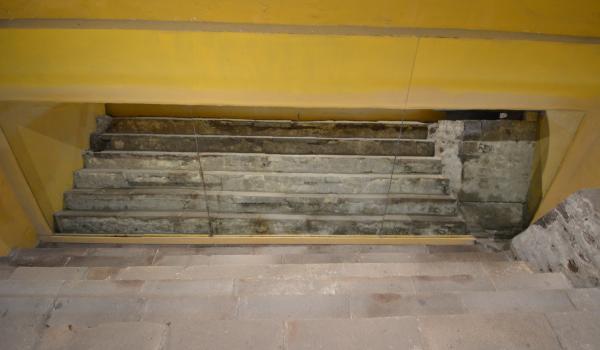
In 1994, archaeologists Laura del Olmo Frese and Diego Jiménez Badillo, from the Urban Archaeology Program, delimited the west and south sides of the temple of Tezcatlipoca. This intervention confirmed that the facade and the access stairway are located to the west.
The INAH decided to open six archaeological windows so that the public could see these pre-Hispanic remains, as well as some architectural evidence from New Spain.
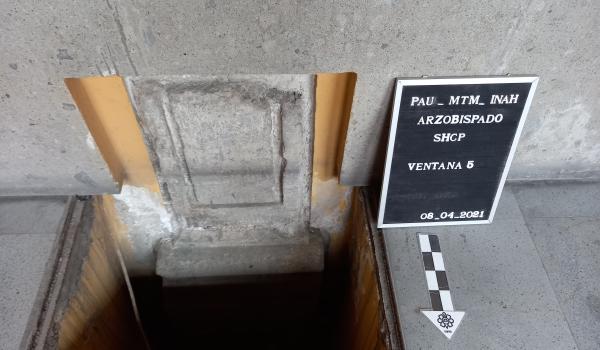
The fourth window, which is not visible to the public, is located in an open-air space and partially under a staircase in the historic building. It shows a section of a slightly sloping wall (in the northwest corner), which is part of the first architectural structure of the Temple of Tezcatlipoca, apparently from the platform that served as its base. Embedded in the wall is an anthropomorphic sculpture that could be one of the gods of pulque, linked to Tezcatlipoca.
Source: Raúl Barrera Rodríguez, director of the Urban Archaeology Program