










Teotihuacán
Archeological site
Teotihuacán
Patrimonio mundial
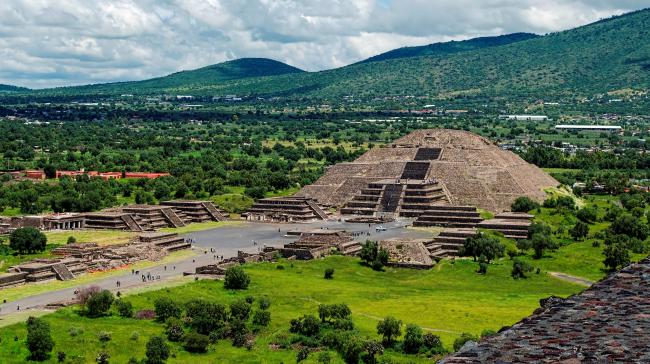
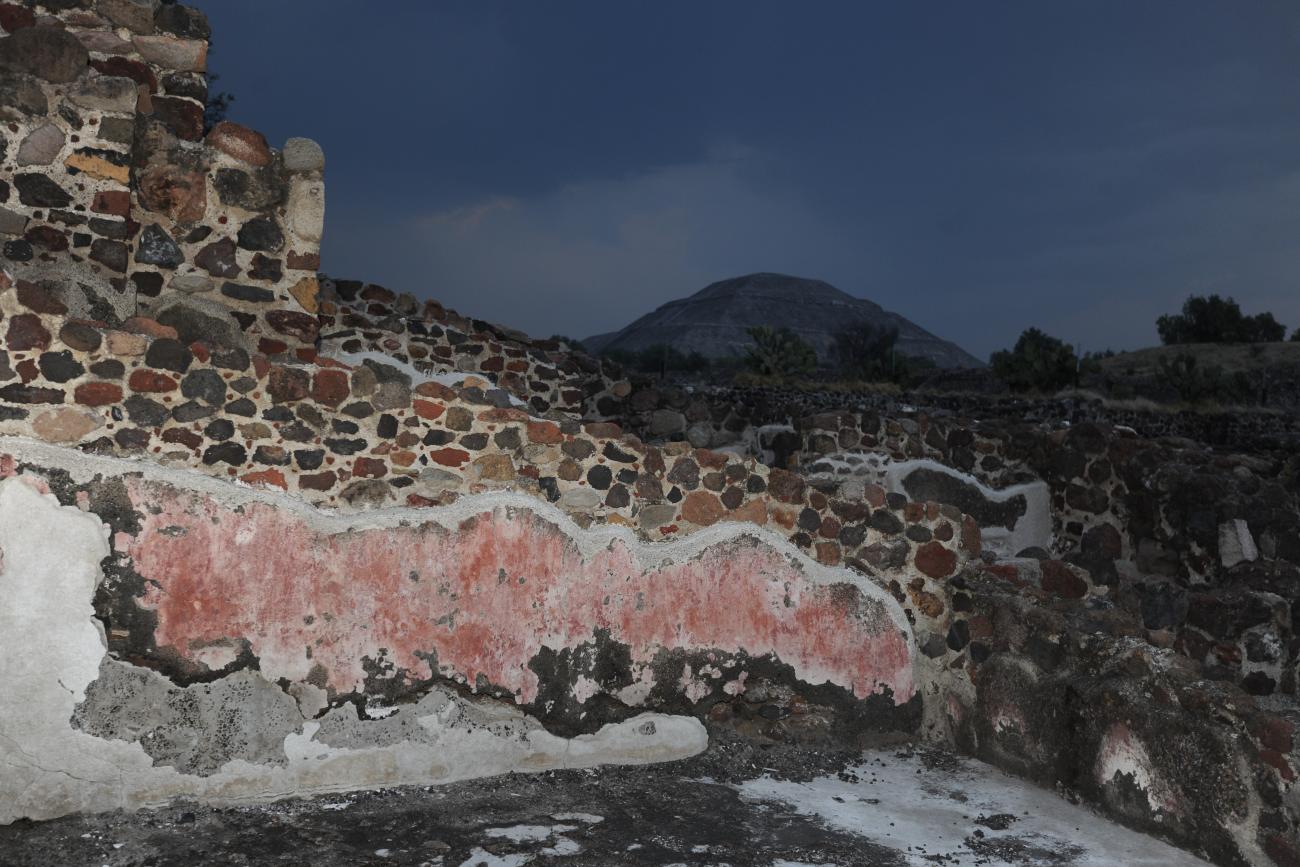
The great Mesoamerican city was at the heart of politics, the economy, trade, religion and culture. Its influence reached such distant places as Tikal. The city of Teotihuacan was placed on the UNESCO World Heritage List in 1987, owing to the outstanding value of its monumental building complexes, mural paintings and living areas.
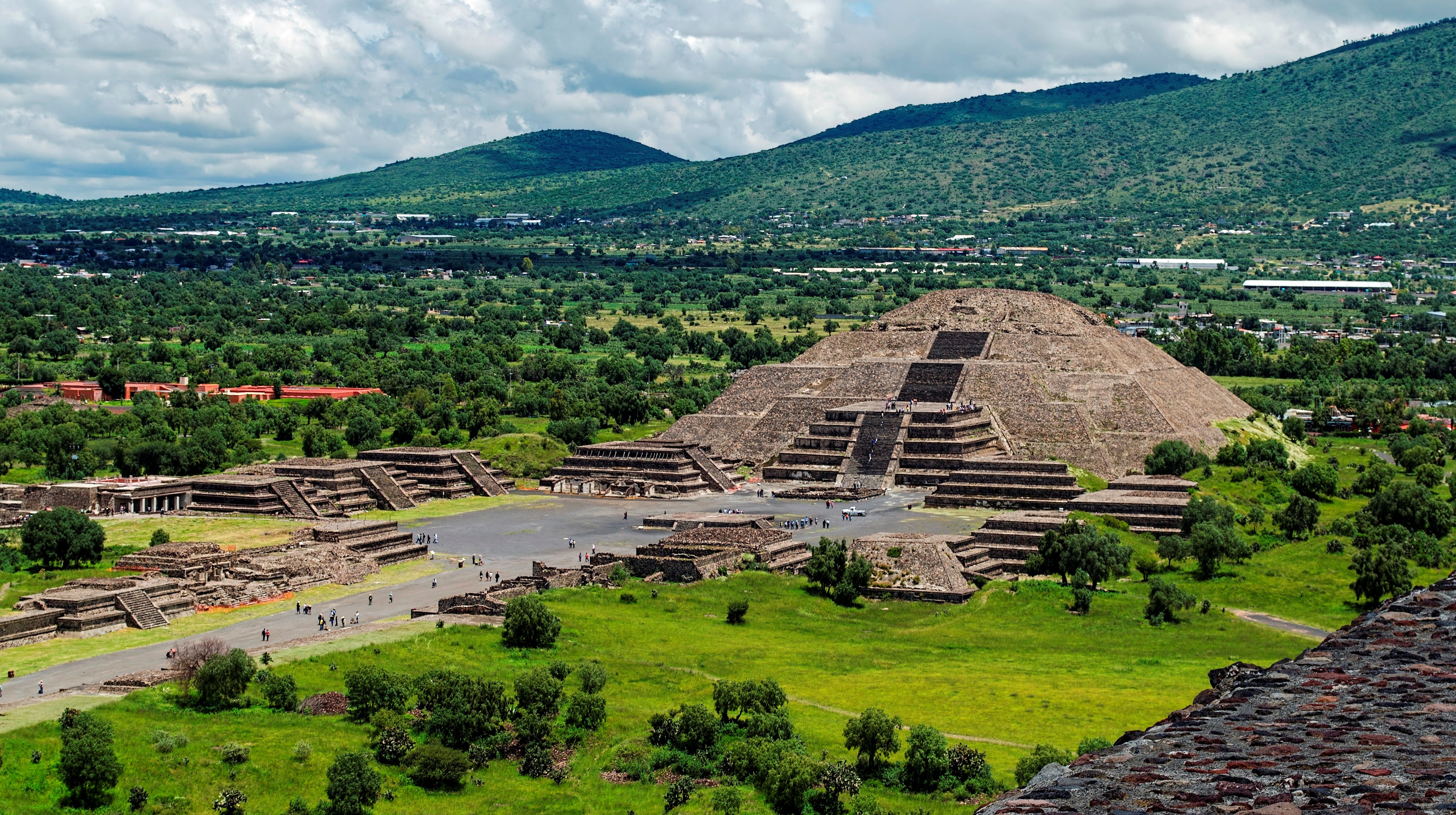
This was the largest city in ancient Mexico. It had a population of approximately 100,000 inhabitants at its height (350-450 AD) and has left us extraordinary monuments like the enormous pyramids, as well as its outstanding urban layout (it was the first geometrically designed city in this hemisphere), and its superb mural paintings. It has been on the UNESCO World Heritage List since 1987.
As capital of one of the first organized states, it maintained trade and political relations which stretched across great distances: the arid north of Mesoamerica (now Zacatecas), the Yucatan peninsula and the high Mayan lands of Petén (Campeche and Guatemala). It had a complex and hierarchical society, in which the priest class occupied the apex, followed by the warrior nobility. There followed the orders of artists and artisans (some living in districts for foreigners, such as the Zapotecs from the present-day state of Oaxaca), builders, miners and a vast number of farmers.
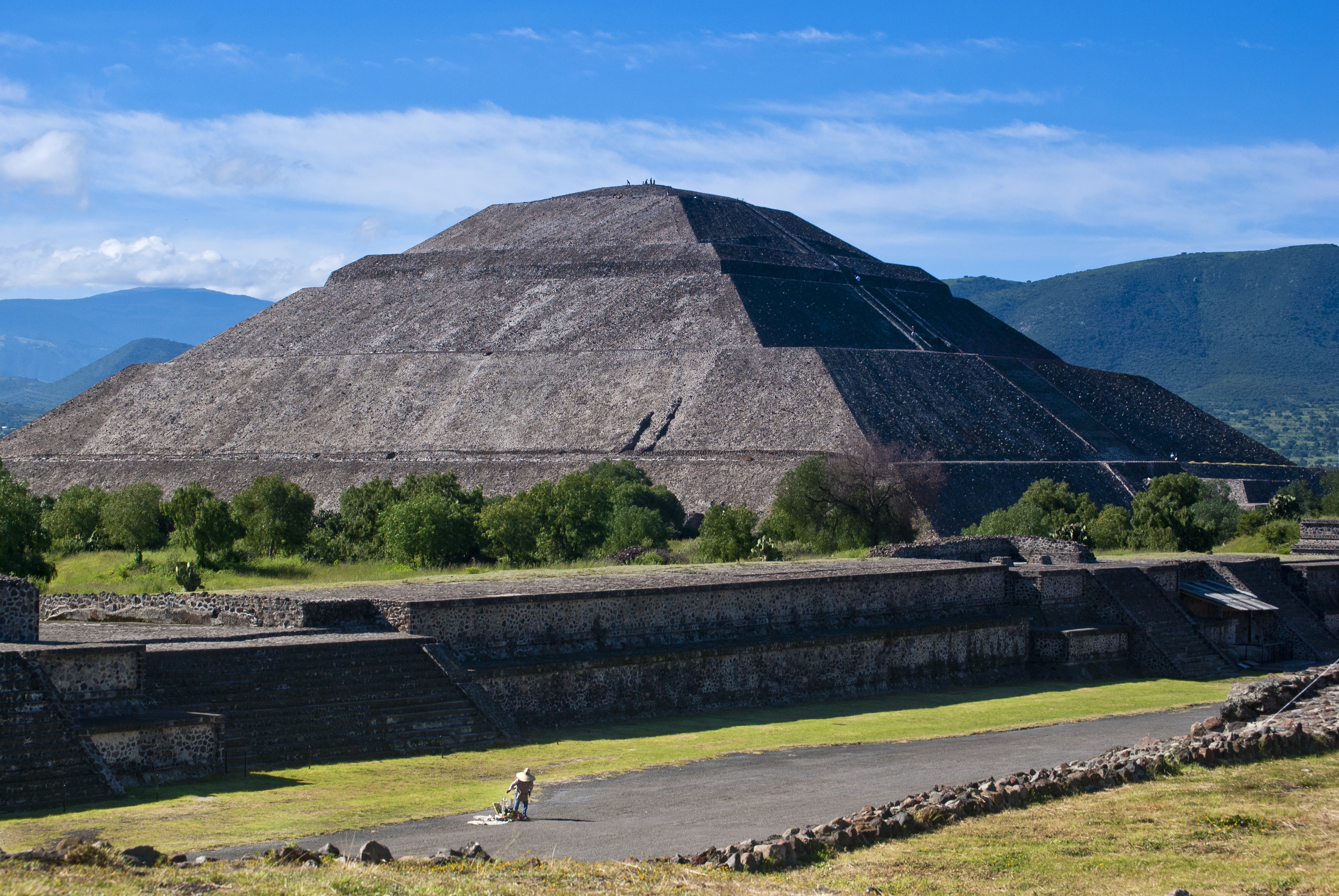
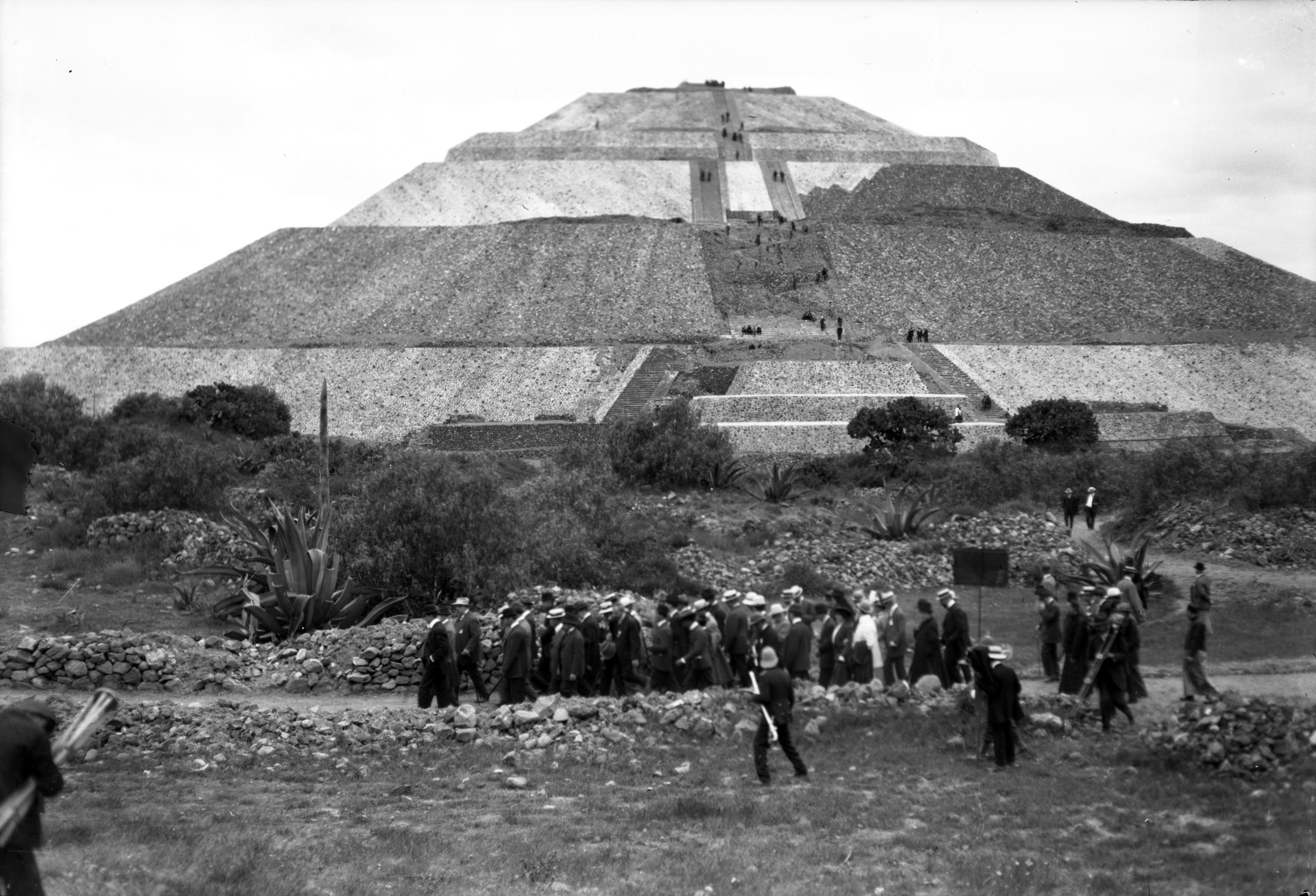
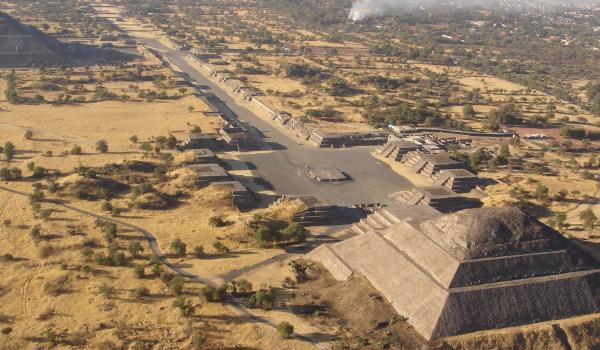
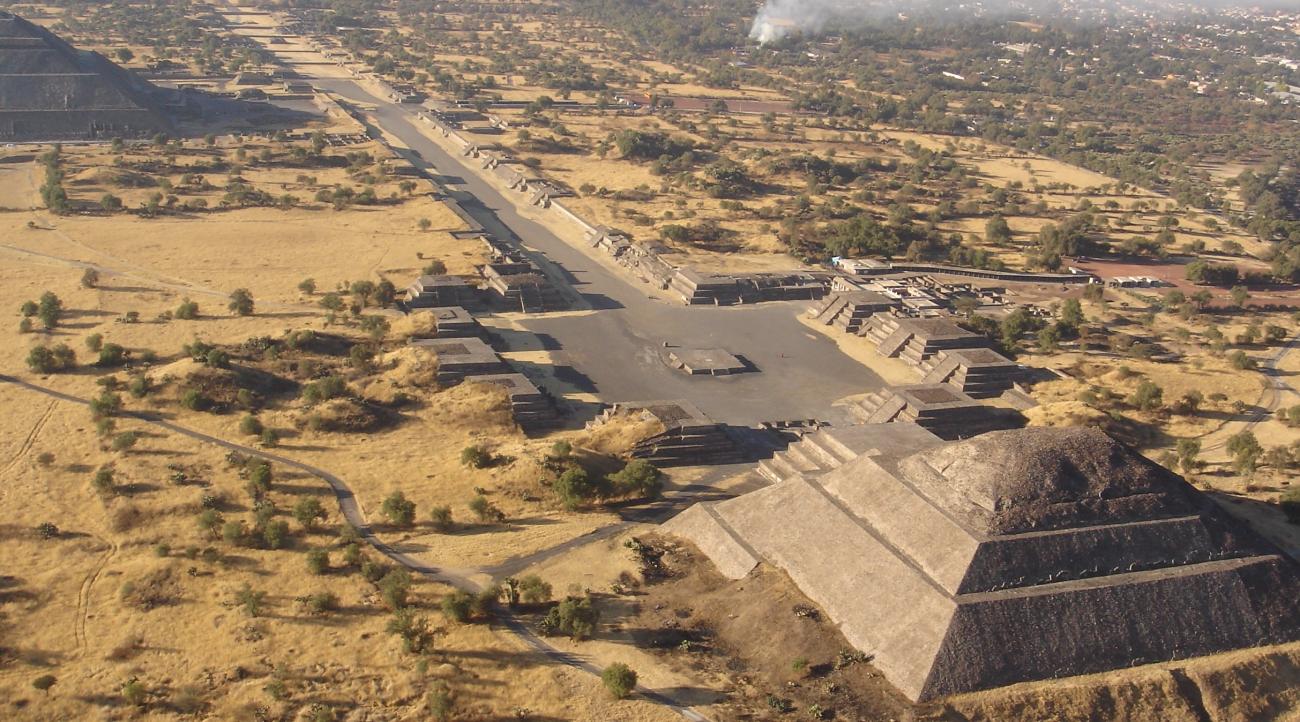
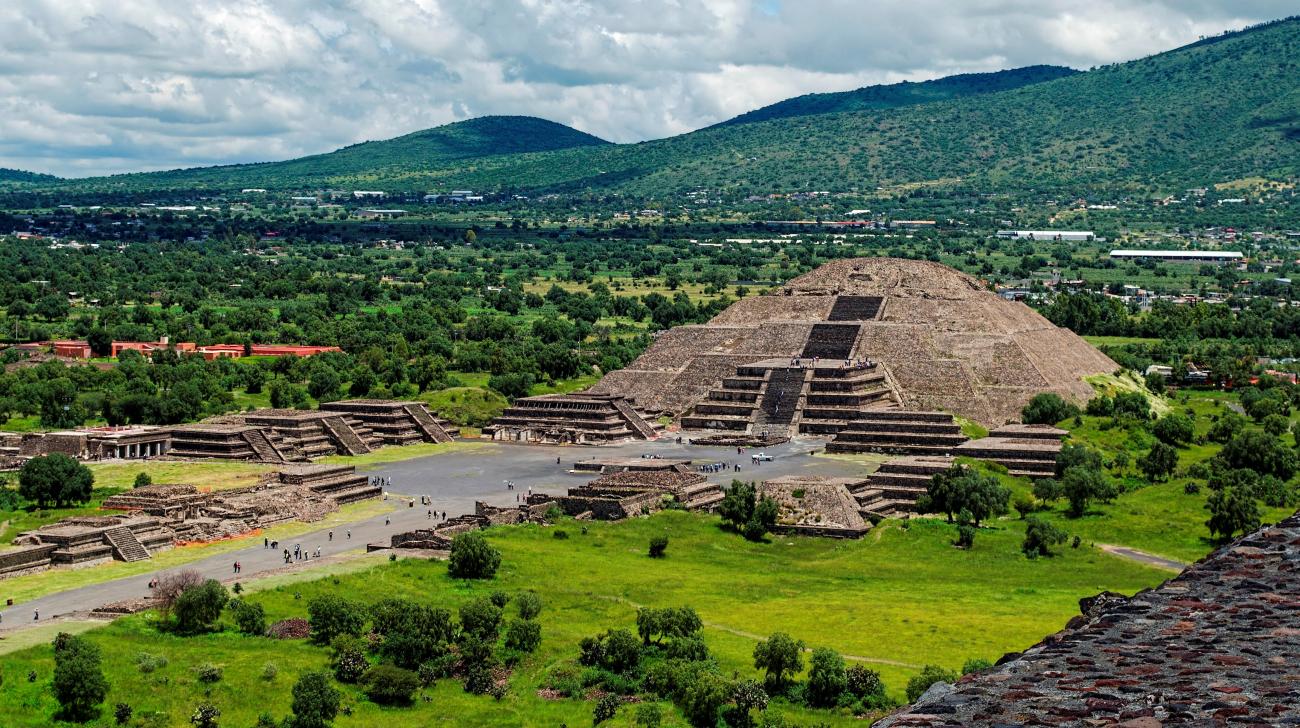
The community first emerged three centuries before the current era, established by villagers from the south of the five lakes in the Basin of Mexico. One characteristic of its architecture was the combination of “talud” (a sloping wall) and “tablero” (a vertical wall, frequently decorated with painted designs). By the third century AD, they had built the great Pyramid of the Sun, the beautiful Pyramid of the Moon and the Avenue of the Dead: their level of organization was already capable of this and more. The city occupied almost 8 square miles.
The city's trade routes soon reached the valleys that surround Monte Albán, Cholula and Matacapan (the latter in present-day Veracruz), as well as Kaminaljuyú and Tikal (both in what is now Guatemala), where the influence of Teotihuacan was made felt in different spheres such as the production of pottery and architecture. Cotton, precious feathers, fine blankets, sea and snail shell jewelry, chalchihuites (jade) and many fruits and vegetables arrived to the city from a multitude of markets, including very distant ones. Its apogee was reached in the fourth and fifth centuries AD.
However, violence erupted in the city in the mid-sixth century AD. Its central area was severely damaged, apparently by sectors of the population itself. The great city, sadly diminished, conserved a preeminent role in the region, but had to share it with others. Decline followed. In the thirteenth century, groups of people who spoke the Uto-Aztec language arrived from the north. As they passed through, they found it abandoned, surrounded by only a few hamlets. Its majestic, half-ruined constructions led them to call it admiringly in their language “place of the gods" or “place of deification”: Teotihuacan. Nobody knows what its inhabitants called it.
We do know that they worshipped Tlaloc for rain and agriculture, Huehueteotl for fire, Chalchiuhtlicue for running water, Quetzalcoatl for creative ability and the morning star, Quetzalpapalotl apparently for war and Xipe Totec for corn. They worshopped them all with names that have not survived, different to the Nahua names that prevailed. They believed that the dead lived on, and buried them as if for a journey, with offerings and formal attire. They thought they would last forever. However, these people, their city and their state only lasted from 50 to 650 AD.
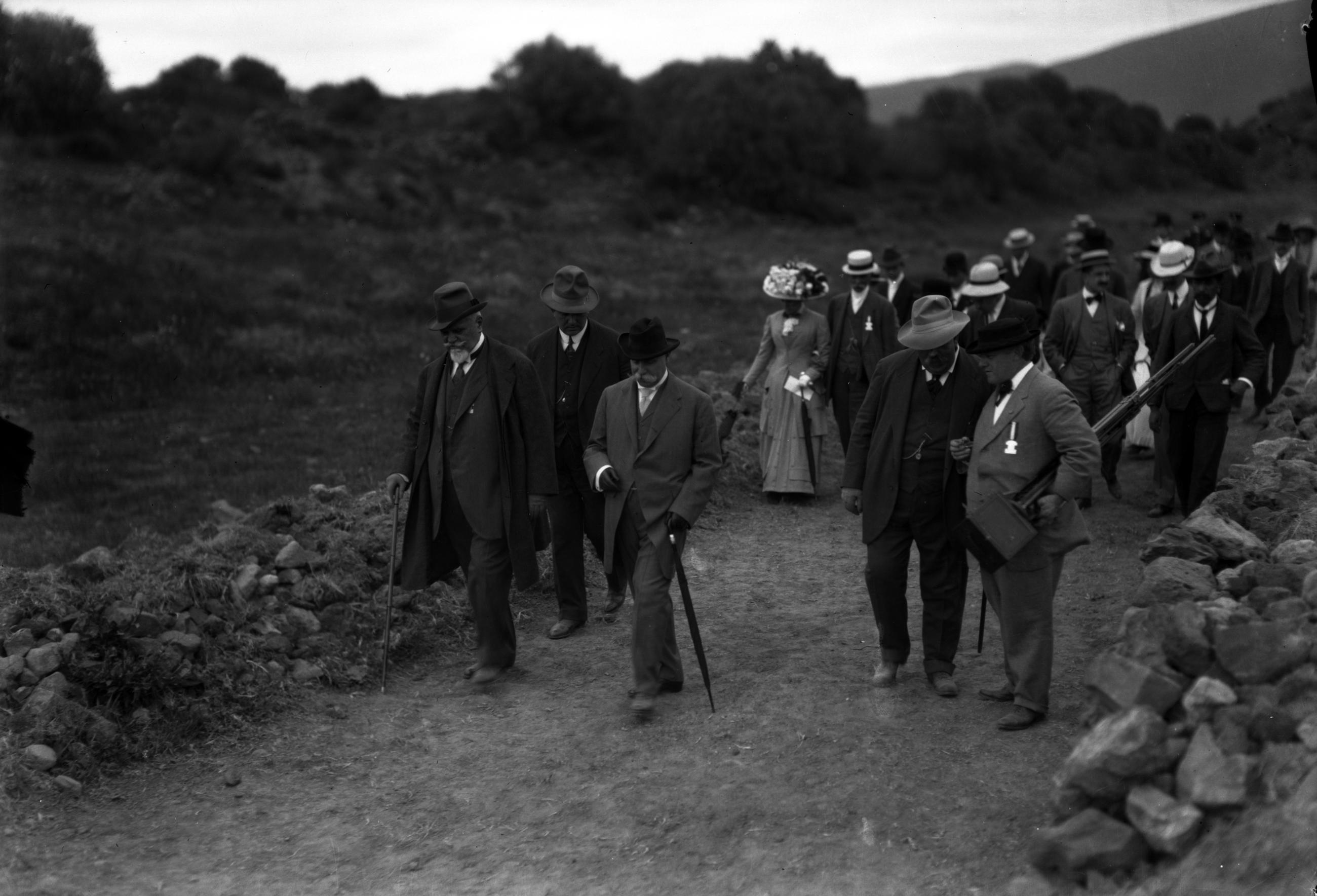
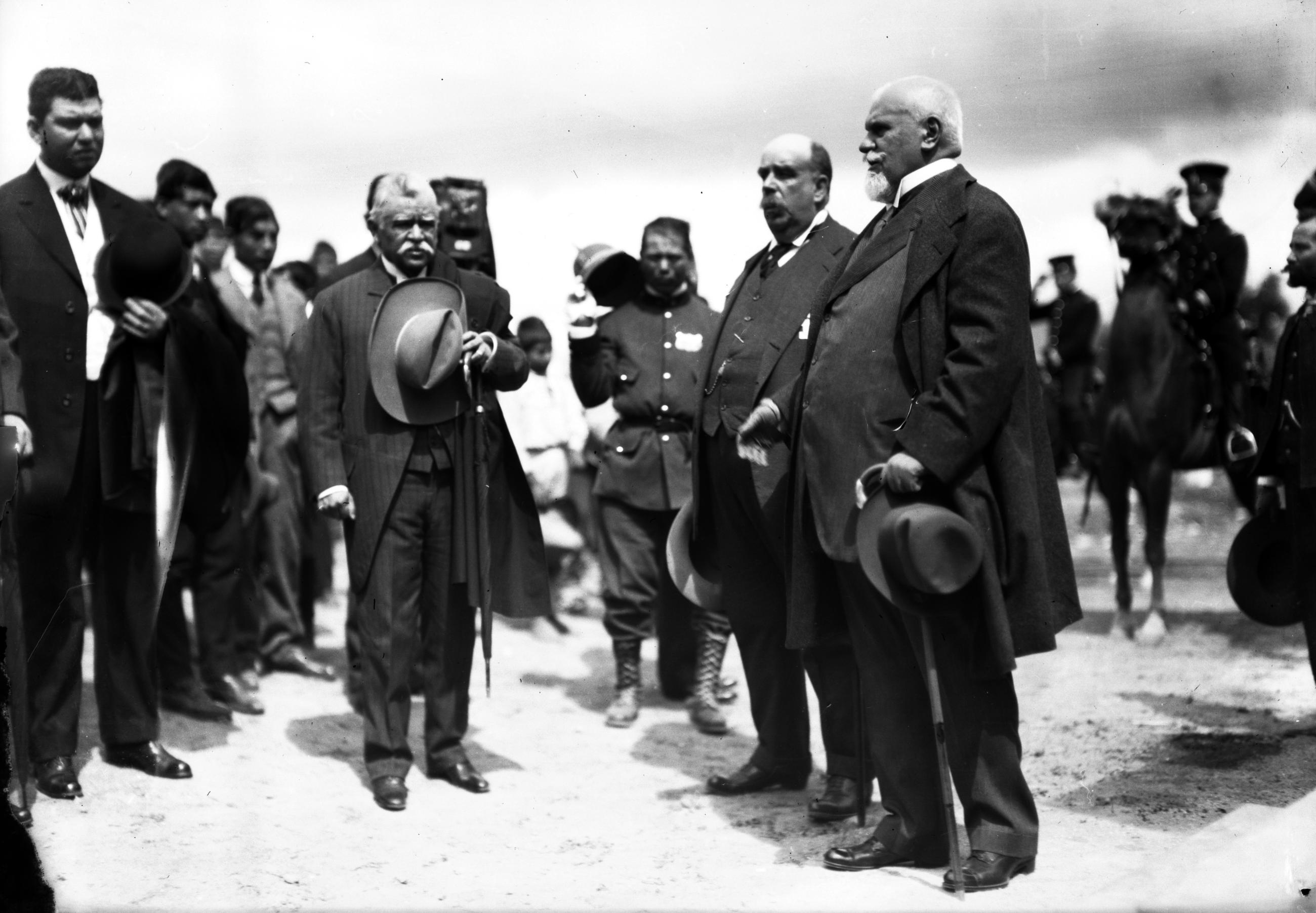
In 1675, the colonial-period scholar Carlos de Sigüenza y Góngora explored the square-based building at the foot of the staircase that climbs the Pyramid of the Moon. In the 1880s and in 1905, the anthropologist and archeologist Leopoldo Batres performed excavations and reconstructions near the Pyramid of the Moon and the Pyramid of the Sun on the instructions of President Porfirio Díaz. He also founded the first site museum. Three new projects of investigation, excavation and preservation (the largest in Mexico’s archeological history until then) were then performed in 1962-64 by the INAH. Others took place in 1980-82 and 1992-94. This interdisciplinary task continues.
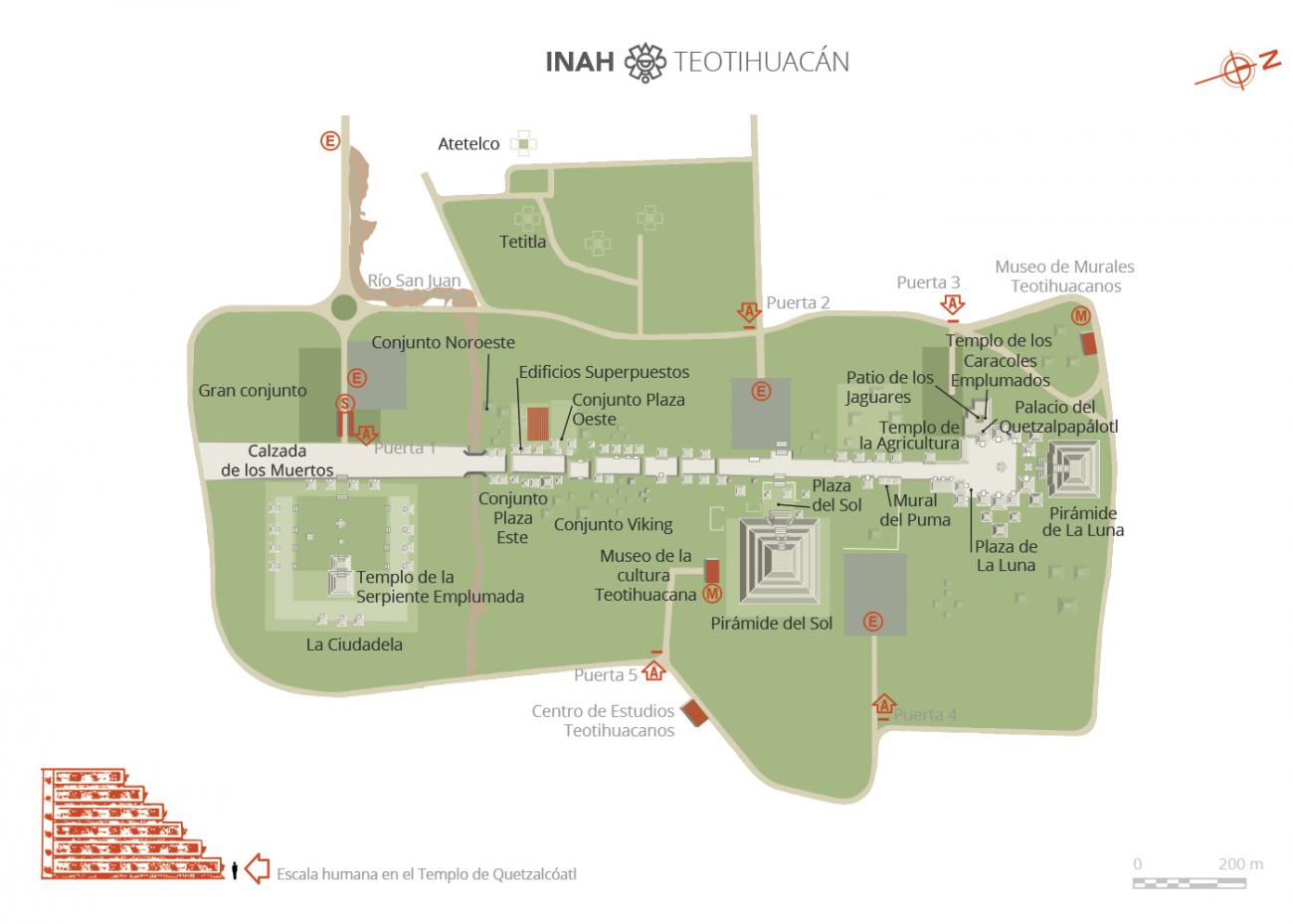
The archeological zone open to visitors covers 652 acres, within which the following main groups of structures and monuments can be found: the Citadel and the Temple of the Feathered Serpent, the Palace of Quetzalpapalotl and three apartment areas with noteworthy mural paintings (Tetitla, Atetelco and Tepantitla).
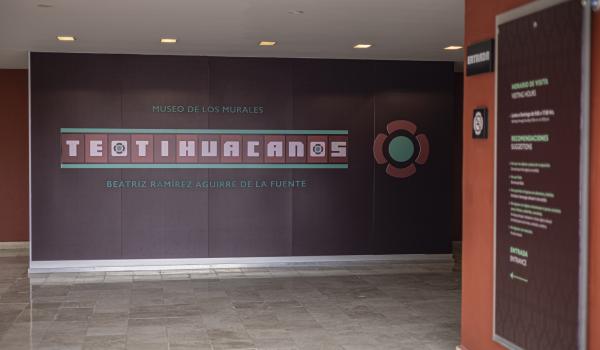
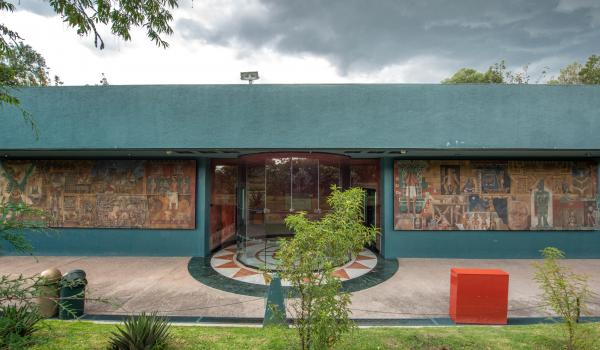
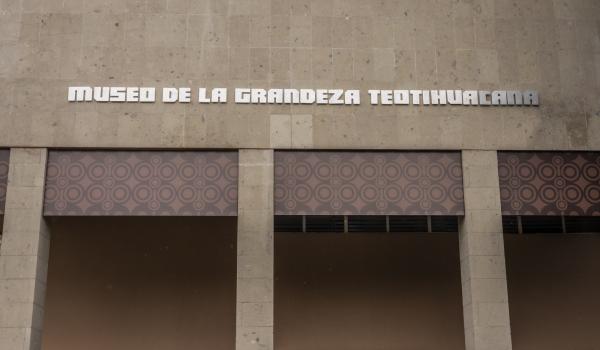
Two site museums round off the visit and guide our learning and curiosity: the Museum of Teotihuacan Culture and the Beatriz de la Fuente Museum of Teotihuacan Murals, in addition to which there is a temporary exhibition hall in the so-called “Former Museum.” Archeological pieces can also be admired in the Sculpture Garden. It is also well worth visiting the botanical garden adjacent to the Museum of Teotihuacan Murals.
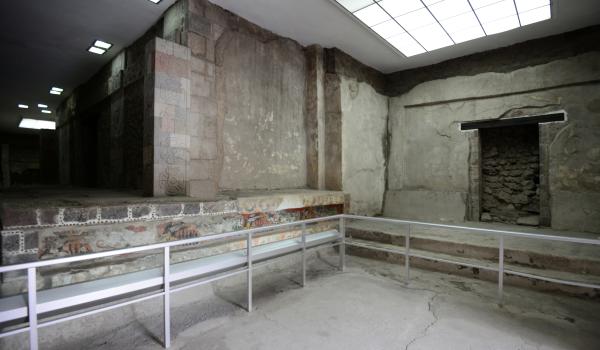
Templo de los Caracoles Emplumados
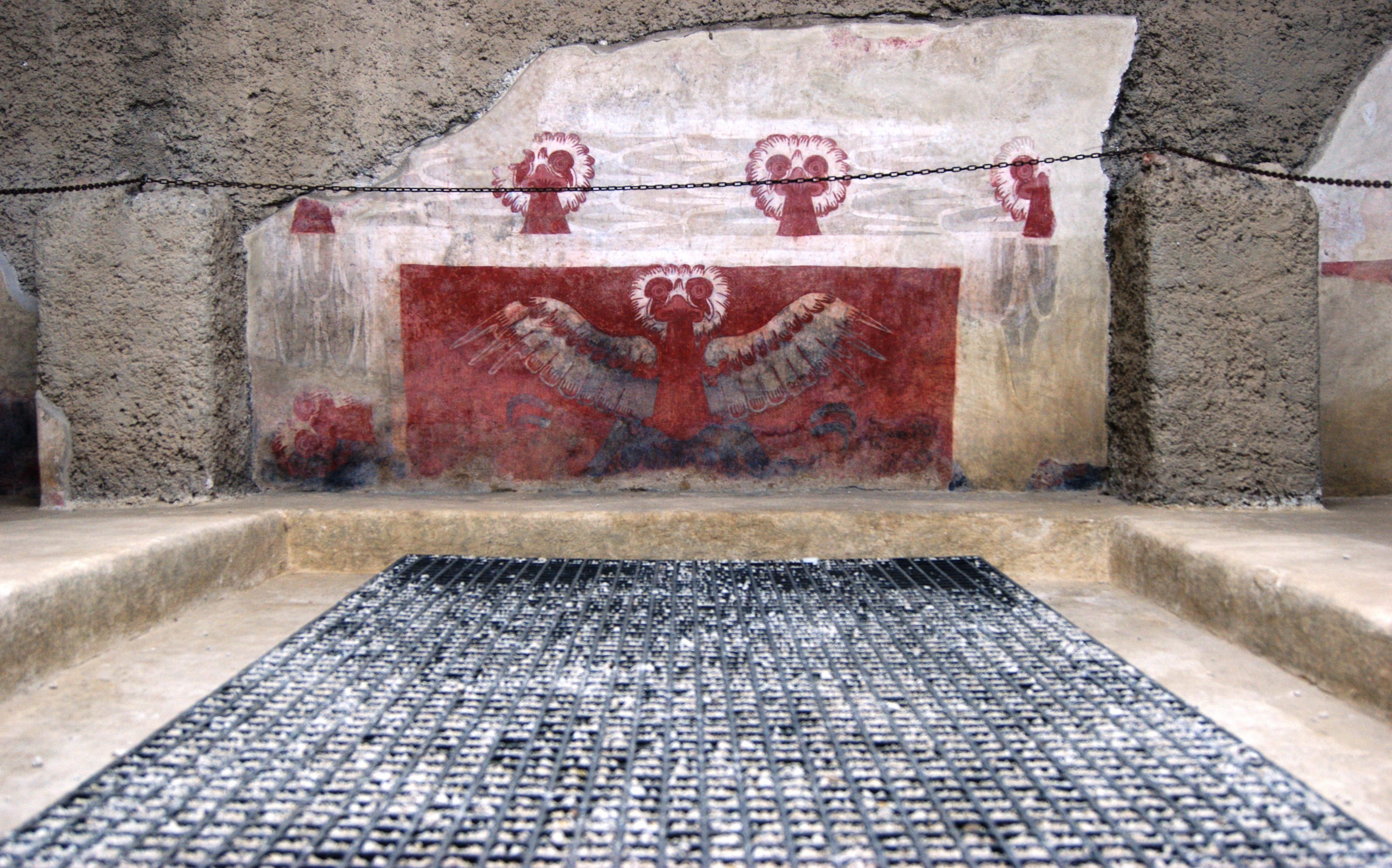
In this precinct there is a pyramidal base built with walls in slope and board, in whose facades are represented several birds in procession distributed in four polychrome boards. In front, in a little explored space, a building decorated with red disks can be observed.
Templo de los Caracoles Emplumados
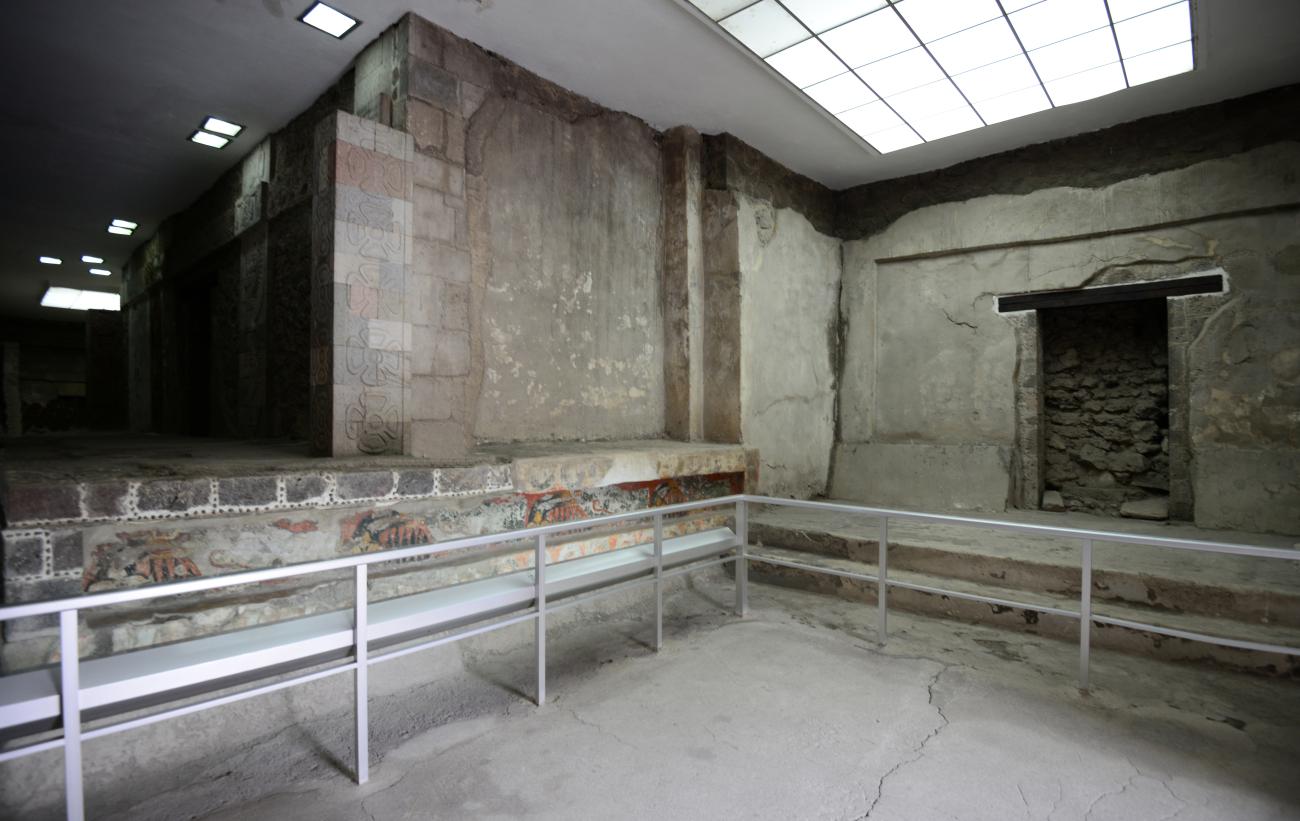
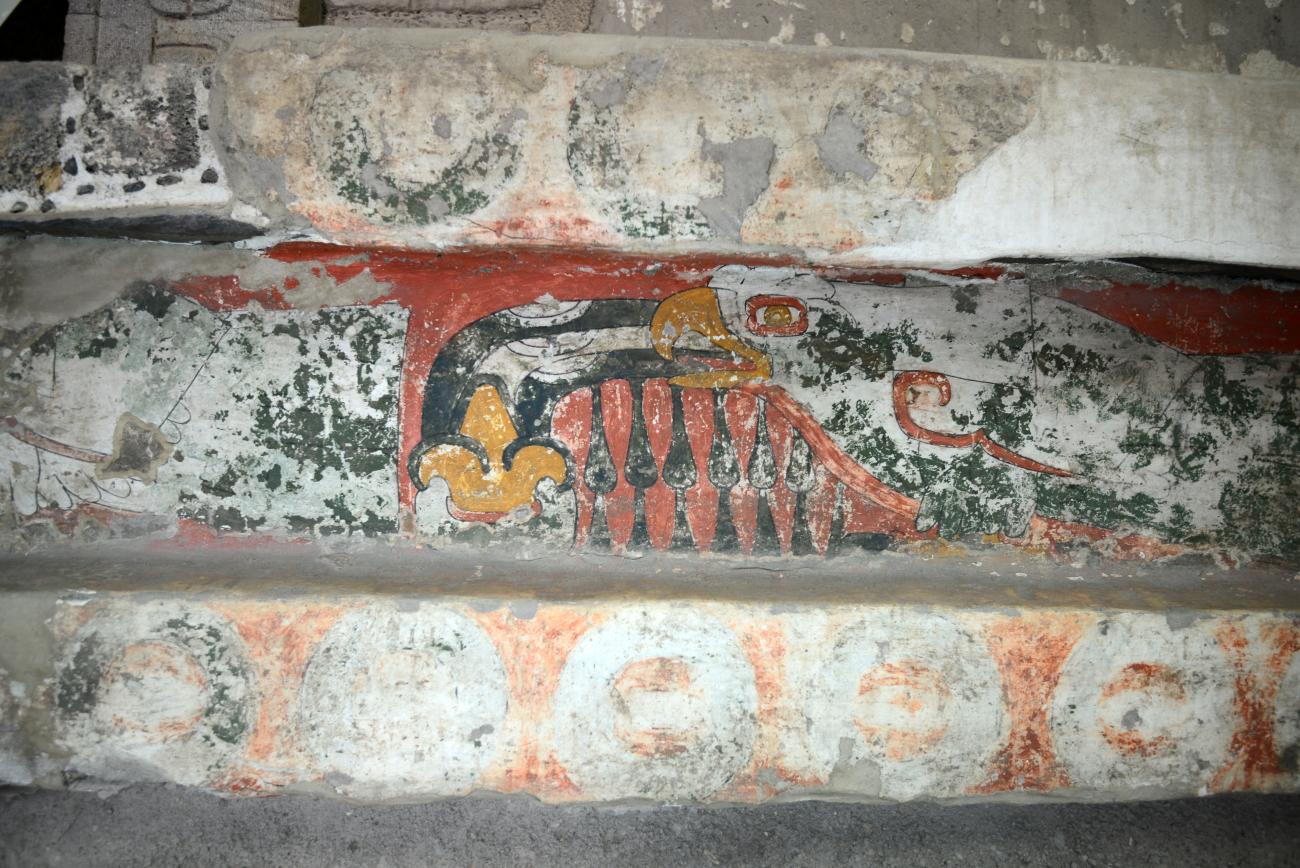
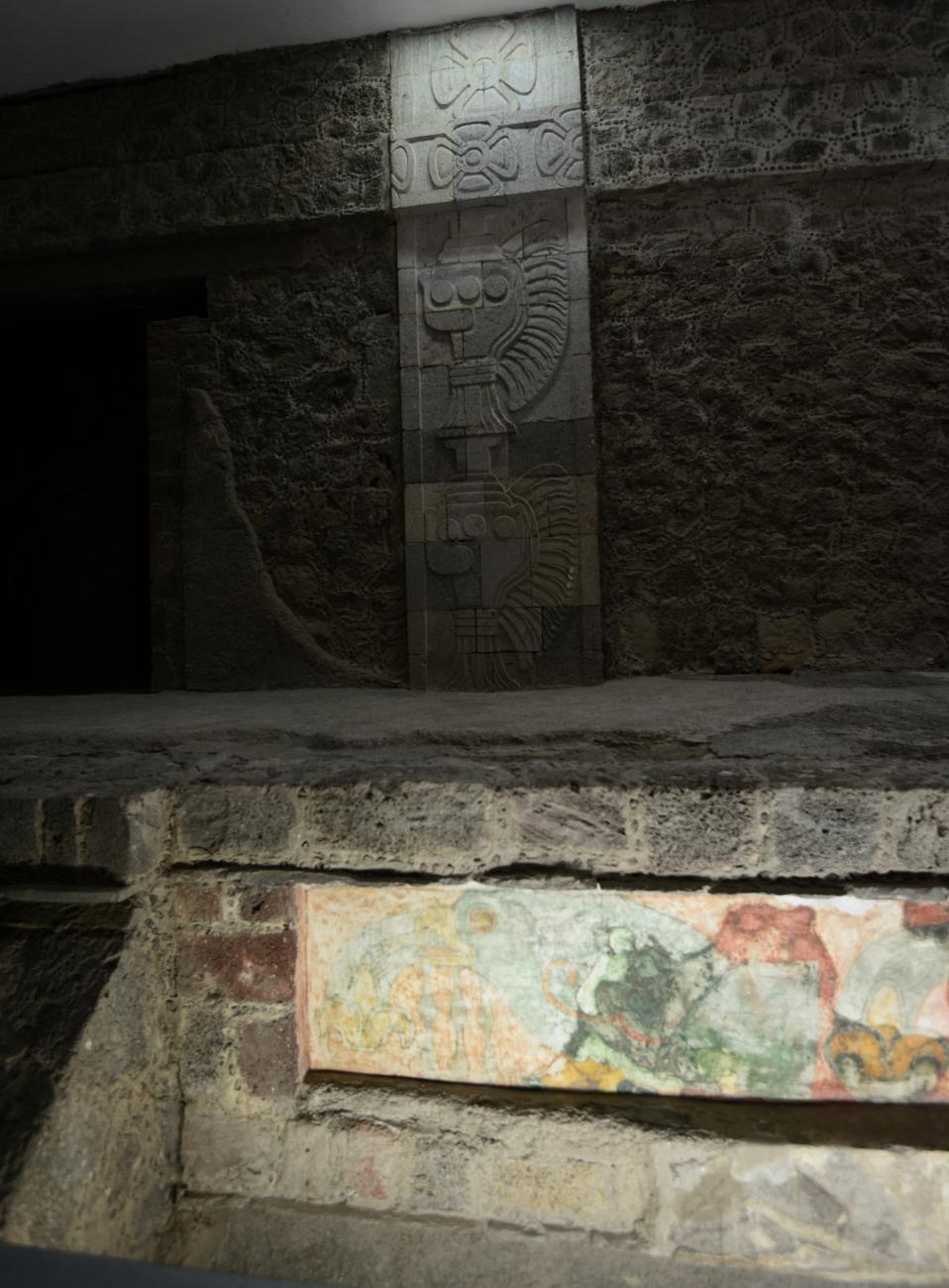
In this precinct there is a pyramidal base built with walls in slope and board, in whose facades are represented several birds in procession distributed in four polychrome boards. In front, in a little explored space, a building decorated with red disks can be observed. On this base is shown the almost complete facade of a temple with representations in bas-relief of flowers of four petals and great feathered snails, figures that are painted directly on the rock.
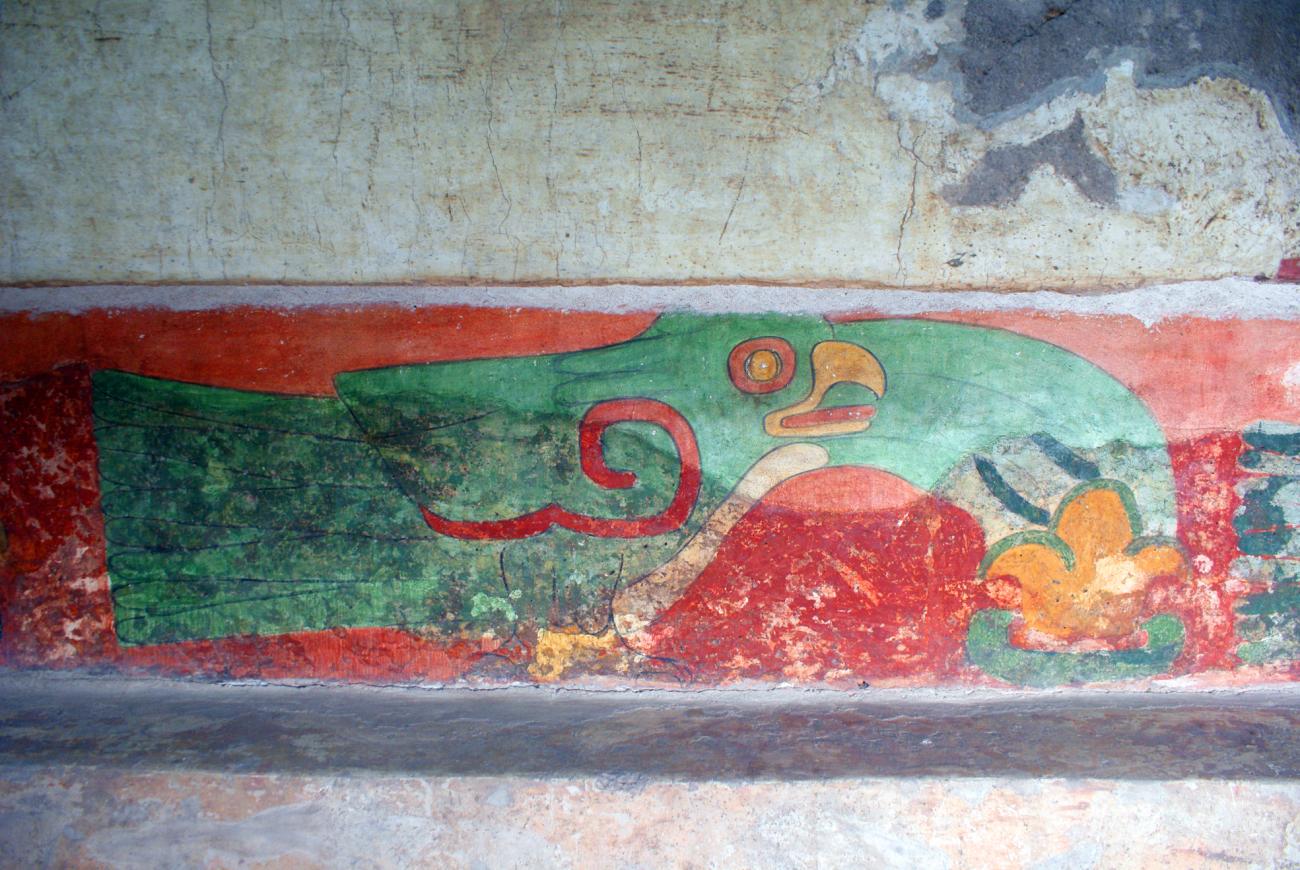
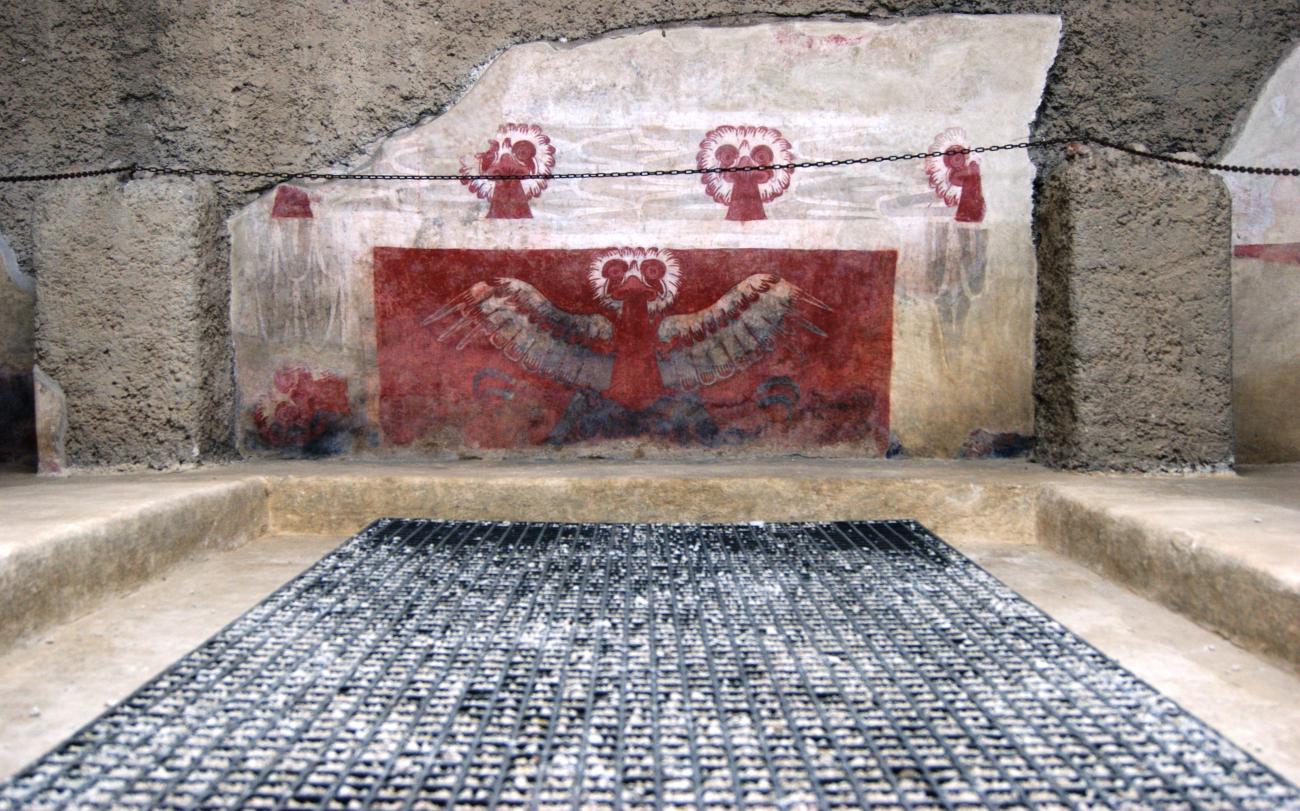
Board with bird: There are four elements that conform the main figure of this mural, located in the Temple of the Feathered Snails. The first is the bird itself, the second is a band divided into three sections that continues the extension of the beak and represents a stream of water, the third are drops descending from a stream, and the fourth is a yellow flower at the end of the band.
The bird is green, outlined with black. It is painted on a red-orange background and spread horizontally; it has the appearance of a macaw or parrot because of its large, strong, hooked beak that opens to reveal the tongue. Above and behind the eyes, short and wide feathers delimit the perimeter of the head; on the body two sections of feathers are distinguished: the short ones are of the wings and are framed at the bottom by a sinuous band, which ends in a scroll and underlines the base of the wing, while the long ones of the tail are extended horizontally.
The band or stream, which exits behind the bird, is broad and is divided into three parallel sections extending in a curved manner between the bird's beak and the three-petaled flower. The upper and lower sections are dark green, the middle section shows traces of highly degraded light green. At the level of the curvature of the band there are three semi-oval shapes, possibly “water eyes”. The flower seen in profile has three petals, similar to a fleur-de-lis; the central petal is directed upwards like a spearhead with a rounded vertex, and the lateral ones curve to the sides. It is bordered at the top by a narrow green band and at the base by a short horizontal band in the shape of a crescent moon.
Fuente, Beatriz de la (coord.), 1995, La pintura mural prehispánica en México Teotihuacán, volume I, Mexico, UNAM/IIE.
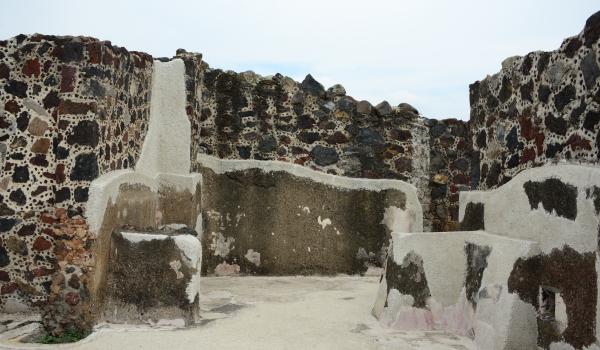
Patio de los Jaguares
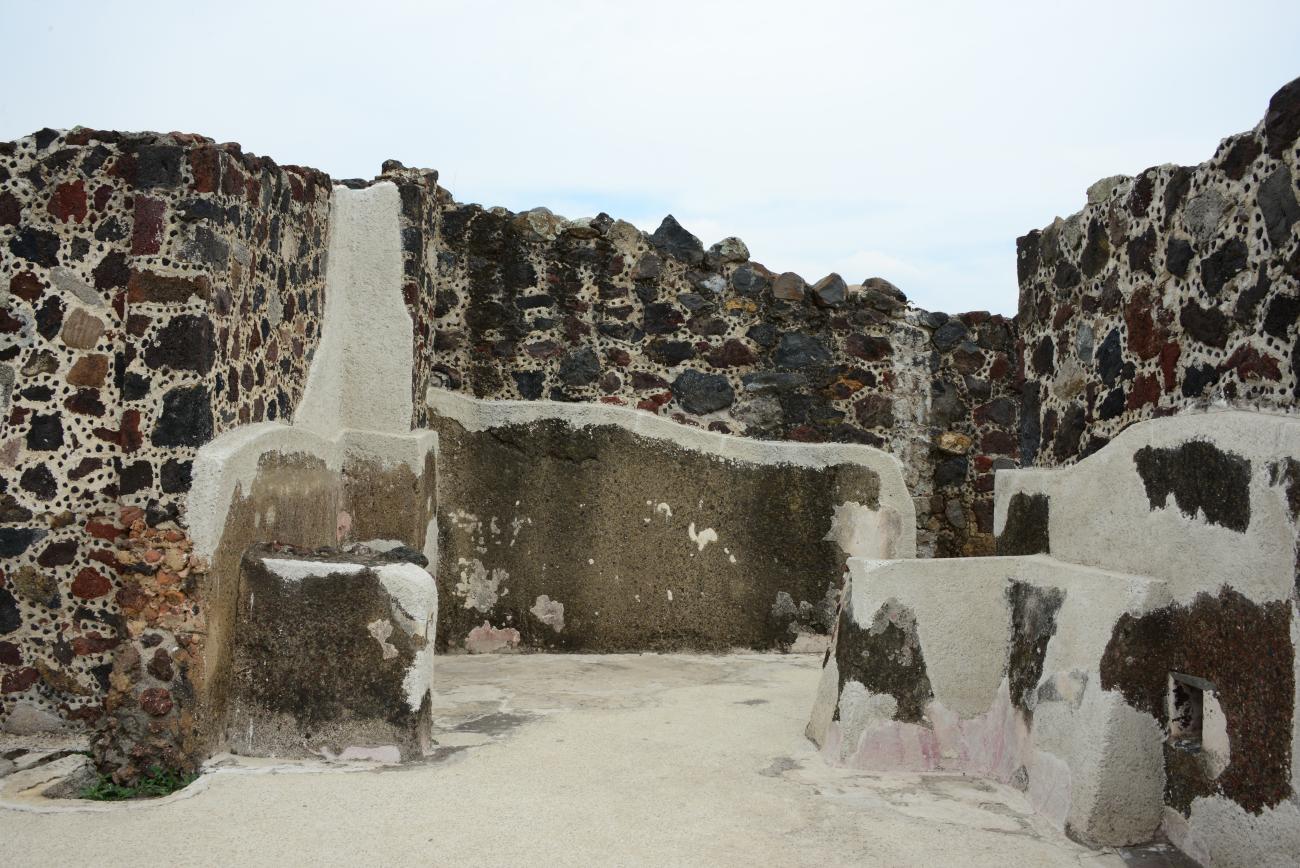
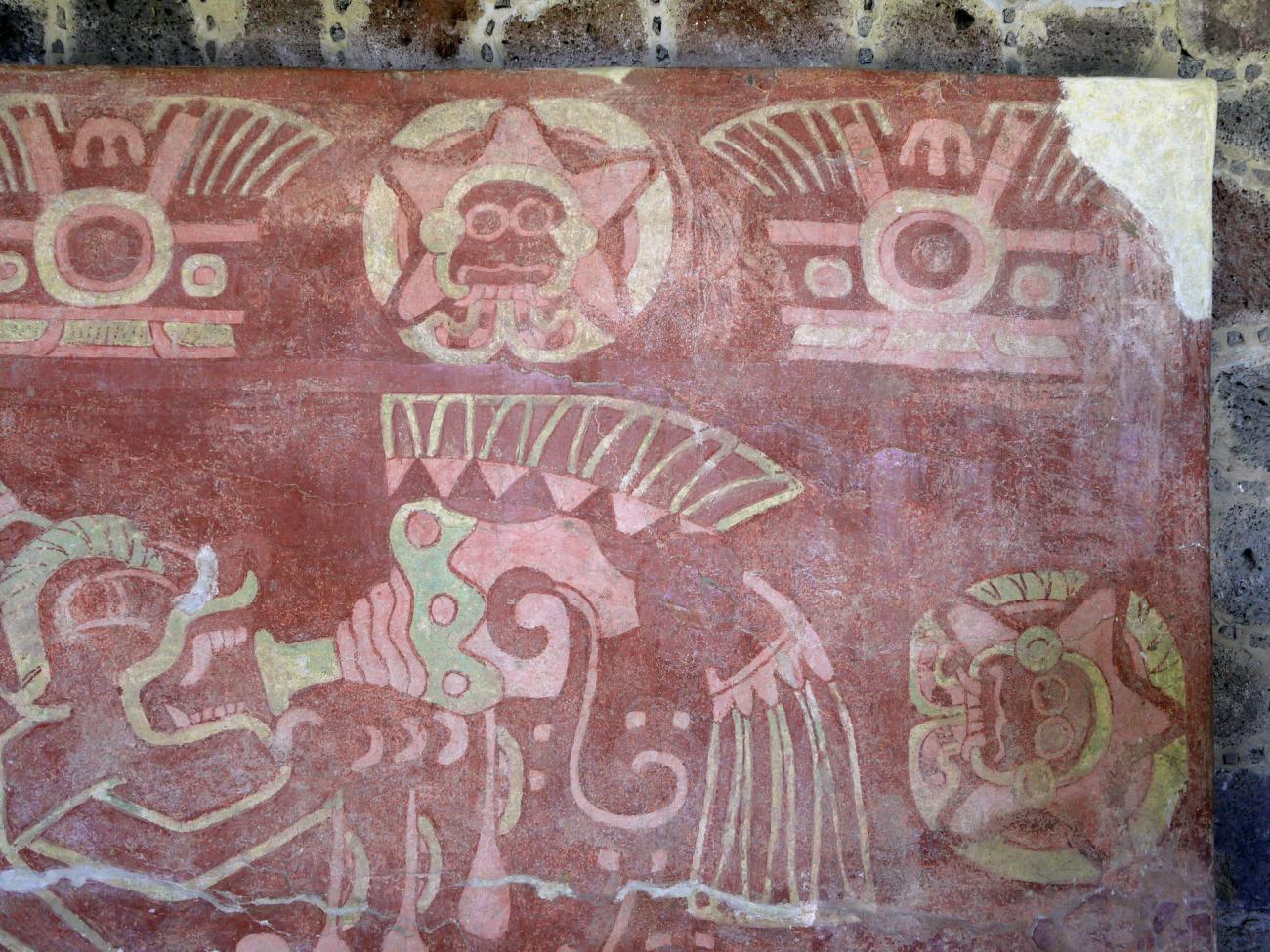
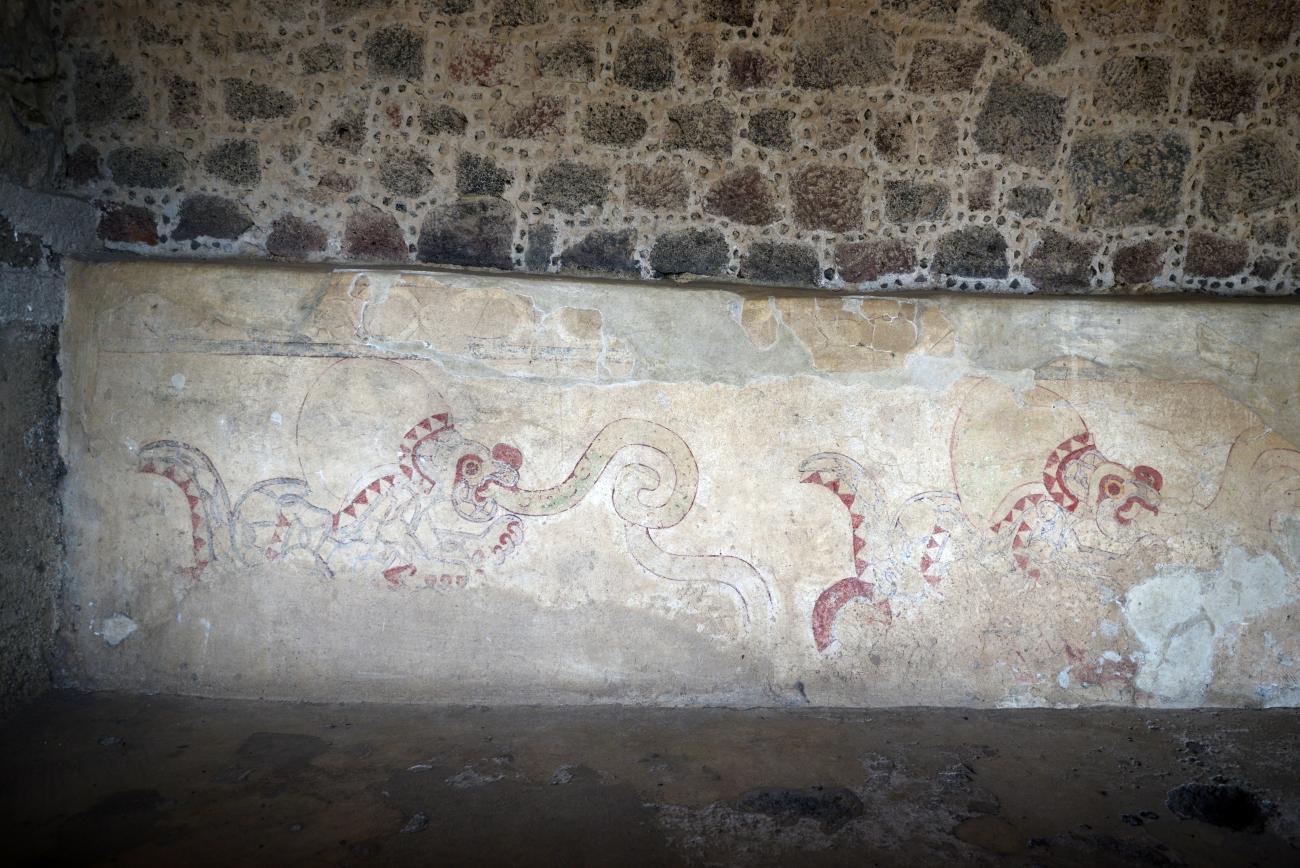
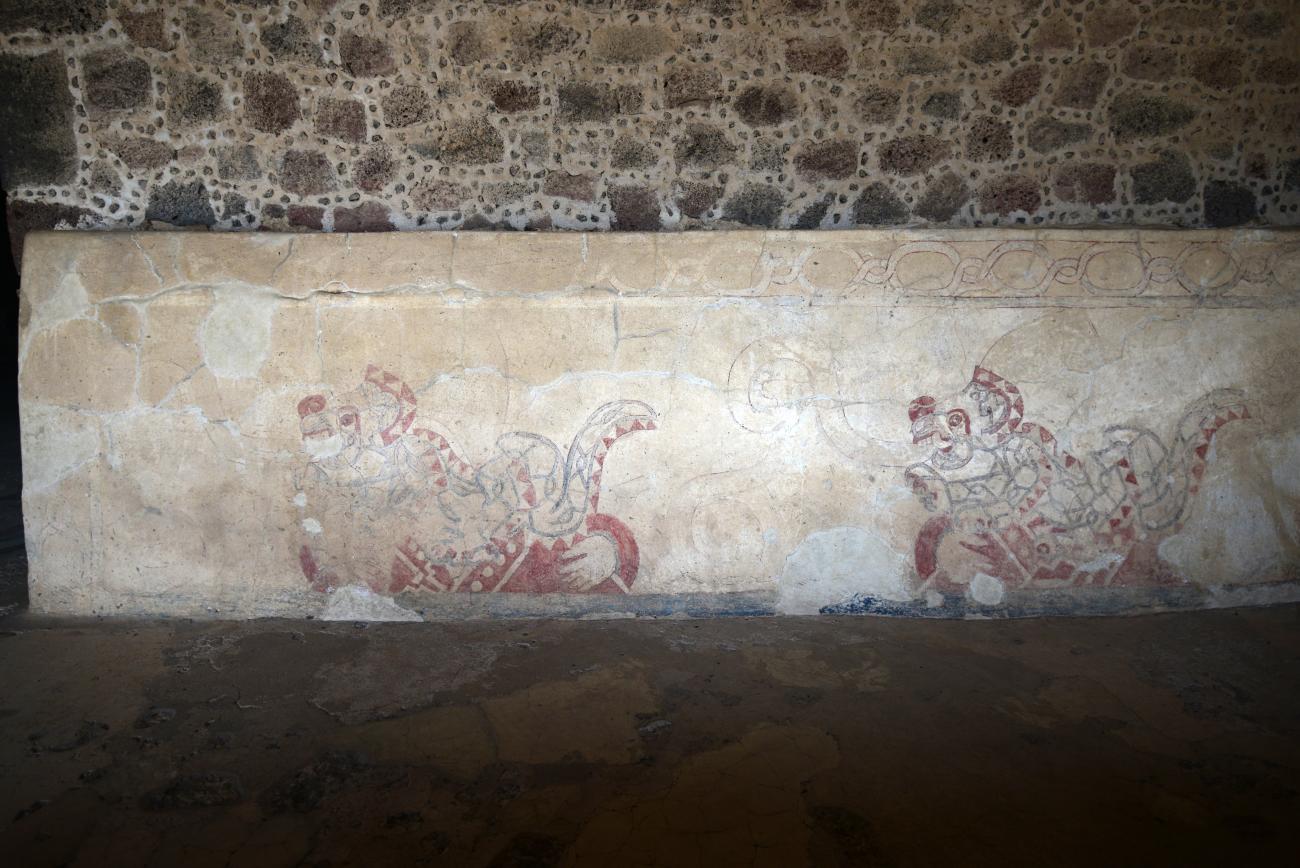
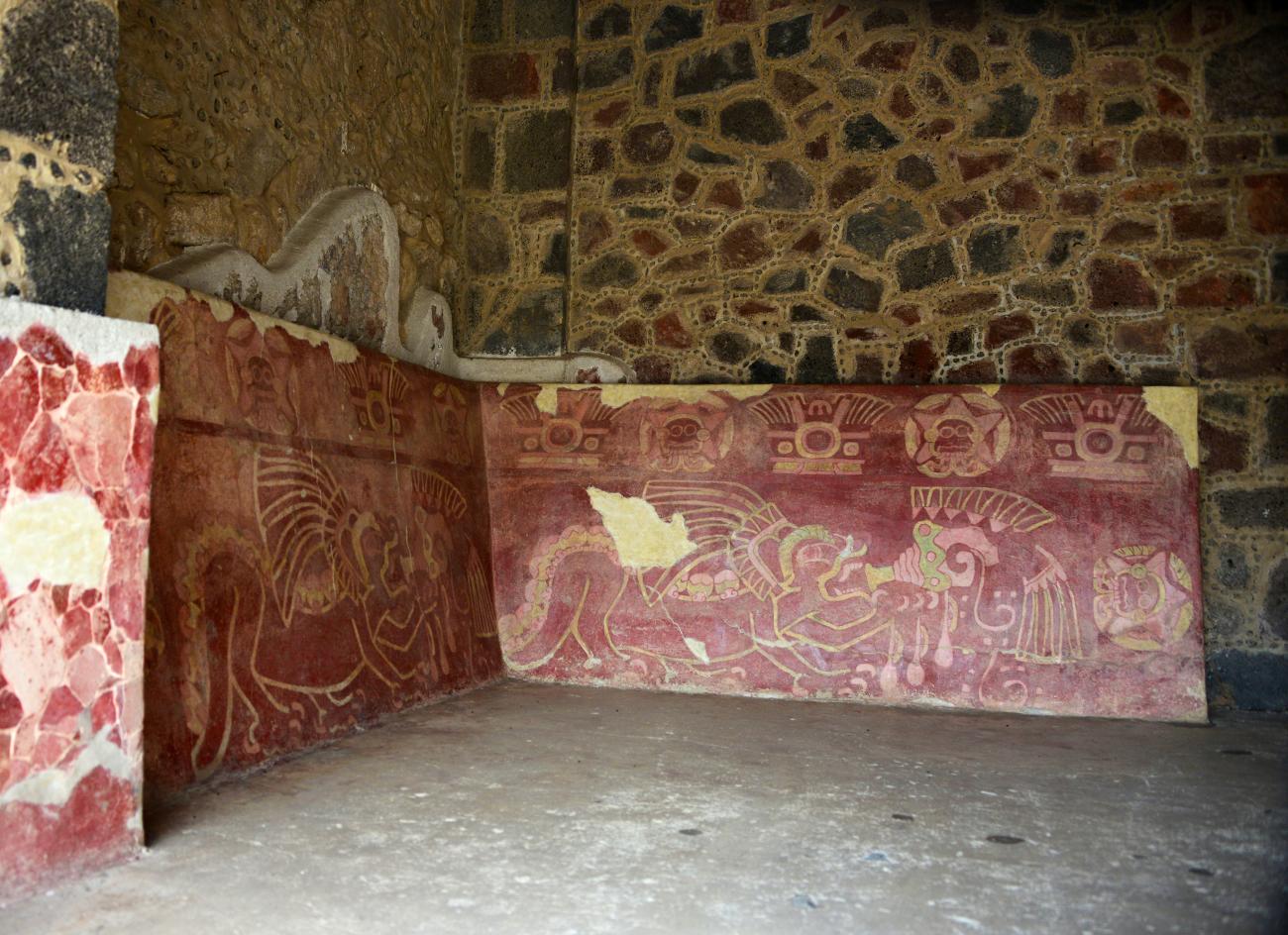
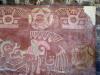
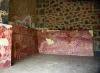
This complex is located to the west of the Palacio del Quetzalpapálotl. In the porticoed walls of its precincts are exposed extraordinary images of jaguars in two versions: a procession of richly dressed felines, that carry in the snout a musical instrument of great feathered shells, and small jaguars wrapped with a reticulated net that are guarded by two human hands.
Felines with shells playing a snail: The scene of this mural, located in the Patio of the Jaguars, depicts a feline of elongated body in dark red color. The head is slightly tilted upwards; the eye looks like a design of curved lines in pink; the erect and rounded ears are above and behind the eyebrows; the muzzle is open and inside it teeth and fangs show; a small circular nose can be seen.
The headdress is composed of a plume holder or rigid diadem of short feathers, and a plume of five long feathers that are directed upwards and backwards; an ornament of symbolic character, composed by a row of bivalve shells, runs along the animal's back behind the plume holder up to the tail. The snail that is in front of the snout of the feline is constituted of a sort of tube or mouthpiece with flange; it is composed of three sections: a flared one of red bottom and green striations, the other one is a species of green band in zigzag with three green points in its vertical axis, and finally the great spiral. Below the left claw of the feline there are also three red drops.
Everything is framed by a border composed of two images: the first is a feather headdress and the other is a face, which could be Tlaloc, in the center of a star.
Fuente, Beatriz de la (coord.), 1995, La pintura mural prehispánica en México Teotihuacán, volume I, Mexico, UNAM/IIE.
Reticulated felines: Another of the most representative murals of the Patio de los Jaguares represents a feline in profile. Its body is green and is covered with a strong blue reticule; a blue line also defines its outline; on the head we can see the round eye with concentric circles, bordered in its upper half by a wavy red band and a half fan of short feathers that represents the eyebrow; the open muzzle reveals the gum of the upper jaw, three teeth and a long curved fang; the nose is a sort of red scroll with a curved appendage in the center, and the ears are seen from the front as two erect plates. The narrow body has a drooping belly; its forelimbs support the right claw and the left claw is directed forward; the blue claws are surrounded by a light red ring. The tail is raised in an S shape; a band composed of red and green triangles runs along its back, as well as the back of the left limbs and the lower part of the tail. The headdress is made up of two parts: a diadem or tuft holder that repeats the design of red and green triangles, and a plume of long green feathers that curve downward to touch the body. Two continuous virgules, narrow and extended, emerge from the open jaws of the feline, inside of which is a band of scrolls. The border is limited by two straight bands, and in its interior there are two other bands that undulate and intertwine forming a sort of chain, in which wide loops alternate with narrow loops; a blue band limits the wall in its lower part.
Fuente, Beatriz de la (coord.), 1995, La pintura mural prehispánica en México Teotihuacán, volume I, Mexico, UNAM/IIE.

Palacio del Quetzalpapálotl o de las Mariposas
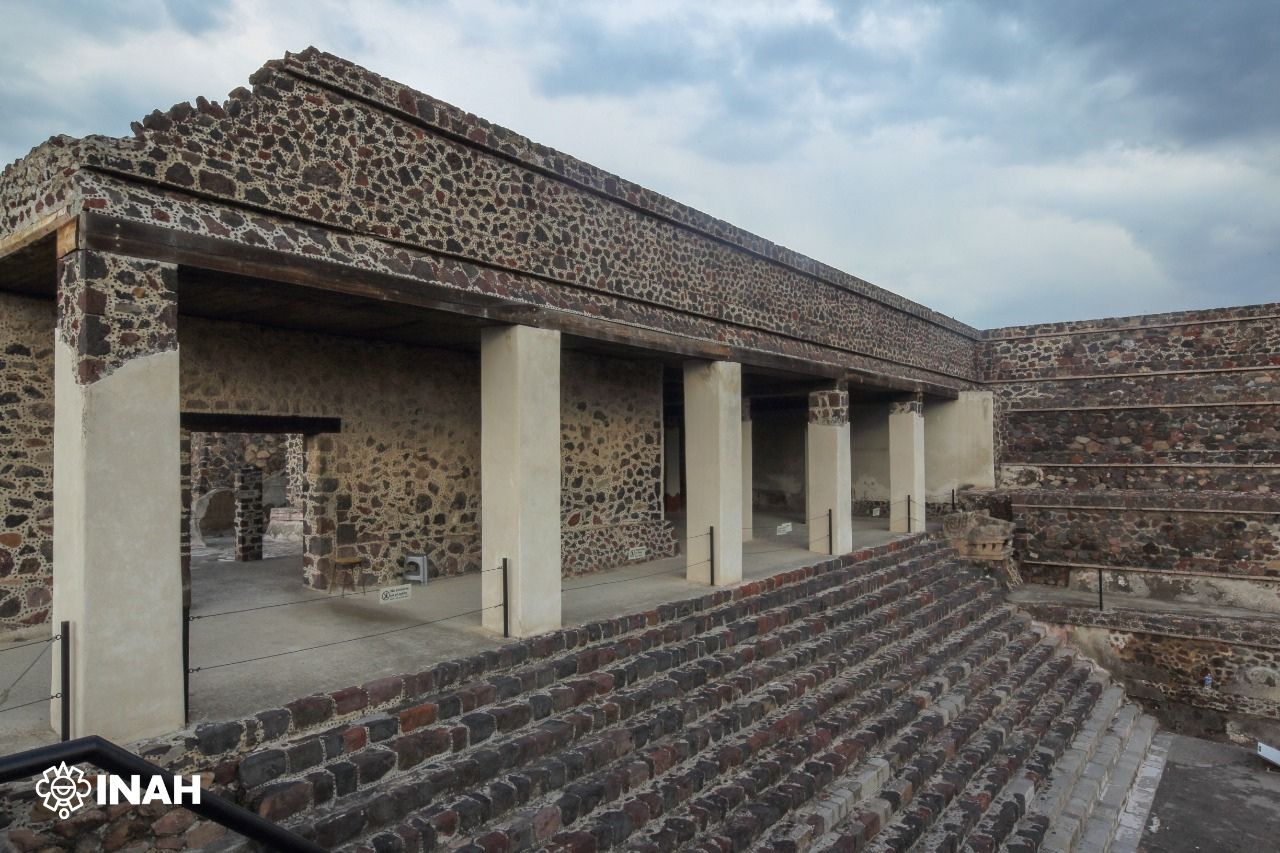
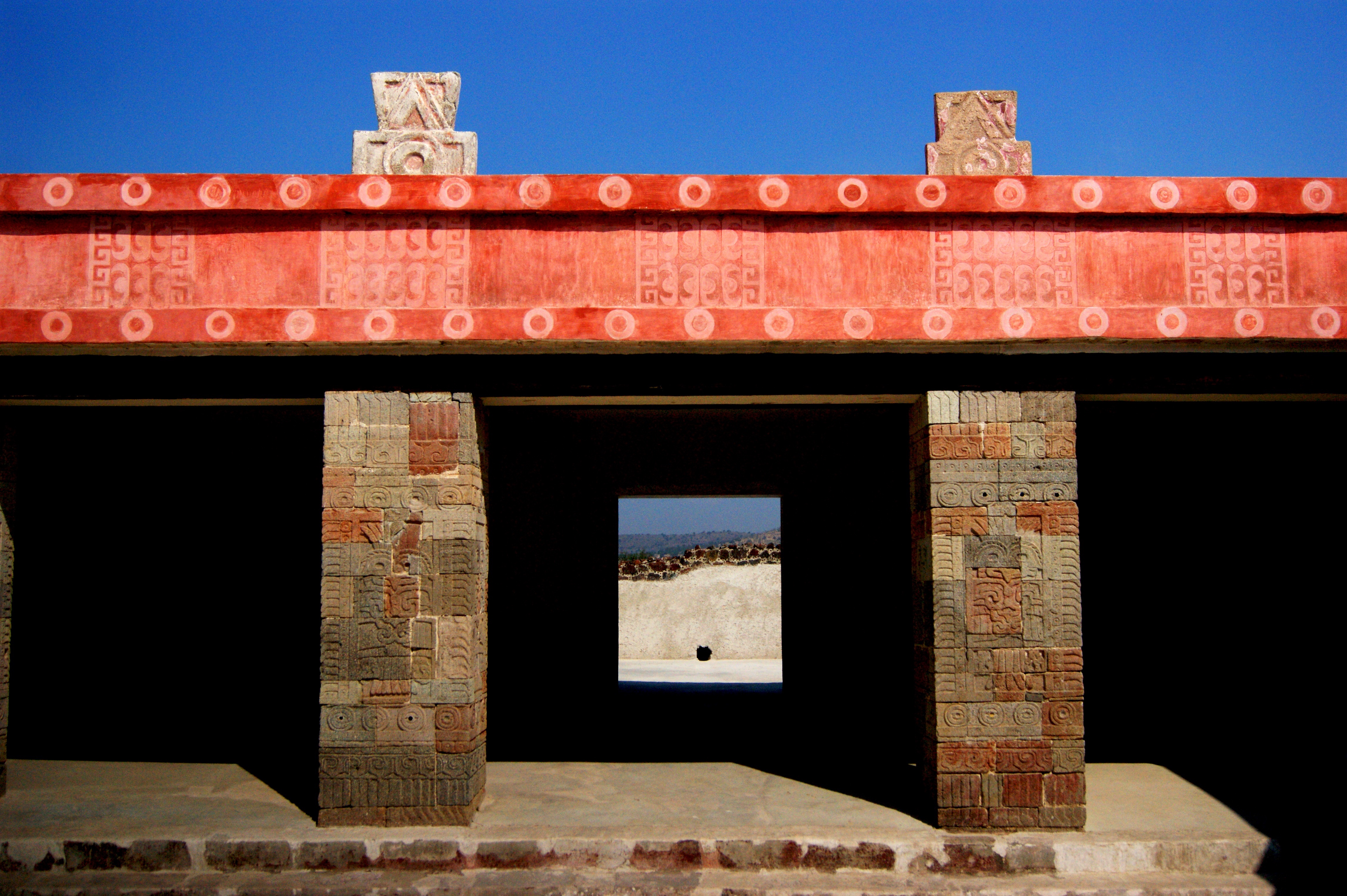
It is located in the southwest corner of the Plaza de la Luna. It emphasizes its interior patio, whose pillars are adorned with bas-reliefs that represent birds of profile and of front with the extended wings.
Palacio del Quetzalpapálotl o de las Mariposas
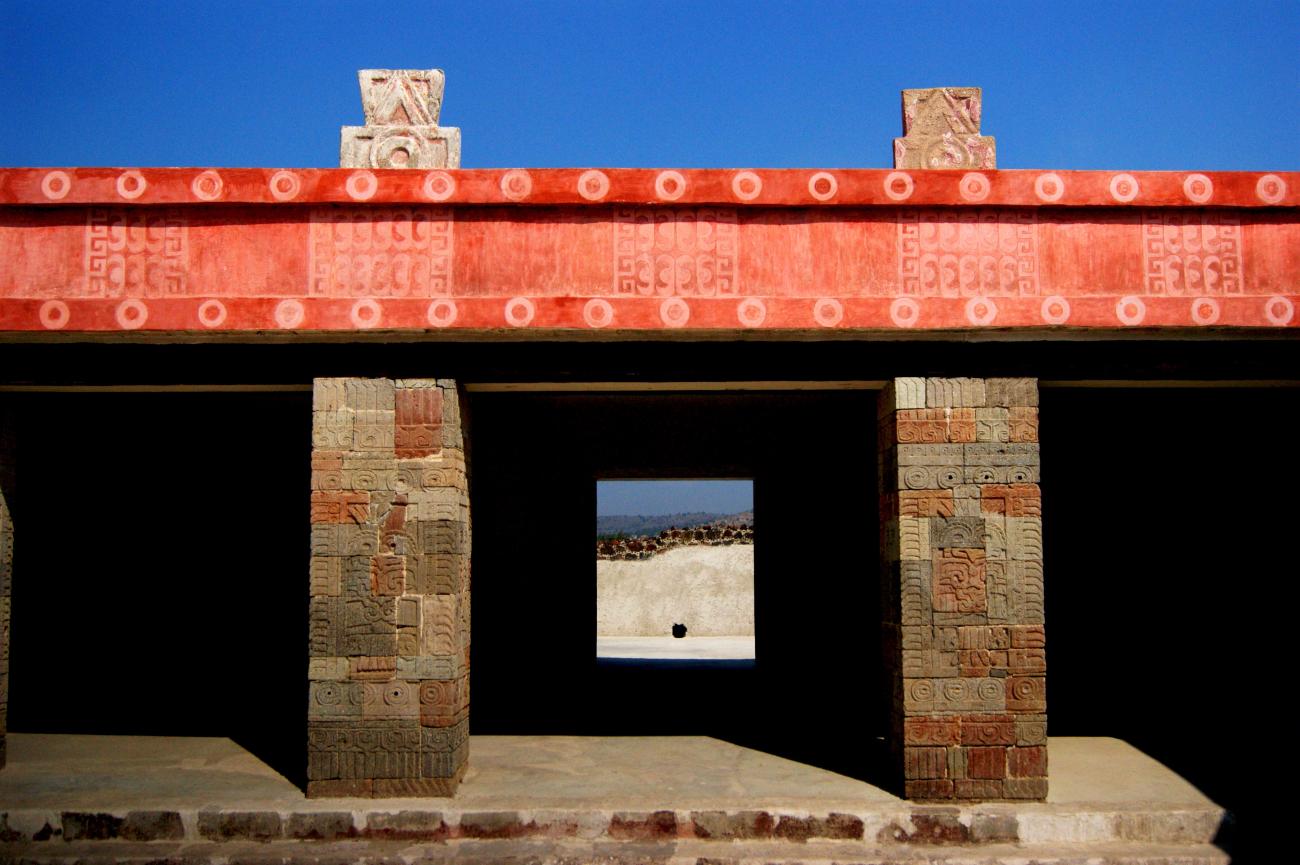
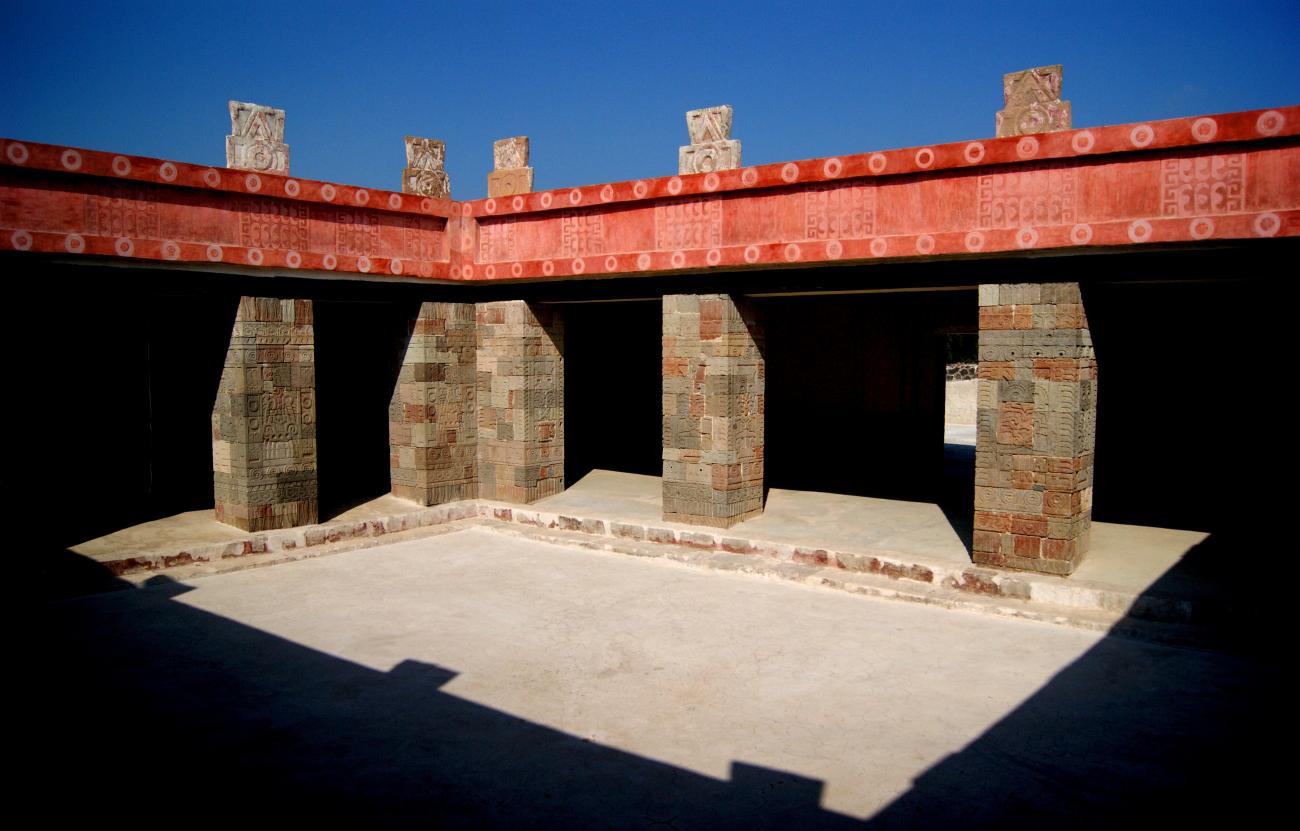
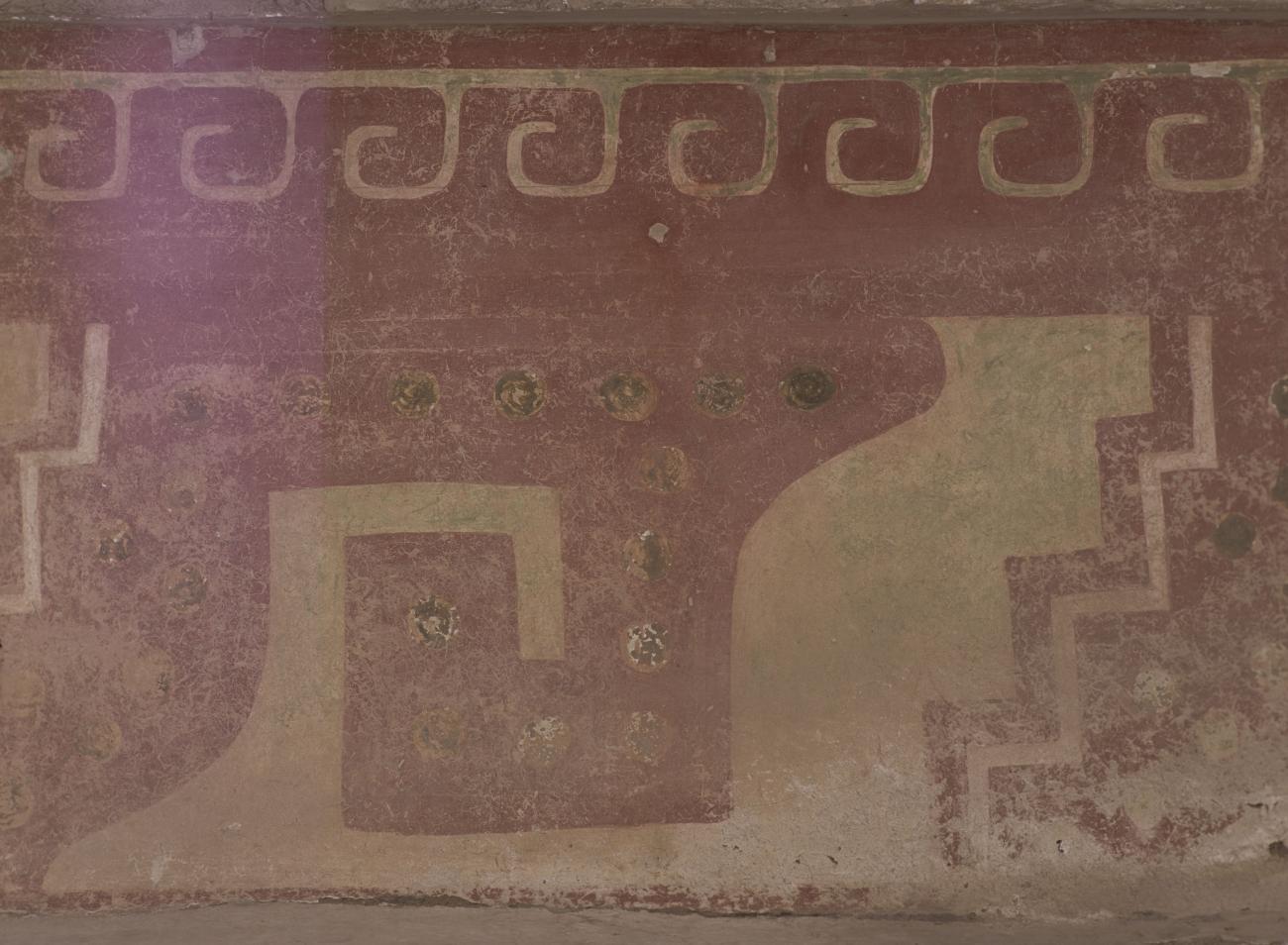
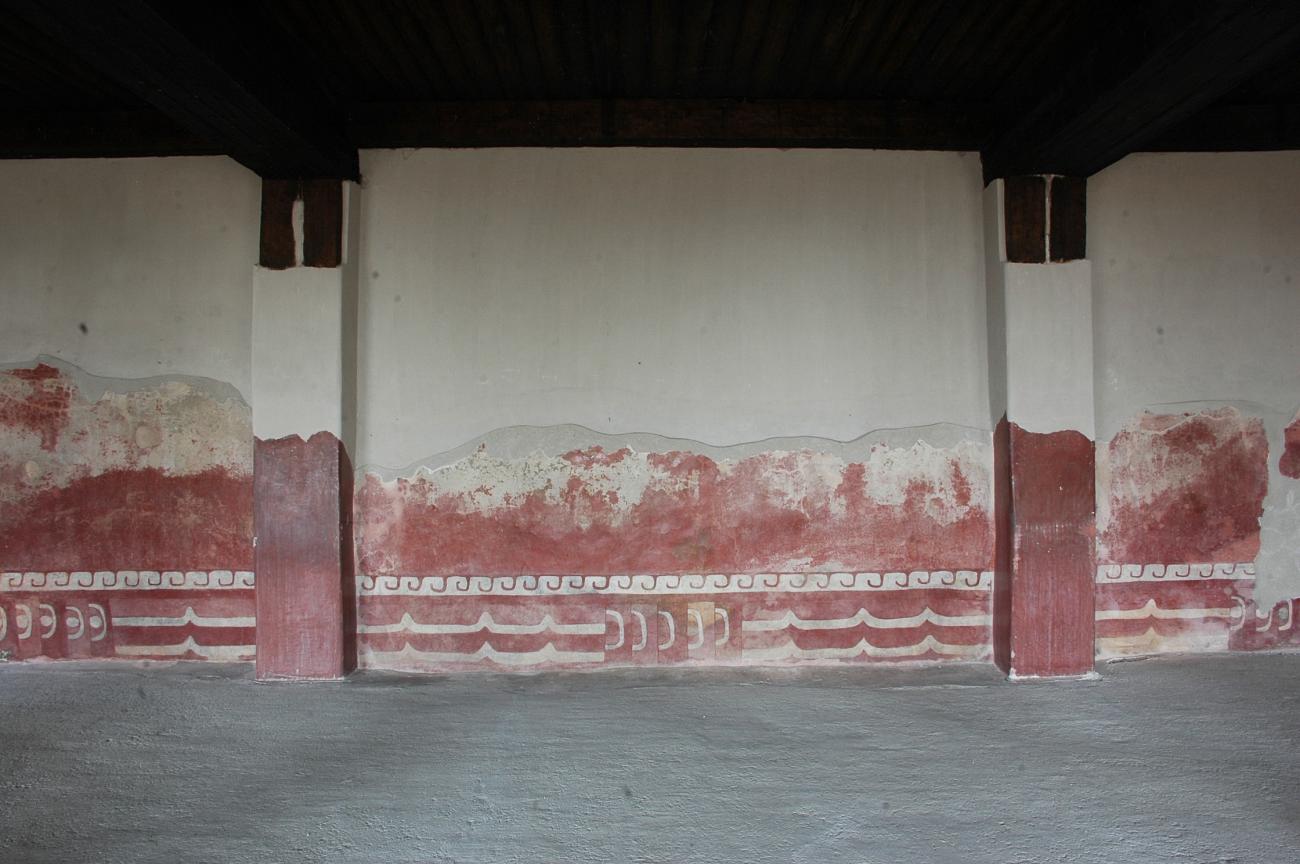
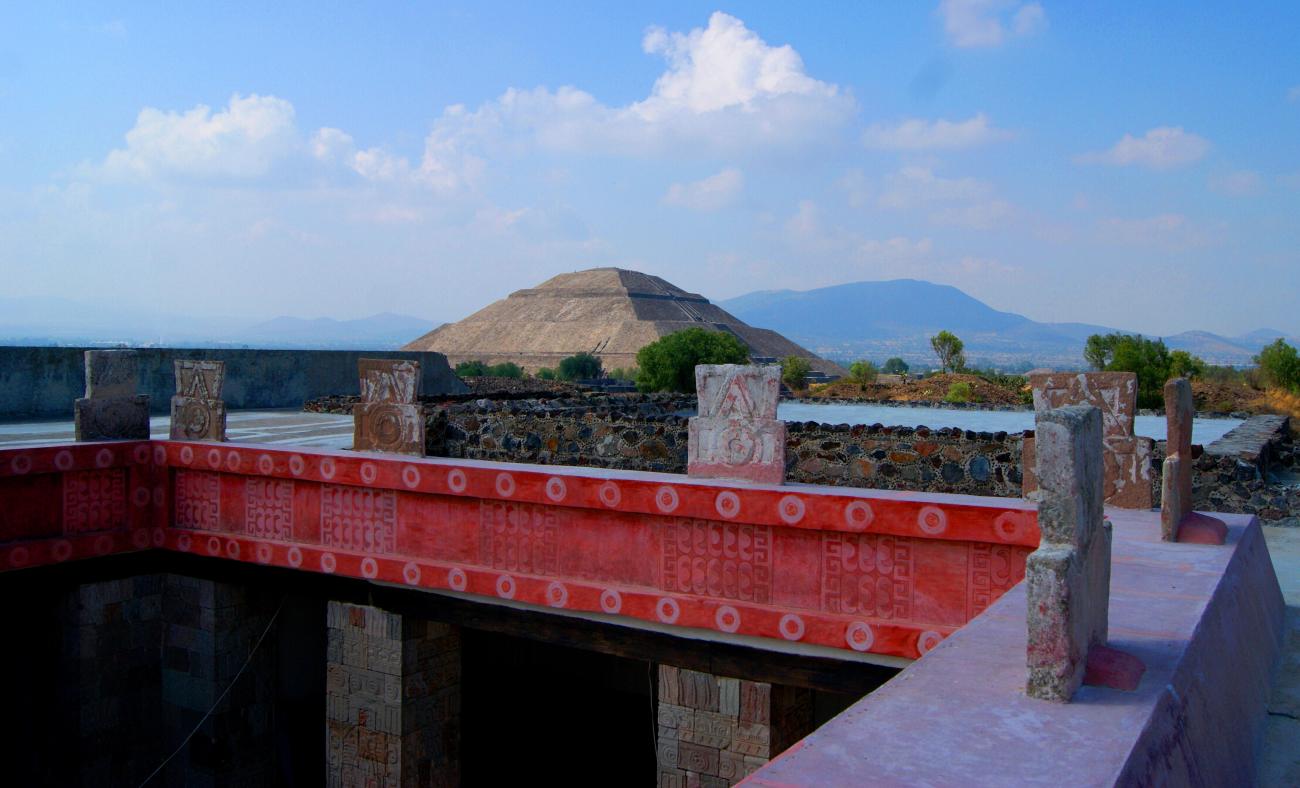
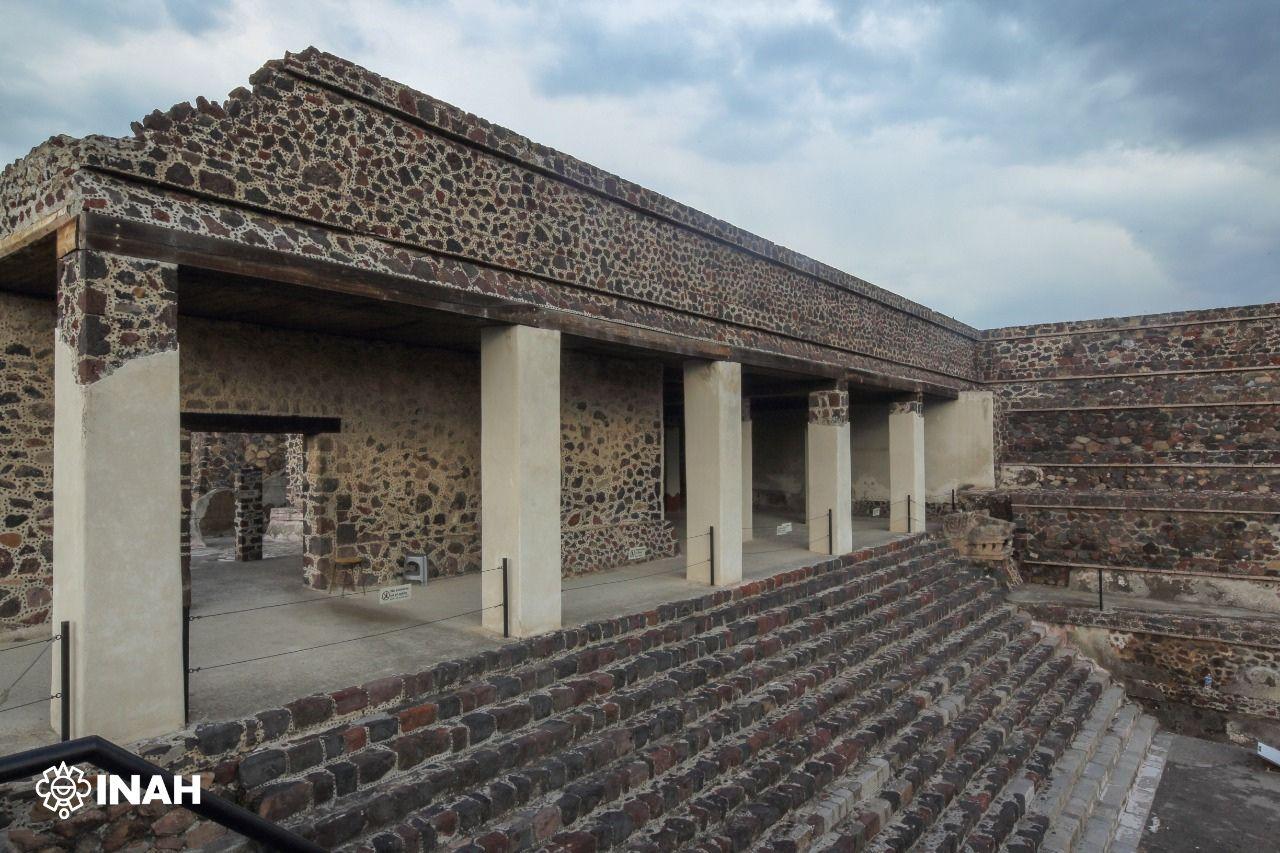
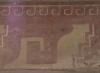
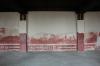
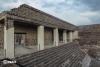
It is located in the southwest corner of the Plaza de la Luna. It emphasizes its interior patio, whose pillars are adorned with bas-reliefs that represent birds of profile and of front with the extended wings. The porticos of its four rooms are decorated with murals such as “Grecas escalonadas y discos de mica”, geometric design that is extended in all the walls of the Porticos 1, 3 and 4. It also stands out “Ondas, ojos y volutas”, which is formed by two bands, one on top of the other, which are curved and point upwards at regular intervals, forming a very open U that seems to simulate water waves.
Stepped fretwork and mica discs: This mural is a geometric design that extends throughout the walls of Porticos 1, 3 and 4 of the Palacio del Quetzalpapallotl. It is framed above and on the sides by a border composed of wide geometric scrolls defined by a narrow perimeter line that describes its contour. The design, formed by a simple fretwork and a stepped motif that was painted green, is repeated at regular intervals.
Fuente, Beatriz de la (coord.), 1995, La pintura mural prehispánica en México Teotihuacán, volume I, Mexico, UNAM/IIE.
Waves, eyes and scrolls: Its design is simple, geometrical and of few colors. It is made up of two bands, one placed above the other, which curve and point upwards at regular intervals, describing a very open U; they seem to simulate water waves. In sections, also regular and interrupting the path of the bands, there are five semicircular shapes, with a disk in the center and placed vertically. A border composed of white scrolls outlined in dark red frames the design of waves and semicircular forms above and below; the upper part of the wall is flat, in dark red and without design.
Fuente, Beatriz de la (coord.), 1995, La pintura mural prehispánica en México Teotihuacán, volume I, Mexico, UNAM/IIE.
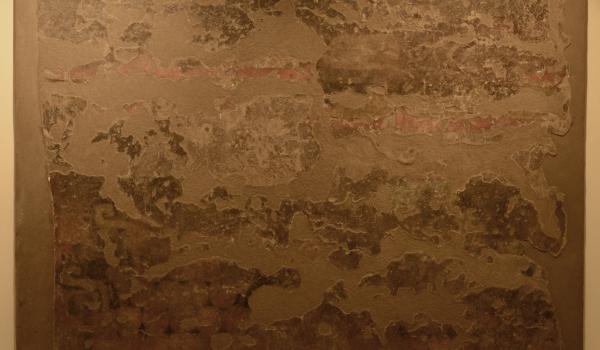
Templo de la Agricultura
It is a superposition of four constructive structures. In the second of them, three large murals were painted, which show two successive pictorial times; their general composition is similar: superimposed horizontal bands, separated by other narrower bands of red-orange color.
Templo de la Agricultura
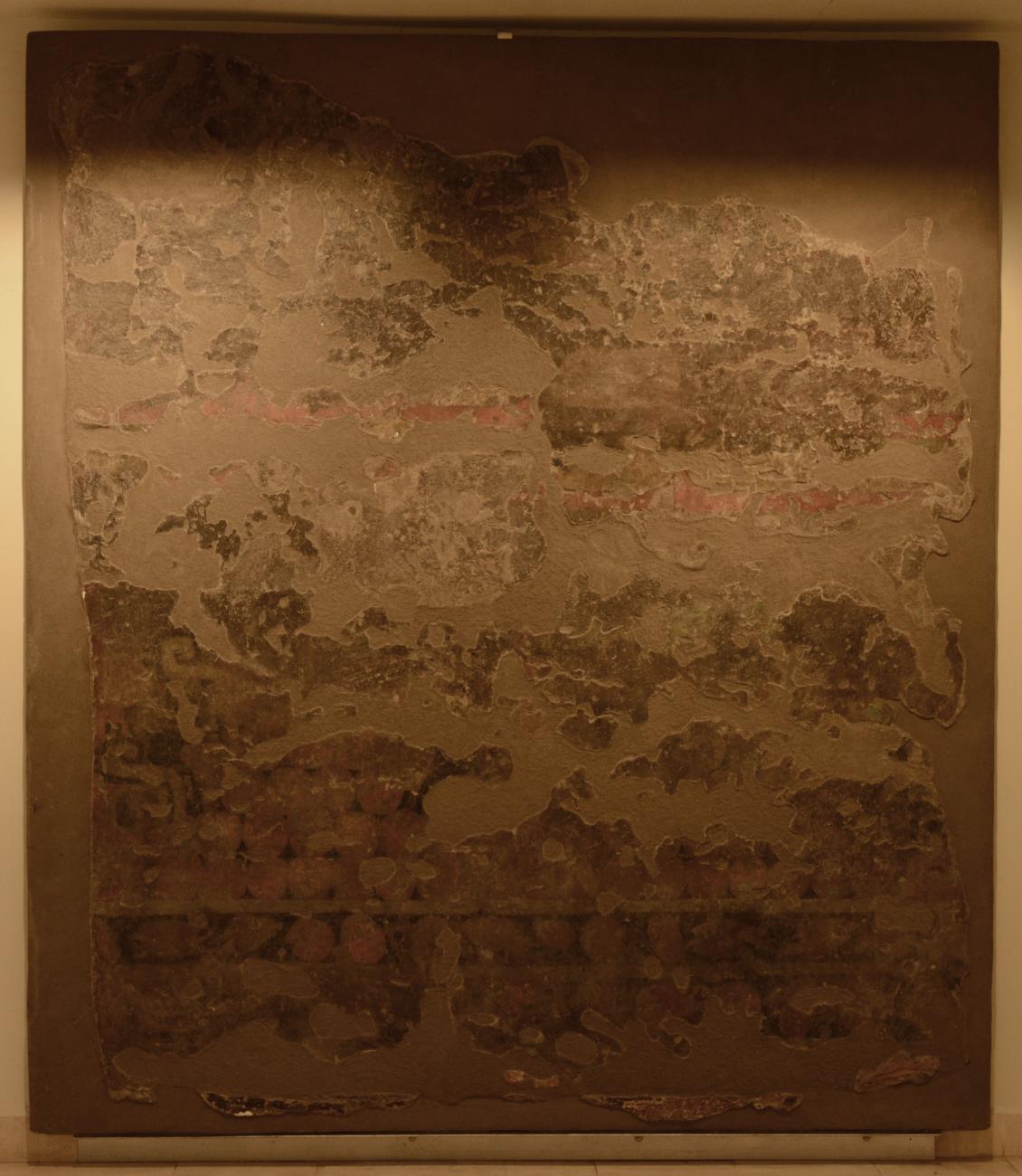
It is a superposition of four constructive structures. In the second of them, three large murals were painted, which show two successive pictorial times; their general composition is similar: superimposed horizontal bands, separated by other narrower bands of red-orange color. This mural can currently be seen in the Museum of Teotihuacan Murals.
Fuente, Beatriz de la (coord.), 1995, La pintura mural prehispánica en México Teotihuacán, volume I, Mexico, UNAM/IIE.
La Ciudadela
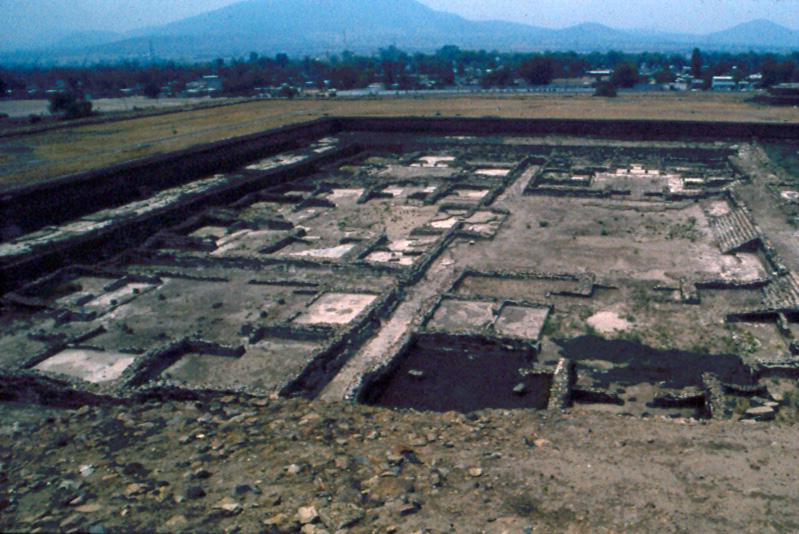
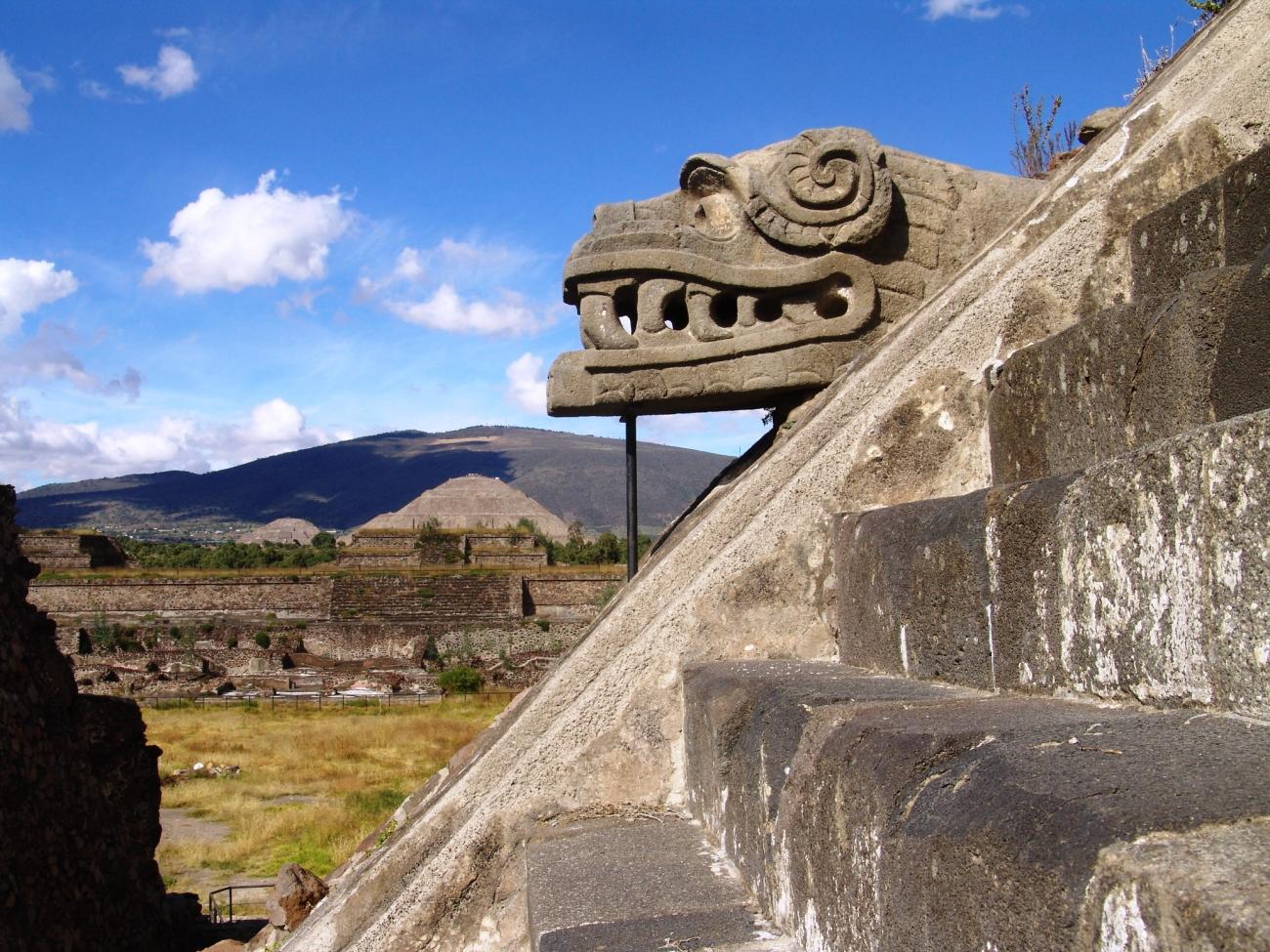
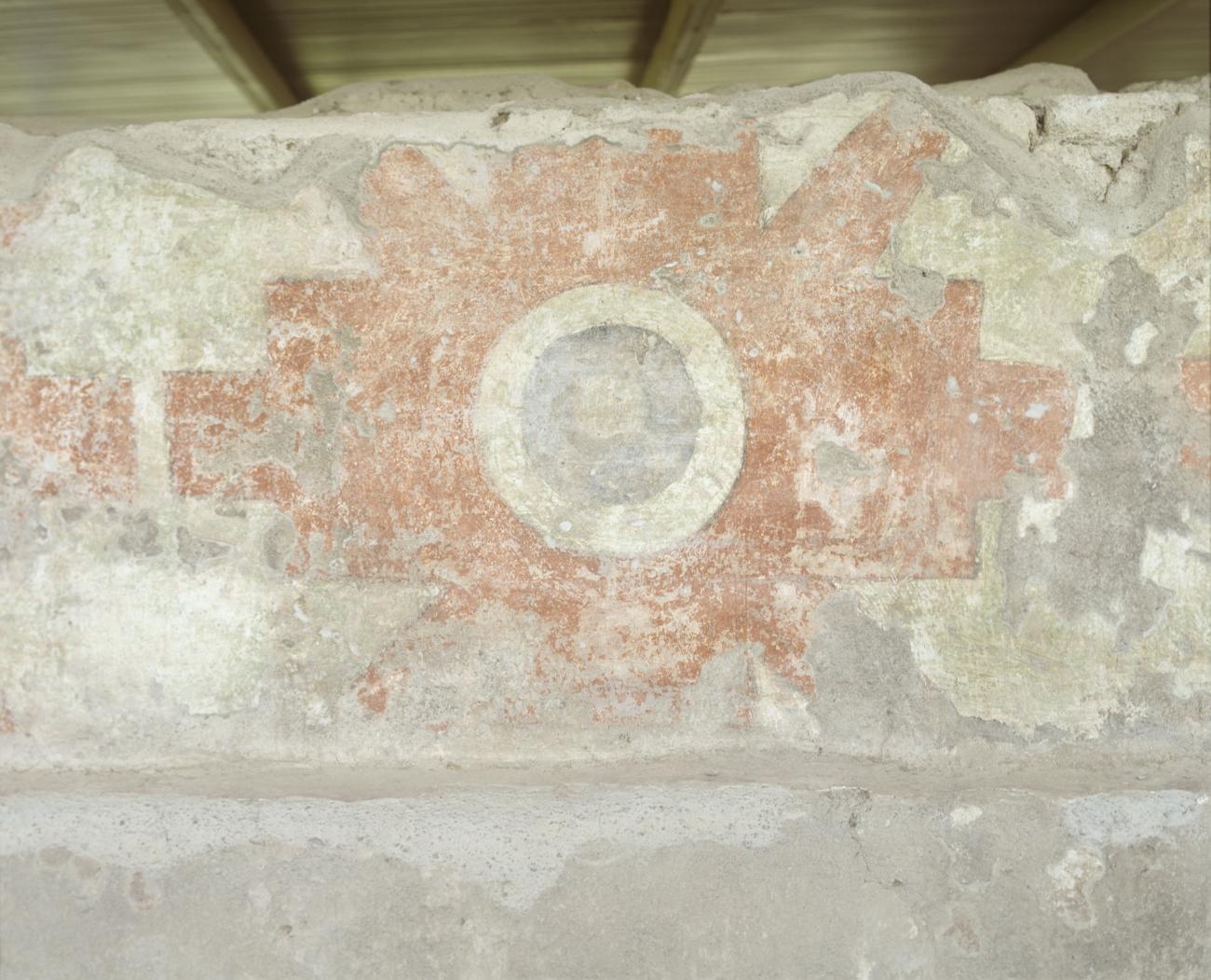
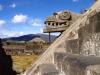
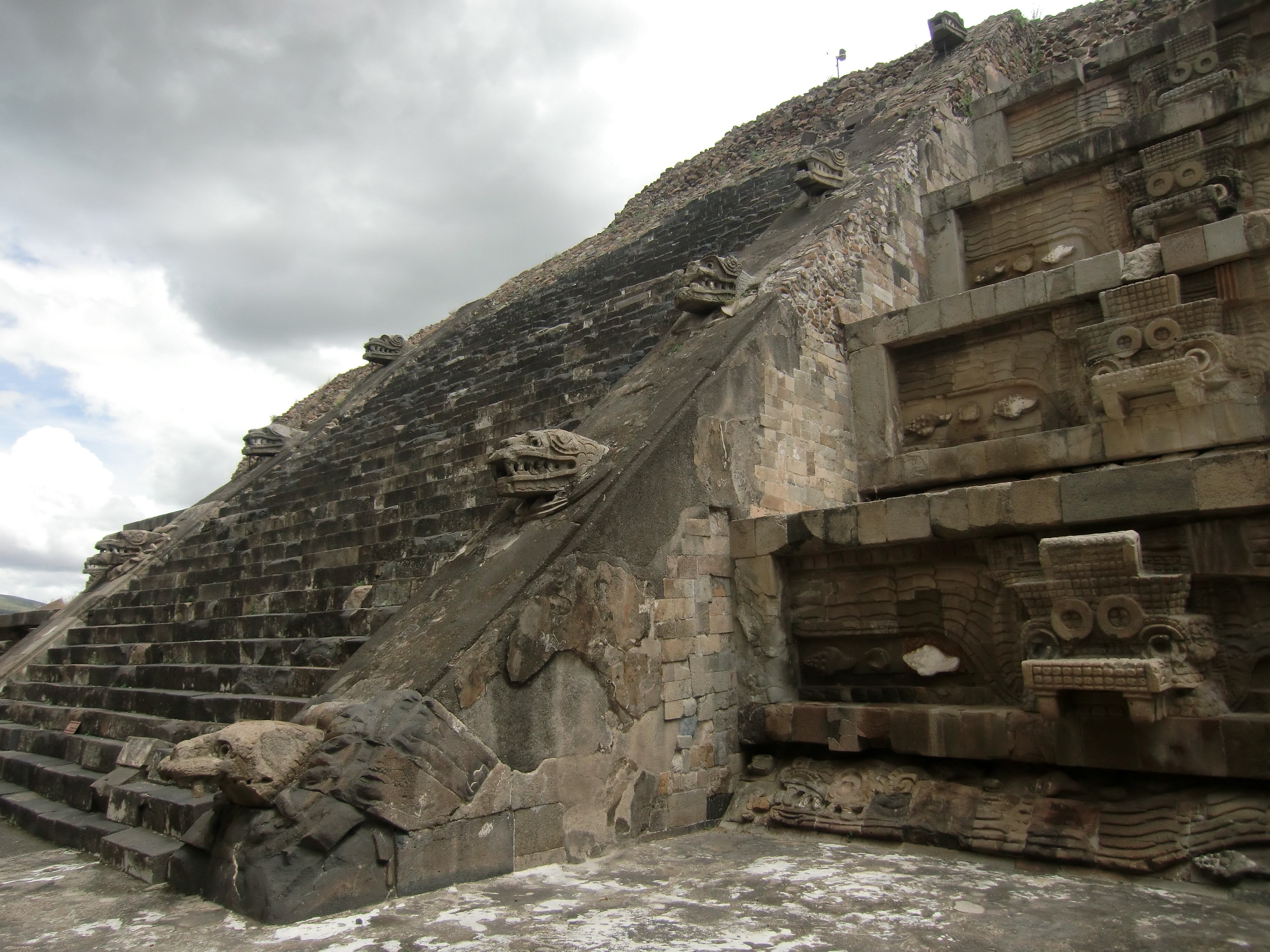
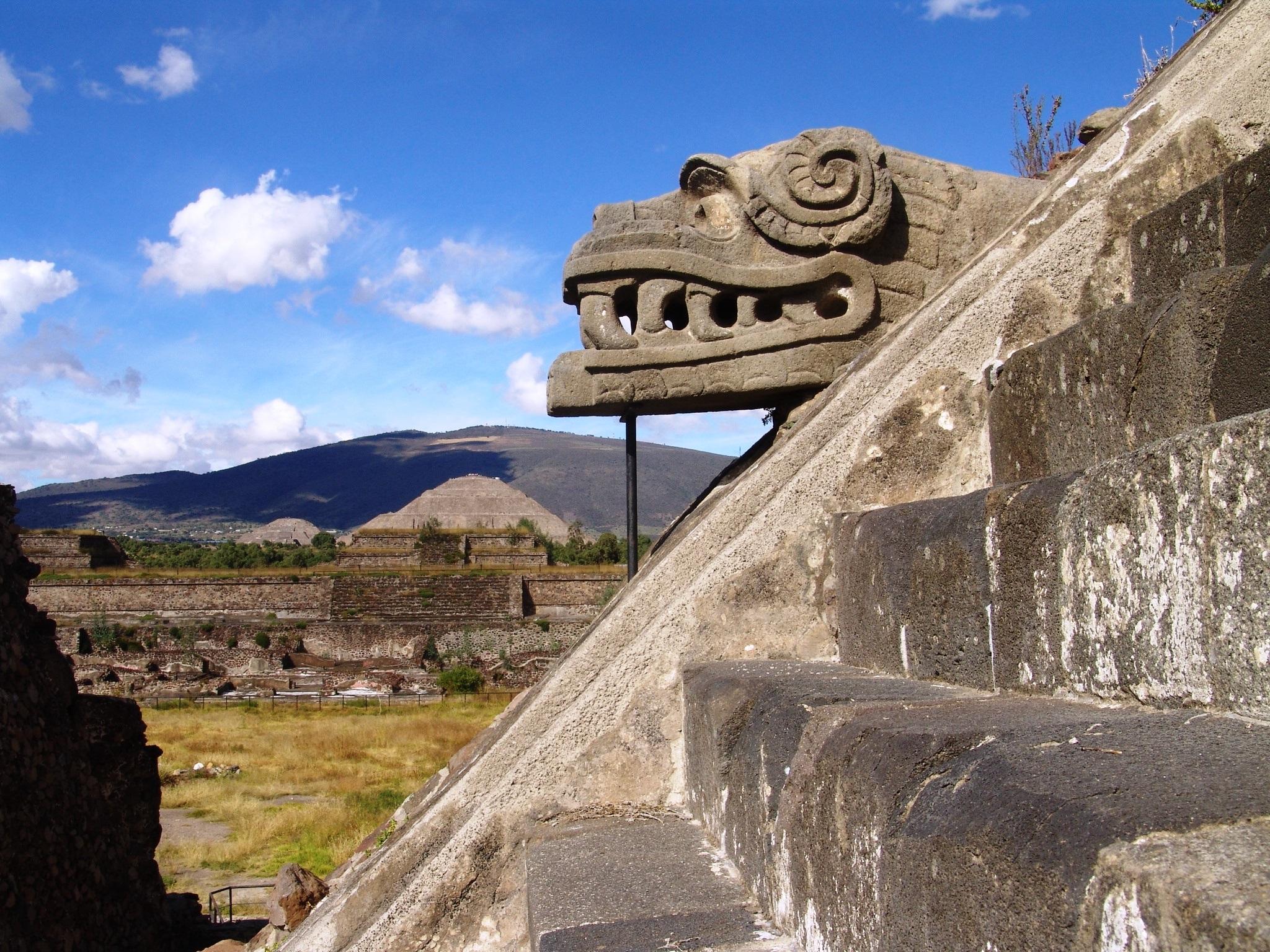
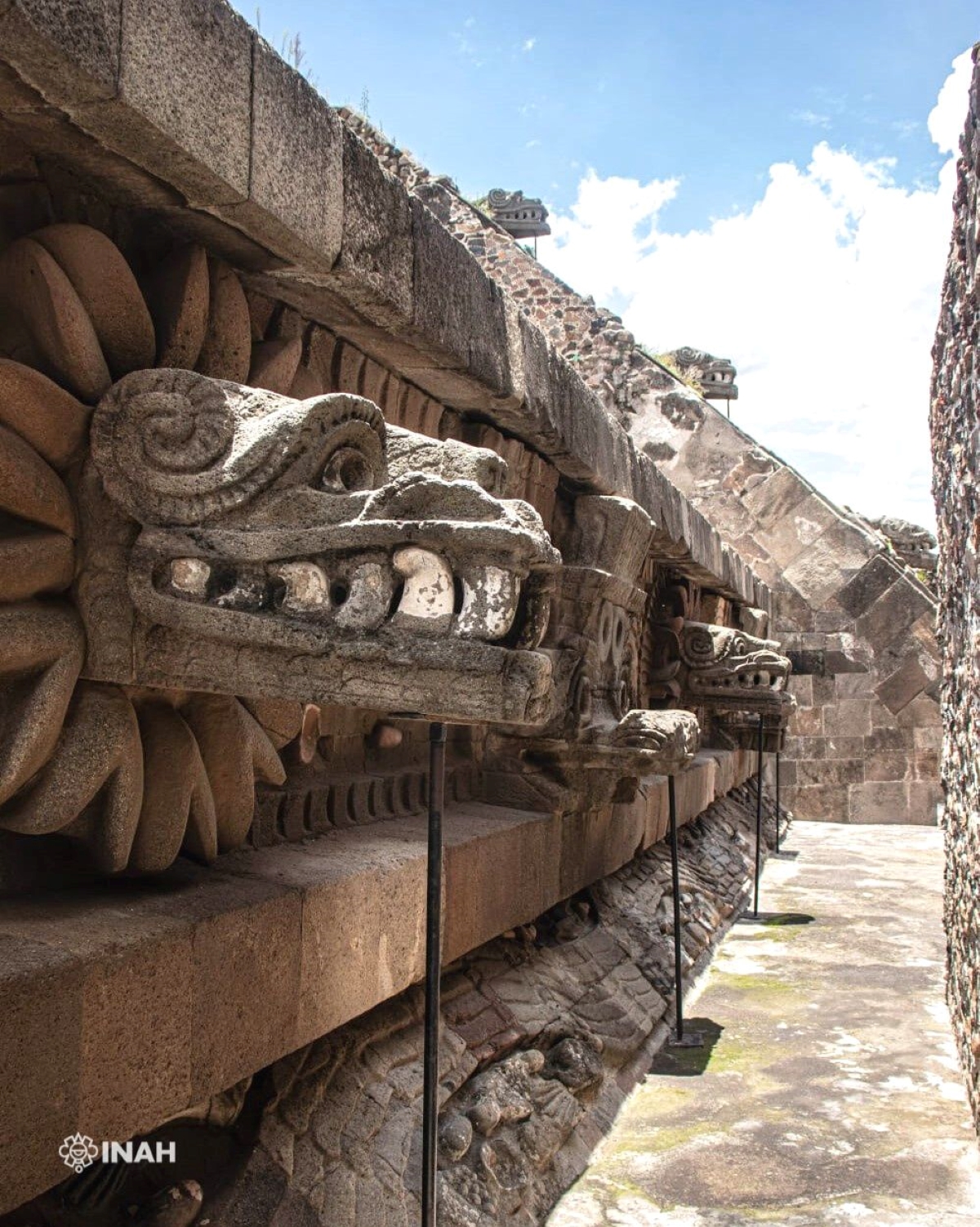
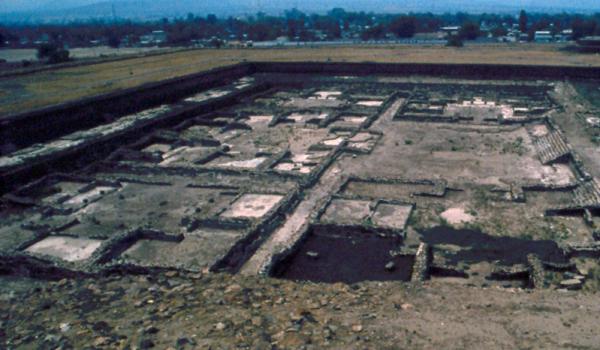
It is one of the most grandiose architectural complexes of the city. It is formed by a great platform in the form of a wall, whose dimensions are 400 m per side, which perfectly delimits a wide rectangular space that houses the Temple of the Feathered Serpent, also known as the Temple of Quetzalcoatl. A large plaza, a shrine in the center of the plaza and two residential units complete the complex of La Ciudadela. The polychrome remains of painting that are preserved both in the reliefs of the facades of the temple, as in the walls of the constructive levels of greater antiquity of the residential groups stand out.
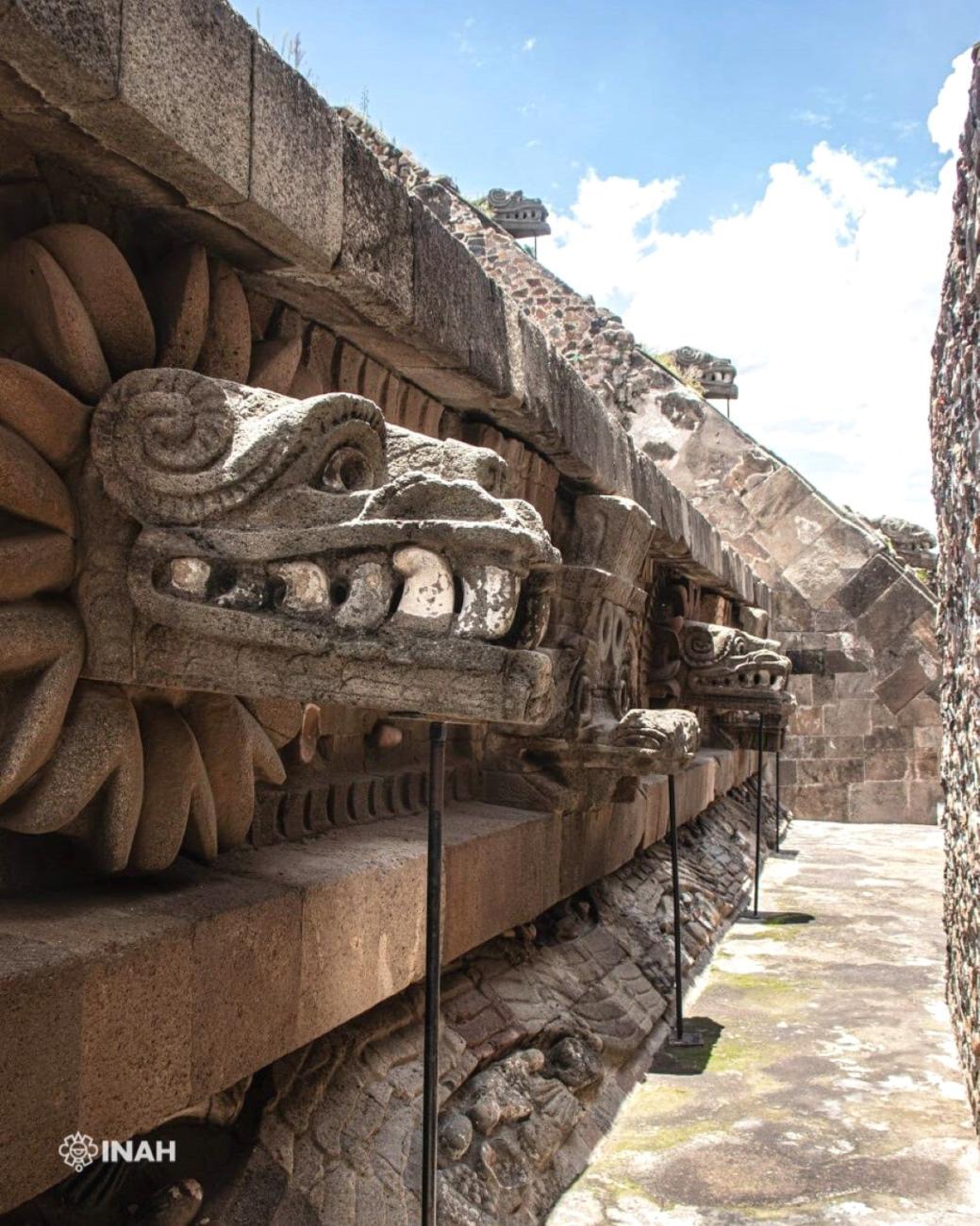
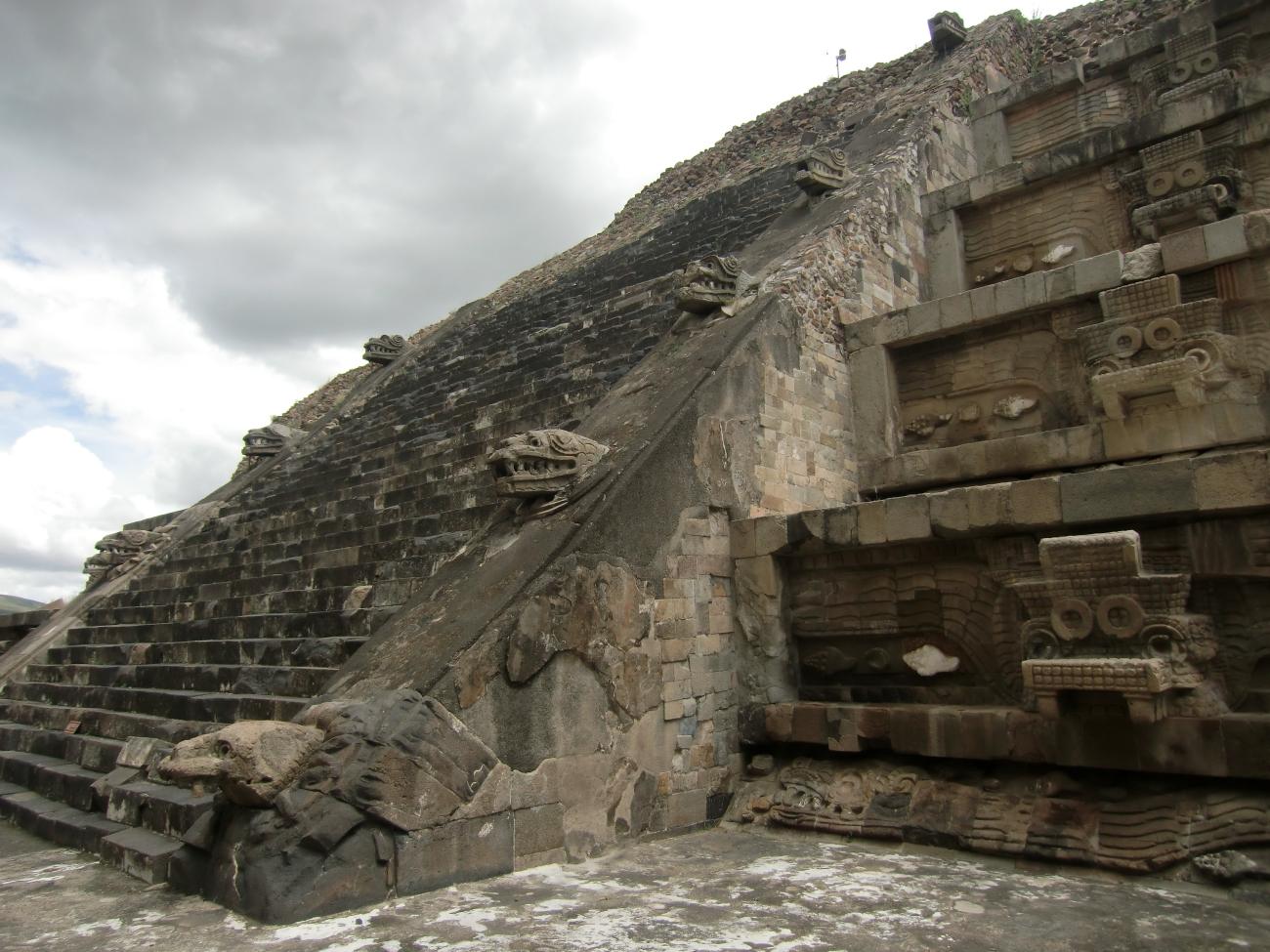
Temple of the Feathered Serpent: The Temple of the Feathered Serpent is one of the oldest in the city and undoubtedly one of the most beautiful, originally built on seven architectural levels with the talud-tablero design typical of this city. This design presents a singular decoration composed by a series of sculptures of two divine monsters alternating in the board, while in the slopes of each body, carved in low relief, there is a feathered serpent in profile; in both cases they present a background with a representation of marine elements, and apparently the four facades had the same decoration. The building is of solid construction, of stones with mud, and in the foundations of the temple a series of offerings were registered that contained mainly human remains; these offerings are dedicated to the construction of the building or to the deity. In the Museum of Teotihuacan Culture there are two reproductions of these offerings, which represent a clear sample of the human sacrifice practiced in Teotihuacan for religious purposes.
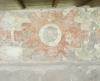
Cosmogonic-calendrical signs: The panels of this building were decorated with circular designs framed by crisscrossed bands, which have been interpreted as signs of the four directions or the quincunx.
Gran Conjunto
Located next to the Calzada de los Muertos, the Great Complex could have been the mercantile and bureaucratic center of Teotihuacan. In its interior murals from different construction stages were found.
Gran Conjunto
Located next to the Calzada de los Muertos, the Great Complex could have been the mercantile and bureaucratic center of Teotihuacan. In its interior murals from different construction stages were found.
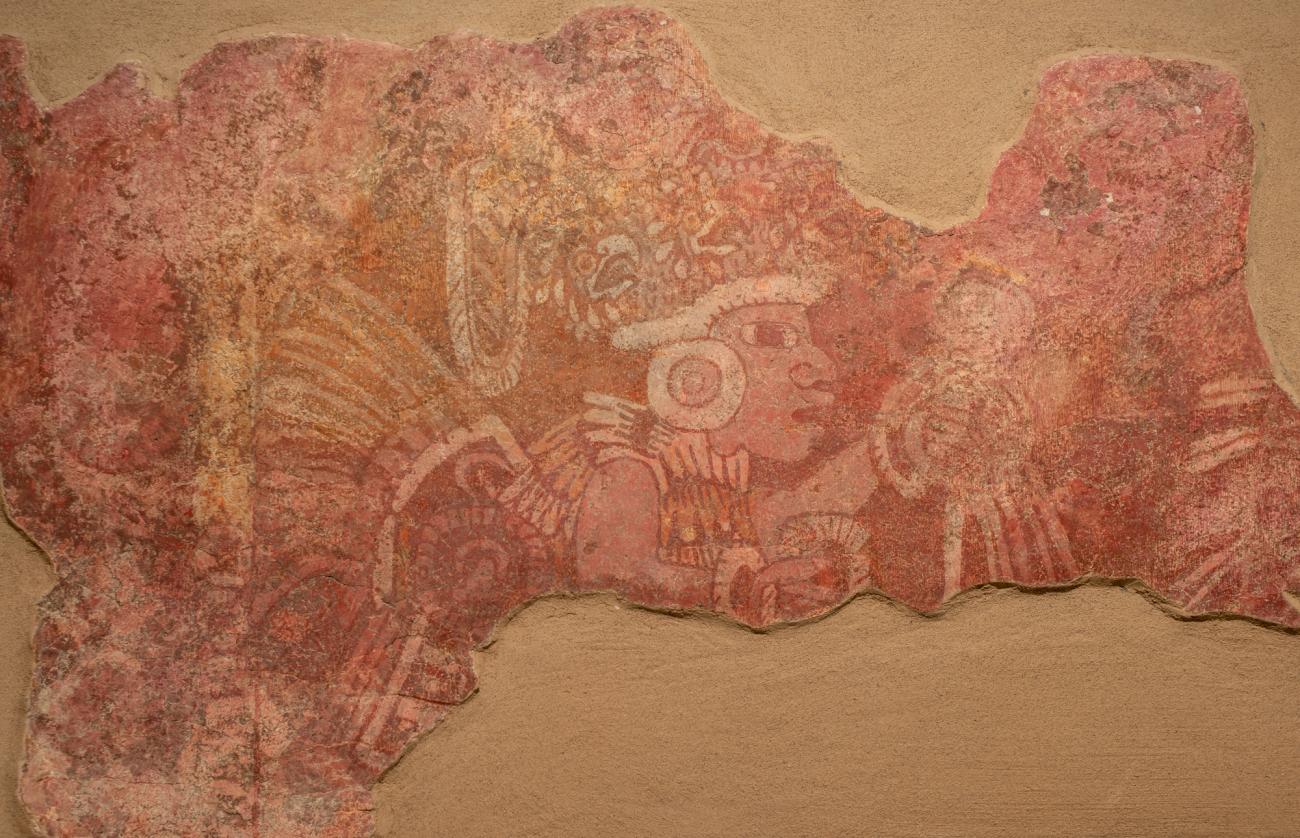
Priest framed with four-petal flowers: In this mural fragment, found in one of the rooms of the Great Complex, a human figure is represented in profile. He carries in his right hand a ritual pouch finished off in its lower part with a serpent's rattlesnake, in the other hand he carries a staff of command with a circular element composed of feathers, bangs and a coiled figure in the upper part.
She wears large circular earmuffs and on her shoulders she wears a kind of cape or canvas with feathers, at the back at waist level, she wears a large adornment in the shape of a rooster tail with ribbons and ribbons fastened with a large brooch. It wears an elaborate headdress adorned with several superimposed bands of bangs, symbolic ornaments, several bird heads with open beaks and ends with long feathers that fall in the back, in front of which is a mat or element formed by intertwined bands; framed by a border of four-petal flower stripes.
Fuente, Beatriz de la (coord.), 1995, La pintura mural prehispánica en México Teotihuacán, volume I, Mexico, UNAM/IIE.
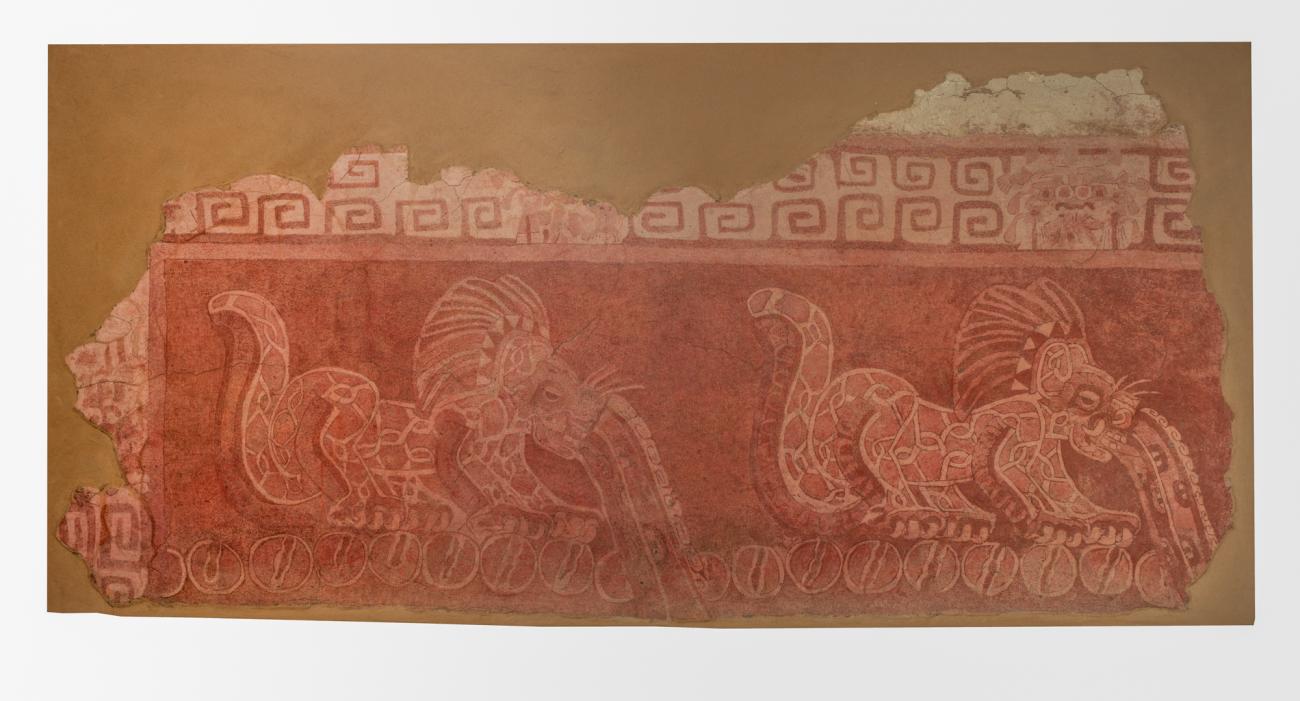
Reticulated felines on sectioned circles: This mural of the Great Set portrays a procession of felines that go from the portico to the central part of the wall at the back of the room. Each feline is in profile and has as base a horizontal line of semicircles, they are profusely adorned with triangular bangs and feathers, decorative elements that appear in the paws, in the tail and in its exuberant headdress, the feathers of this last one are sustained in an arched fringe of triangles, finishing off backwards with a great fan.
They have an open muzzle, from the corners of which comes a fang curved backwards; from the jaws emerge two bands that turn forward, adorned with a kind of eyes with celestial symbols. The murals or panels are framed by a wide band formed by three bands, on which is represented a stylized figure of the head of Tlaloc seen from the front.
Fuente, Beatriz de la (coord.), 1995, La pintura mural prehispánica en México Teotihuacán, volume I, Mexico, UNAM/IIE.

Conjunto de los Edificios Superpuestos
After crossing the Street of the Dead, and crossing the bridge of the San Juan River, the so-called Set of Superimposed Buildings is located, in whose buildings there are remains of murals with the representation of geometric figures that allude to the relationship that Teotihuacan had with other
Conjunto de los Edificios Superpuestos
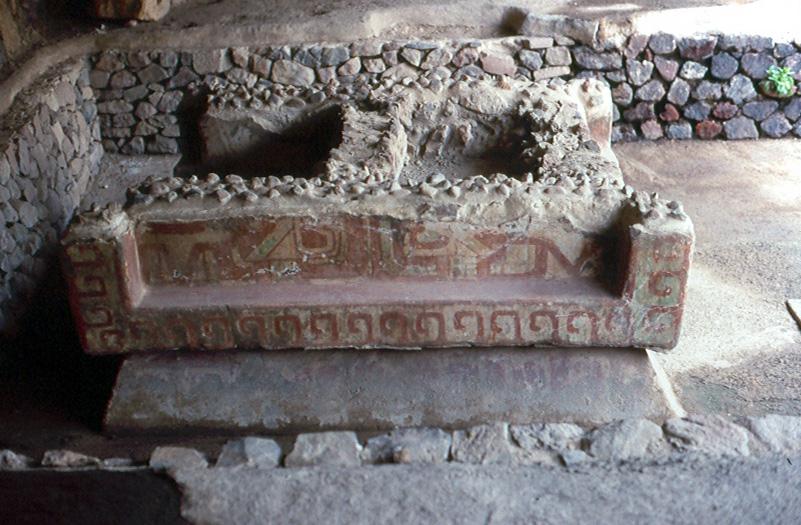
After crossing the Street of the Dead, and crossing the bridge of the San Juan River, the so-called Set of Superimposed Buildings is located, in whose buildings there are remains of murals with the representation of geometric figures that allude to the relationship that Teotihuacan had with other cultures of the Gulf of Mexico.
Such is the case of the Plaza de los Altares Superpuestos, where the four sides of its adoratory are decorated, including the slopes and the boards with their moldings. The designs are geometric: on the boards based on scrolls and interlaces, where the drawings, represented in an abstract composition, are distributed symmetrically to the sides of an imaginary vertical axis.
Conjunto Plaza Oeste
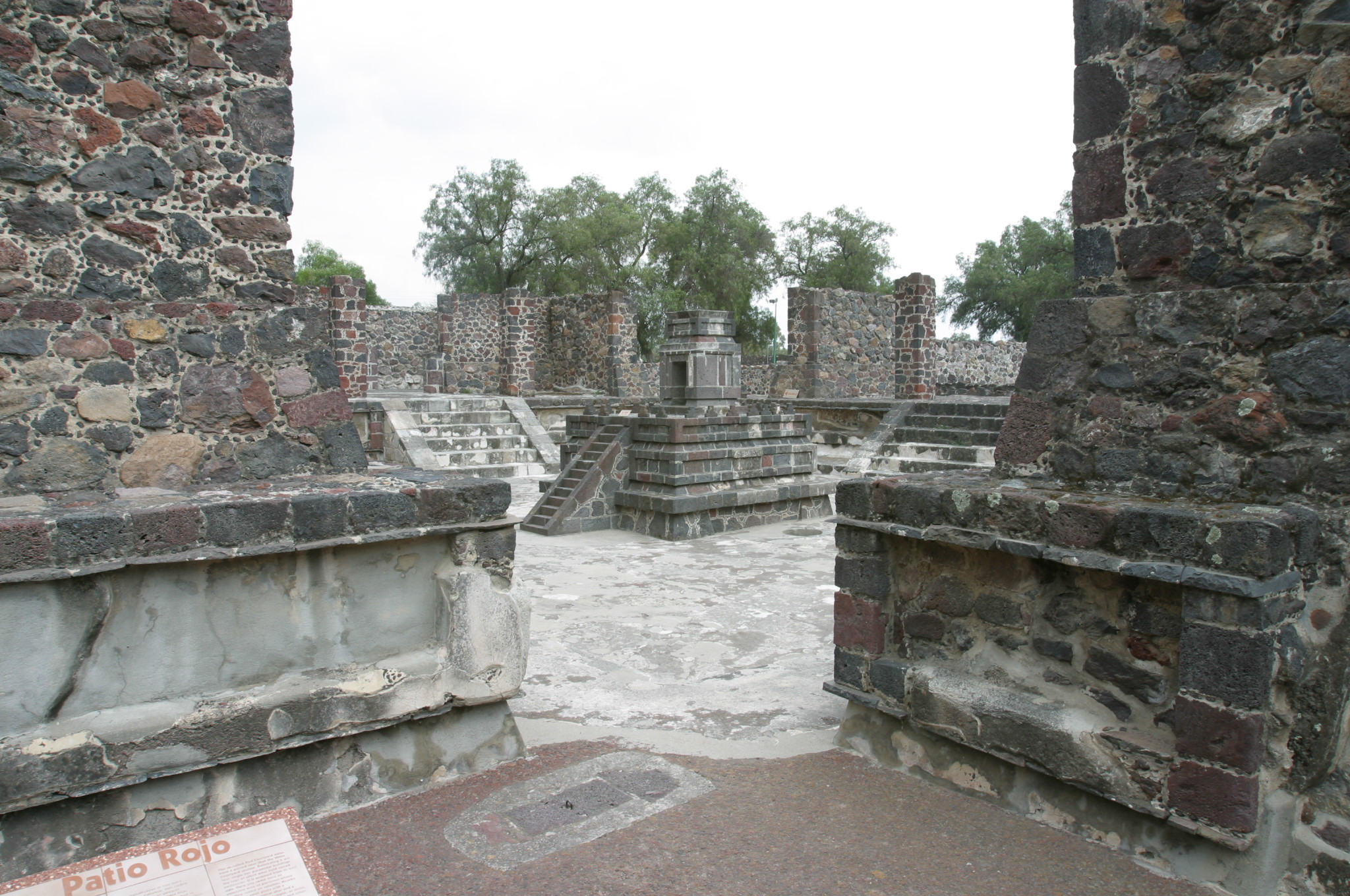
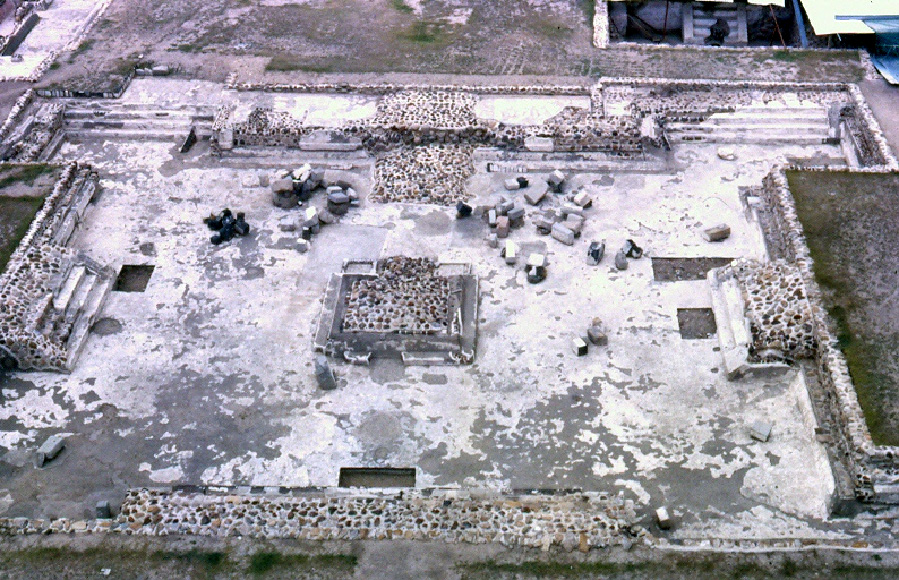
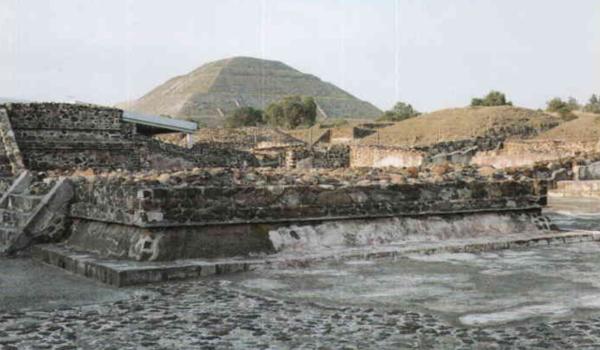
Located to the west of the Calzada de los Muertos and to the north of the superimposed buildings, it consists of a large courtyard with an altar bounded by three temples around which rooms and patios are arranged.
Conjunto Plaza Oeste
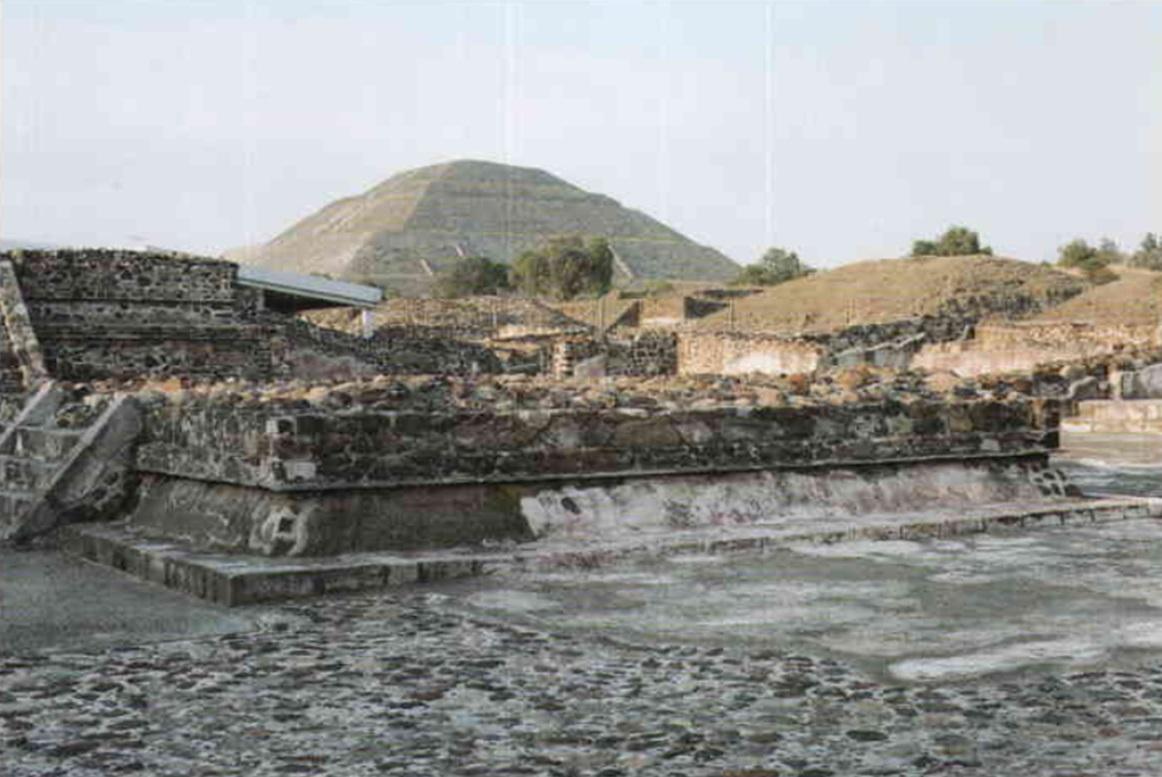
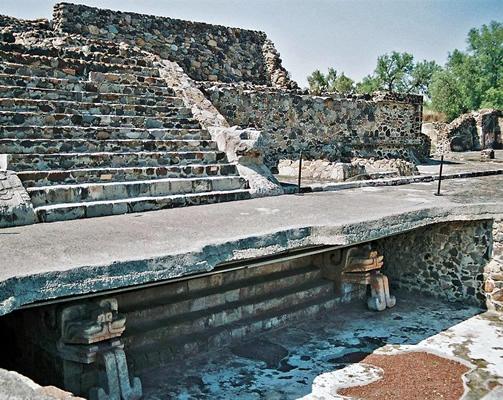
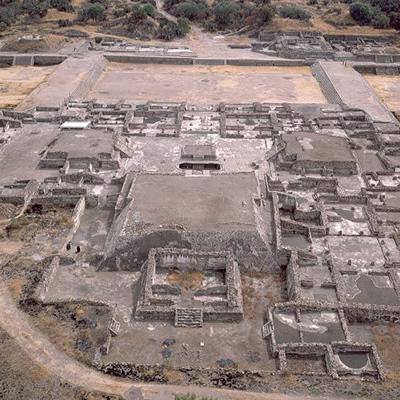
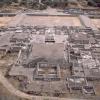
Located to the west of the Calzada de los Muertos and to the north of the superimposed buildings, it consists of a large courtyard with an altar bounded by three temples around which rooms and patios are arranged. In some of them numerous grinding stones were found, as well as sculptures, battlements and domestic ceramics. Recent works exposed two of its constructive stages: one of its temples shows large snake heads and below another decorated with snake heads with forked tongues.

Conjunto Plaza Este
It is located east of the Calzada de los Muertos. Among its structures are the Substructure of Group 17, also known as Temple of Tlaloc, and Structure 1G, on whose façade mural painting has been found.
Conjunto Plaza Este
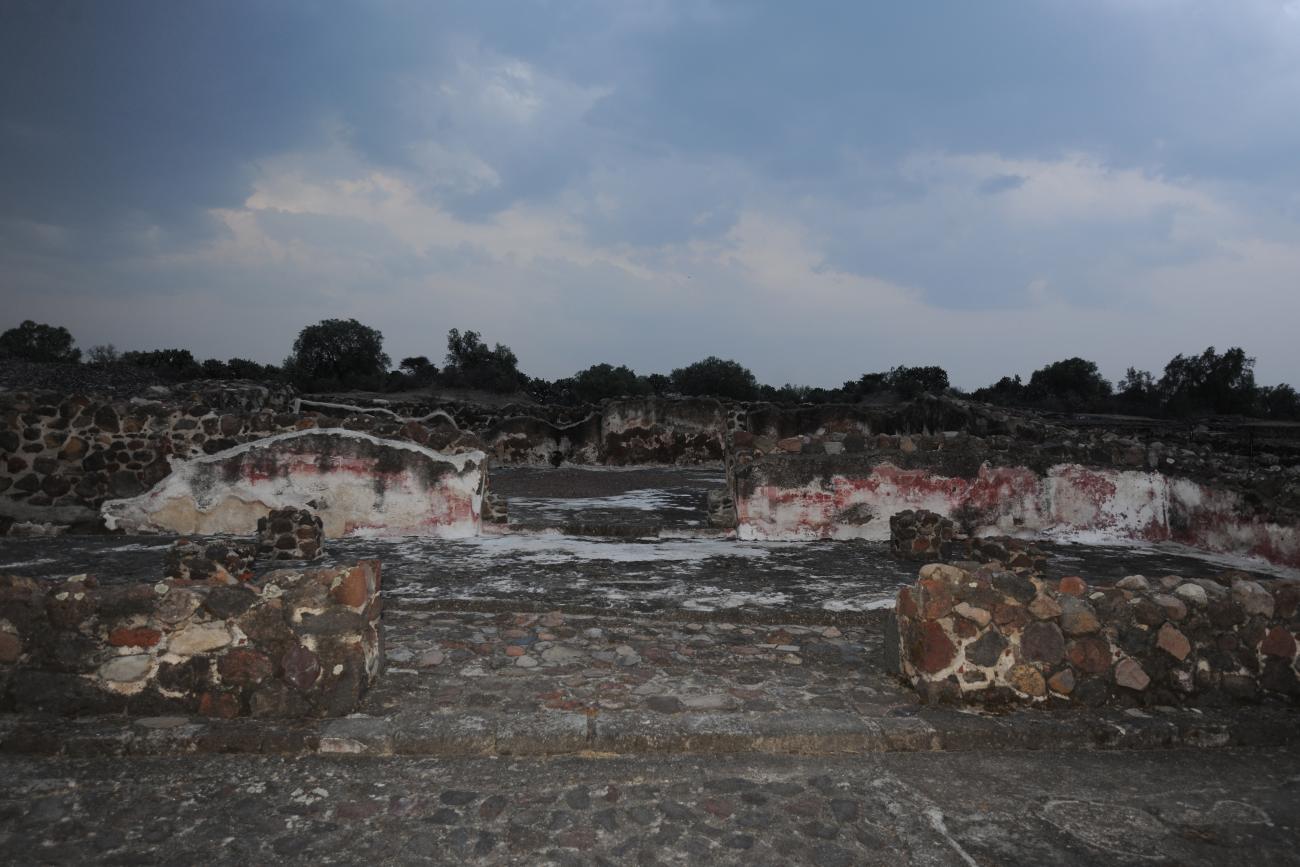
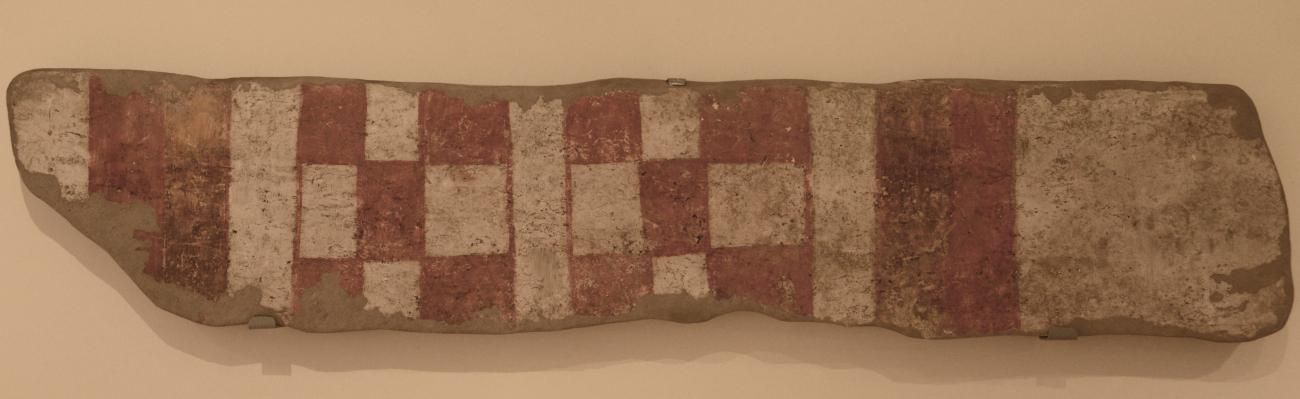
It is located east of the Calzada de los Muertos. Among its structures are the Substructure of Group 17, also known as Temple of Tlaloc, and Structure 1G, on whose façade mural painting has been found.
Geometric figures in the shape of a chessboard: The mural consists of small red squares placed in the shape of an X on a white background, forming two crosses, one in front of the other in a horizontal strip. These motifs are delimited by three vertical stripes in green, yellow and red, a design that is repeated at regular intervals along the lower molding of the architectural board.
Fuente, Beatriz de la (coord.), 1995, La pintura mural prehispánica en México Teotihuacán, volume I, Mexico, UNAM/IIE.
Conjunto del Sol
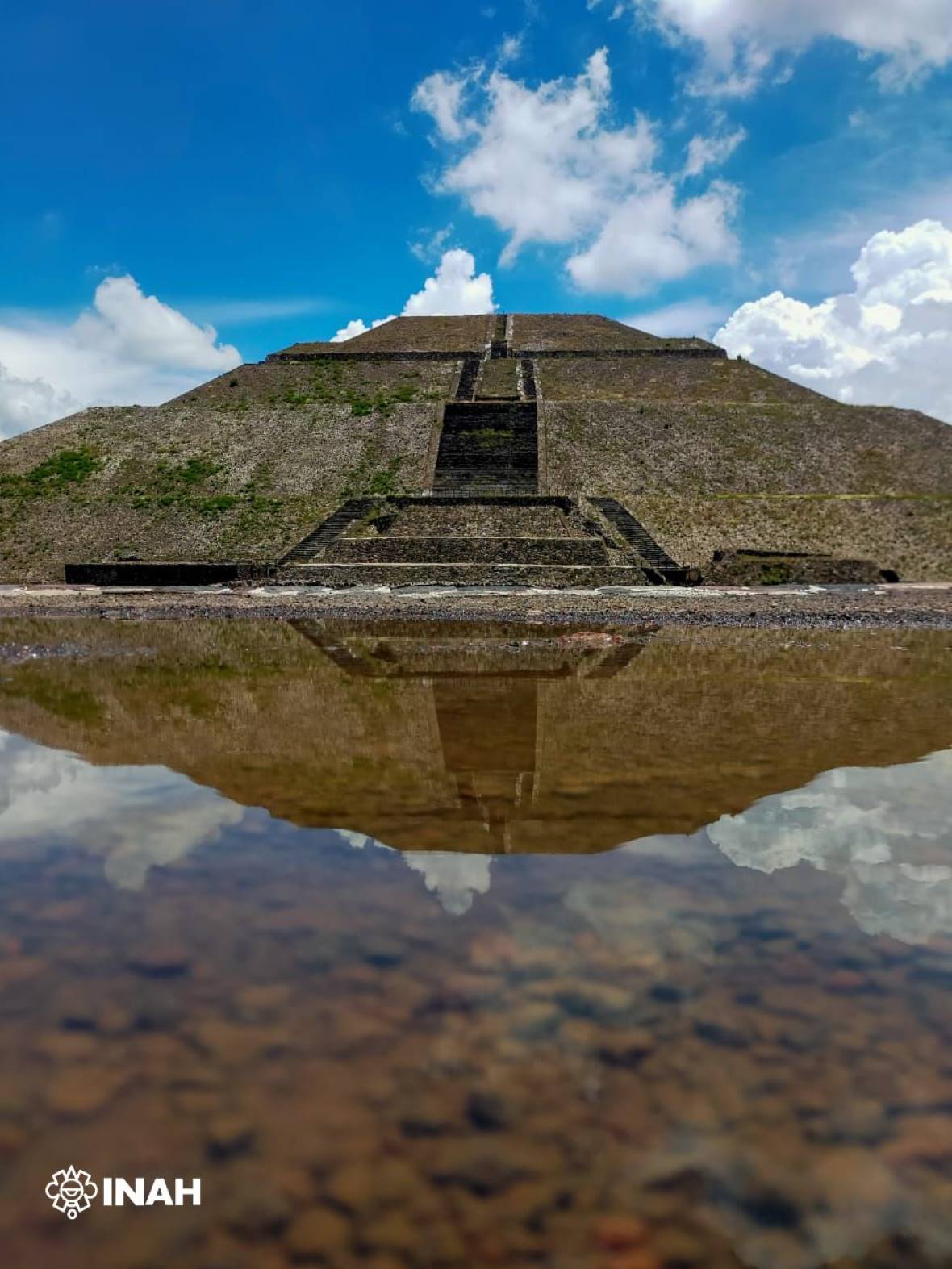
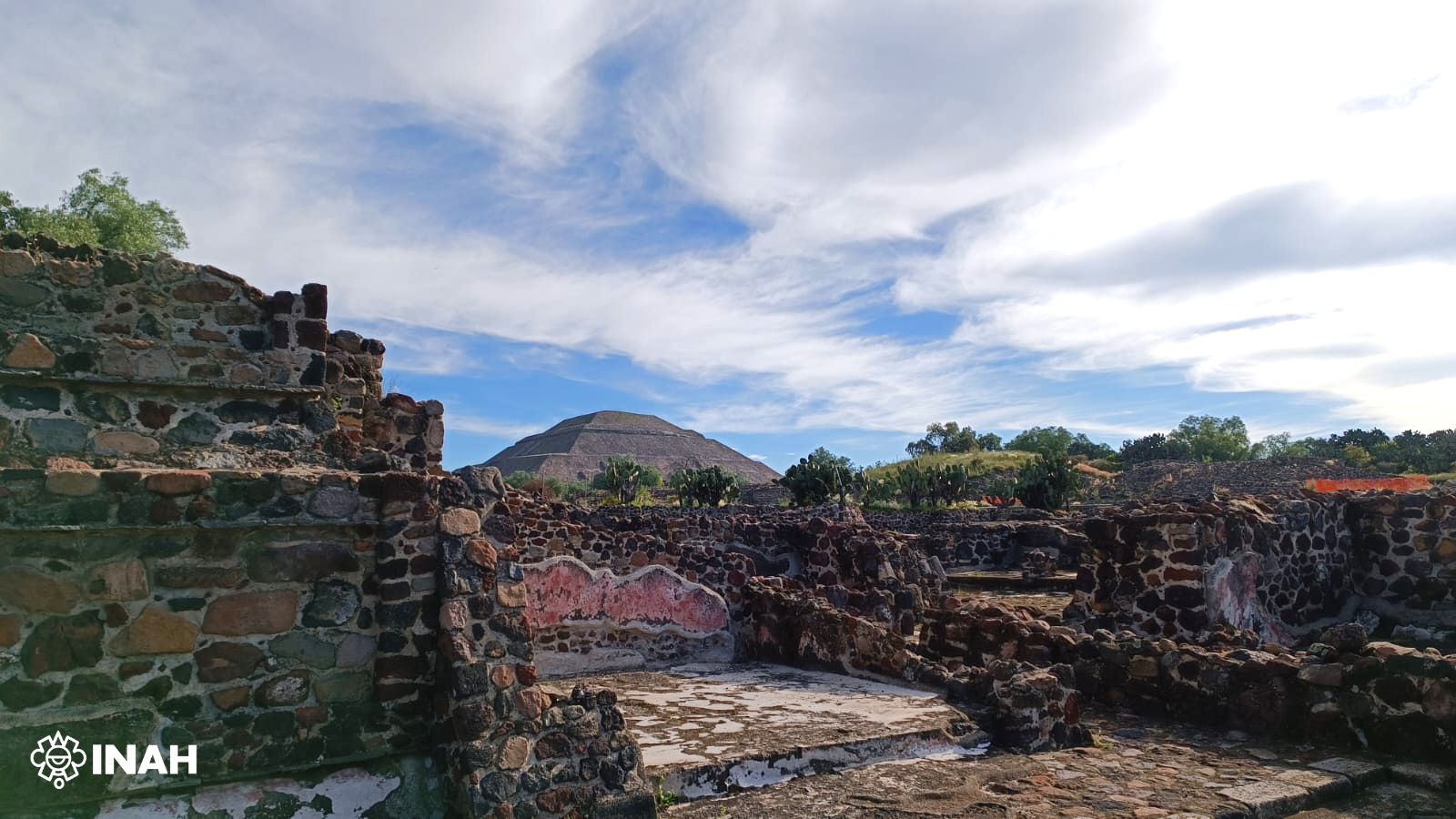
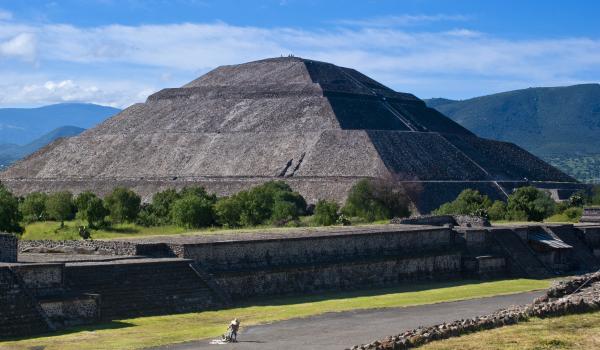
It consists of the Great Pyramid of the Sun, an outstanding platform, a rectangular plaza, which also concentrates three small temples and a shrine, an administrative unit and a residential area, All these elements create one of the most complex and monumental urban spaces of pre-Hispanic America
Conjunto del Sol
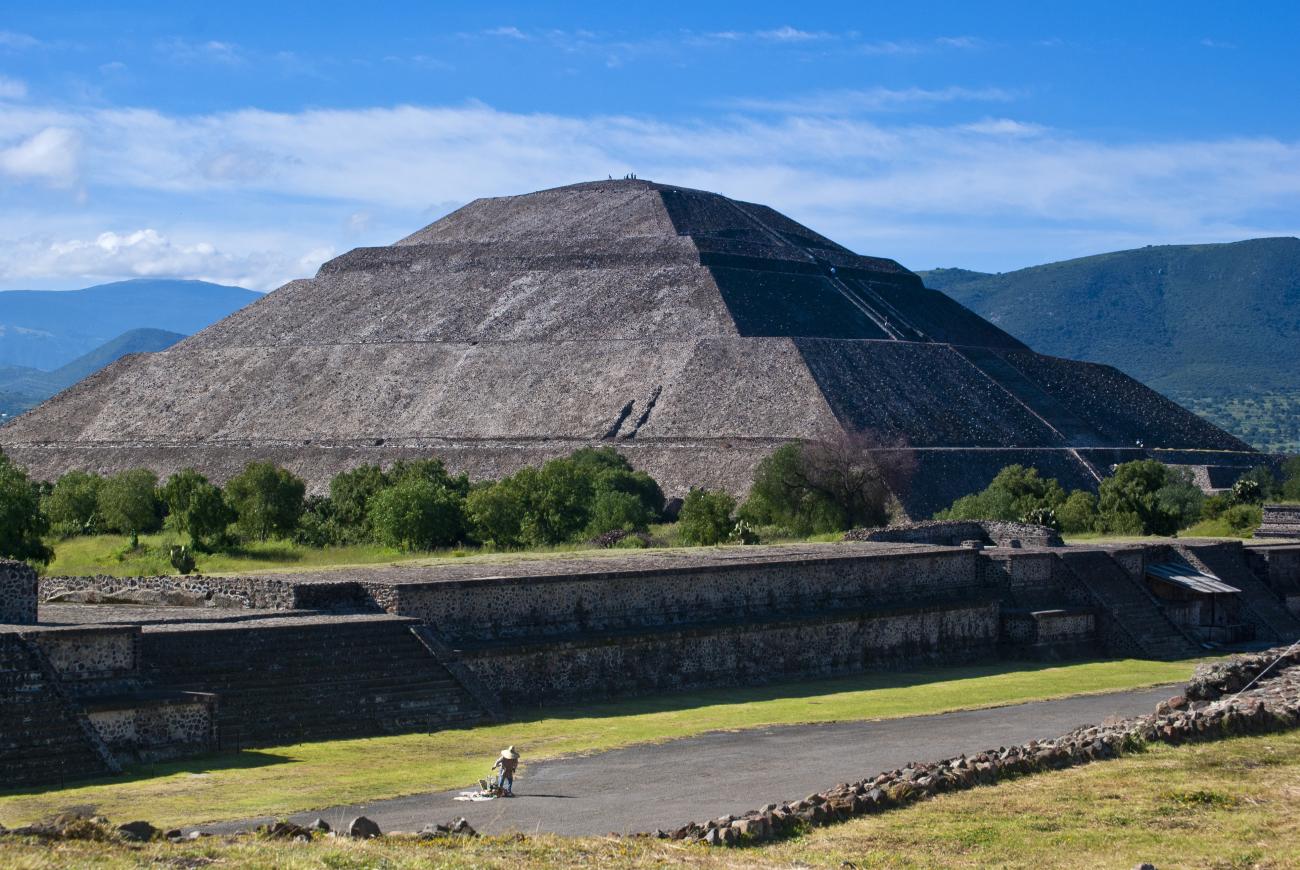
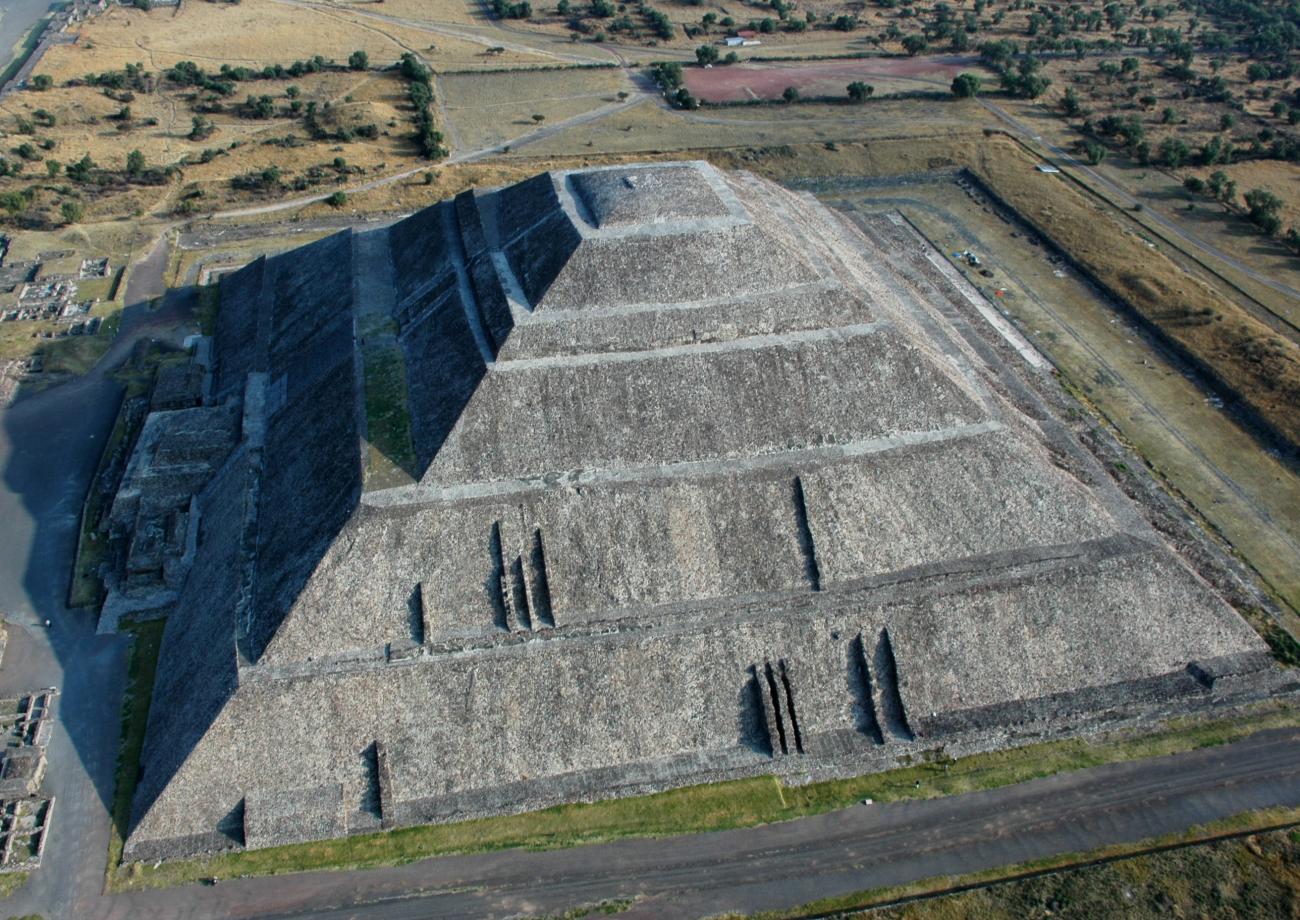
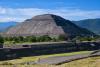
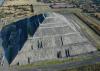
It consists of the Great Pyramid of the Sun, an outstanding platform, a rectangular plaza, which also concentrates three small temples and a shrine, an administrative unit and a residential area, All these elements create one of the most complex and monumental urban spaces of pre-Hispanic America.
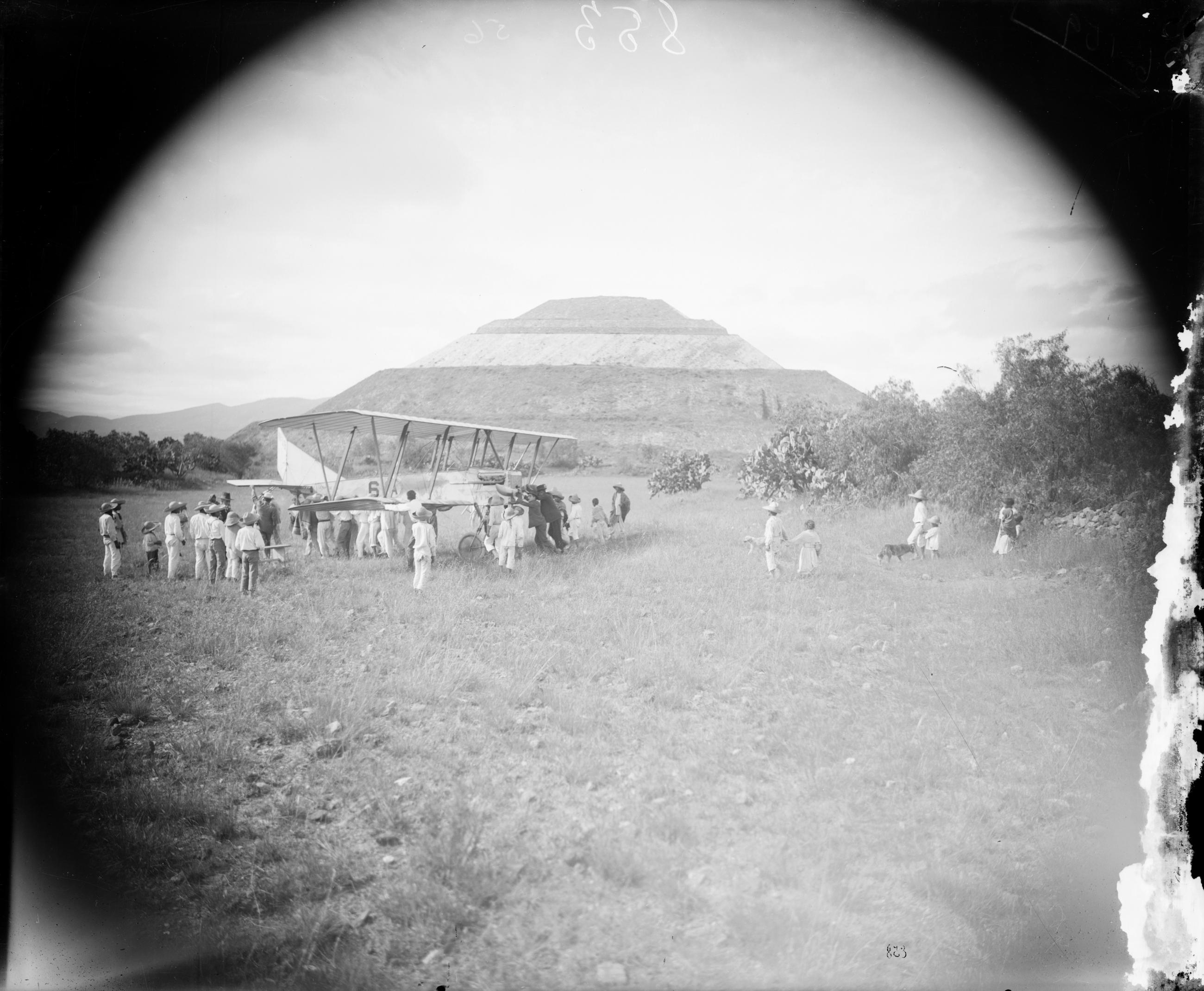
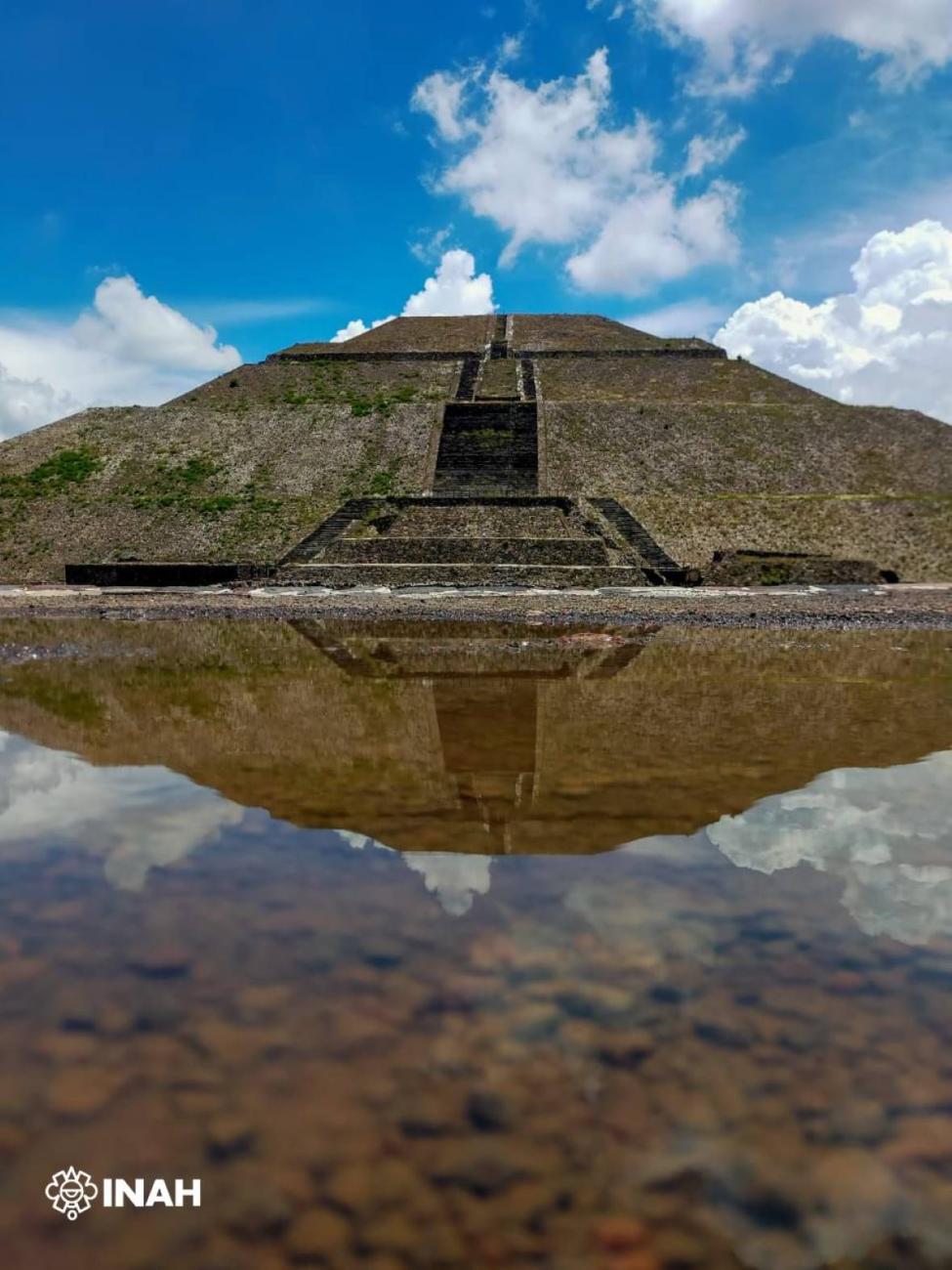
Pyramid of the Sun: It is one of the oldest buildings in the city, 65 m high and 224 m per side at its base, it is the largest in the city; in one of the surrounding residential complexes about 30 murals with diverse representations, mostly polychrome, were detected.
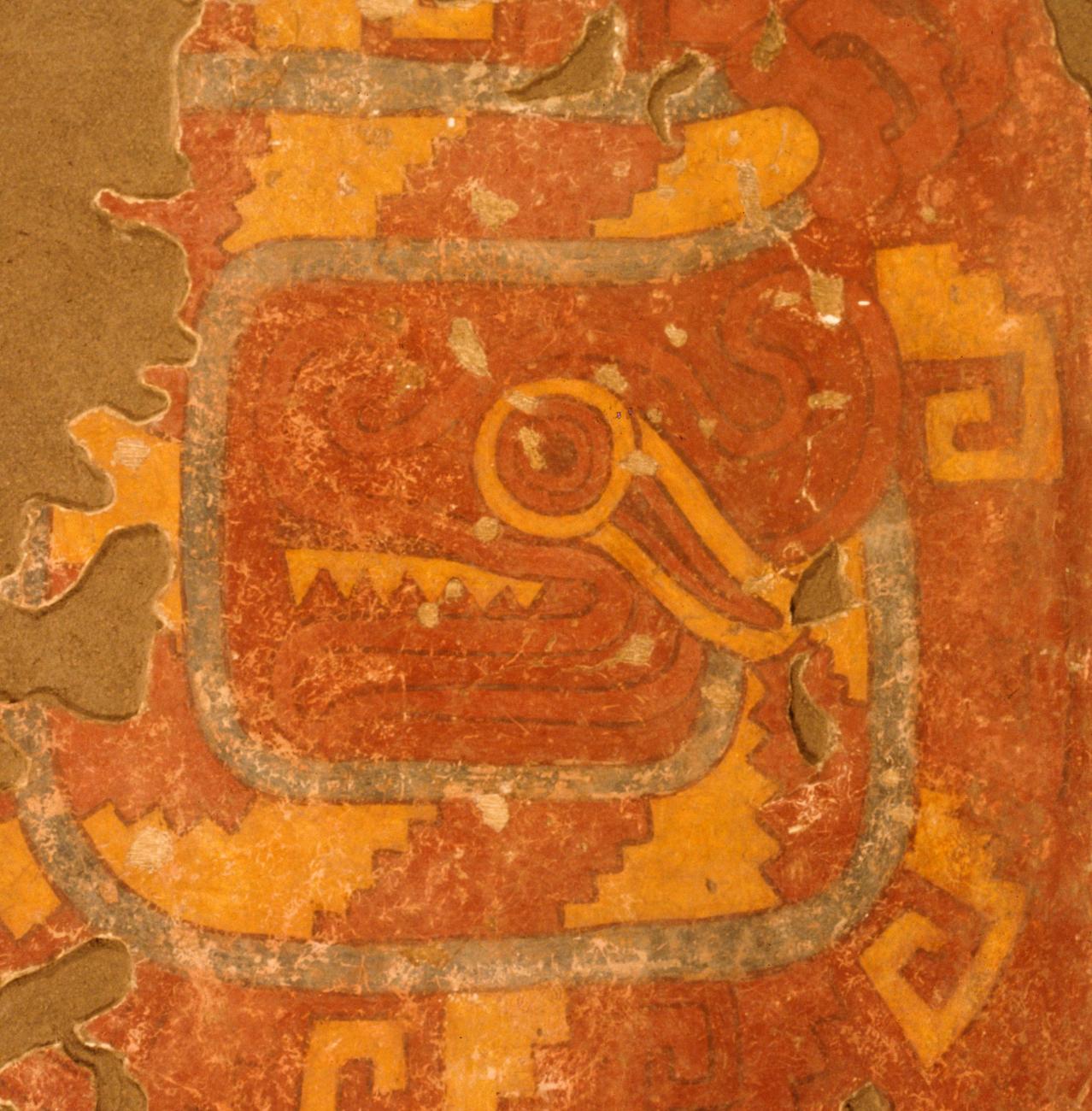
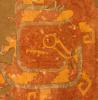
Spiral snake framed by a stepped fretwork design: It is a spiral snake; in its center the stylized head is seen in profile; above and to the left is the tail exhibiting three geometrized petals, its features include the eye composed of three concentric circles, from this descends an inclined appendage, the mouth is open and inside are recognized pointed teeth, the ear is, like the mouth, a kind of trunk, a wide scroll.
The head, in fact, does not look like that of a snake, it is a fantastic animal; the body is a wide strip sectioned by staggered lines, in red and yellow sections, a dark blue band outlines it. On the outside, following the outline of the serpentine body, it is framed by a design of staggered fretwork -alternating a red and a yellow one- which ends leaving space for the representation of the petals. It had a border of stepped fretwork design limited by bands with red and yellow triangles, the schematic and geometric style differs notably from the "classic" Teotihuacan times.
Fuente, Beatriz de la (coord.), 1995, La pintura mural prehispánica en México Teotihuacán, volume I, Mexico, UNAM/IIE.
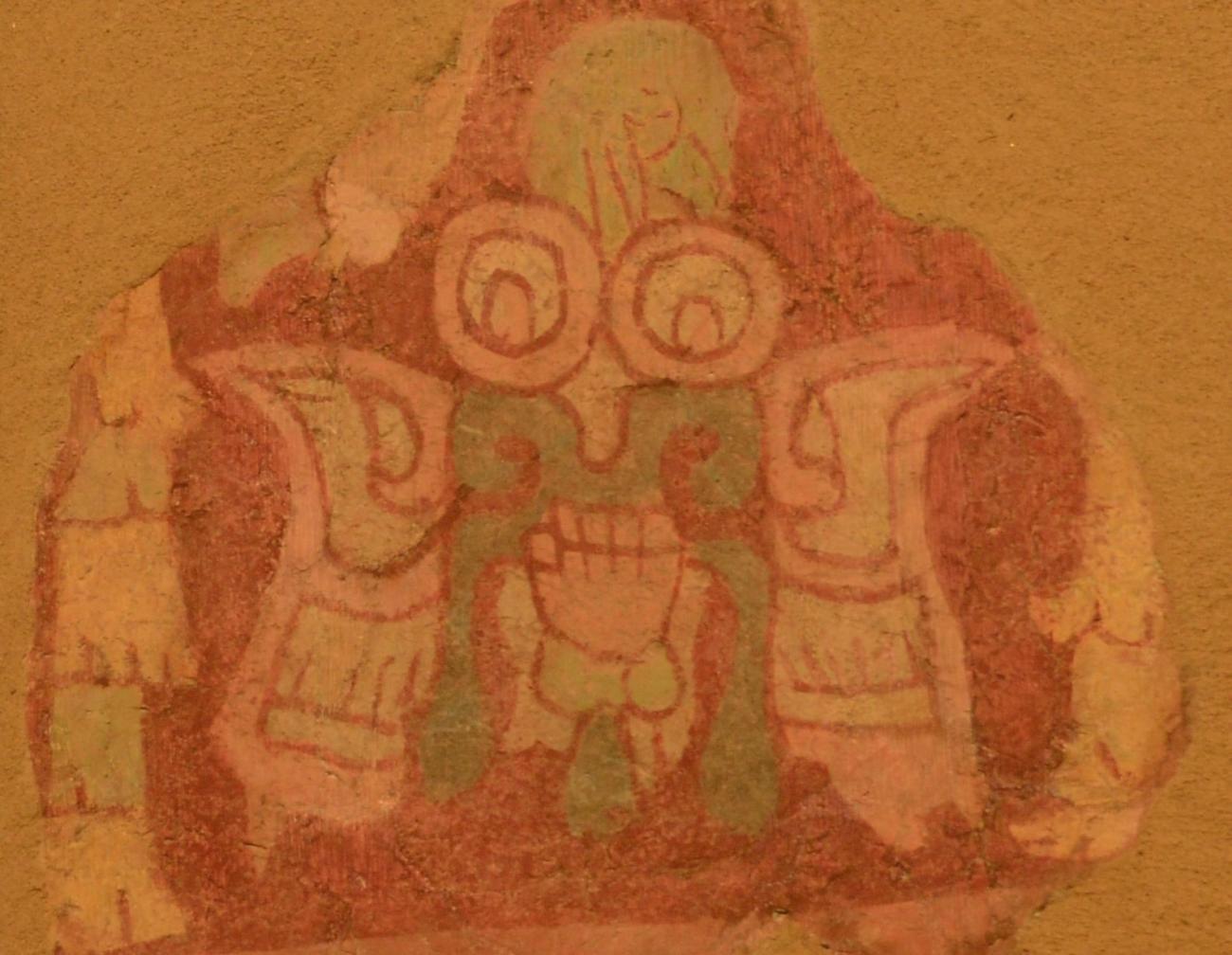
Butterfly with large eyes with concentric circles and human hand on its body: Large eyes composed of concentric rings and eccentric pupils are visible in the central middle part of the inner ring; in the center, where the two rings meet, the antenna of the spiral-shaped butterfly rises, it has a red perimeter and a pink background, a semi-oval shape in light green stands out.
The body is composed of a right human hand that seems to hold up two meanders and, on each side, a narrow band that curves downward and ends in a pointed appendage; the fist of the hand is covered by a knot band in green and a blue pendant, all on a rectangular surface in pink tone; the schematic wings show green designs on the inside, have tucks towards the inner side and in the design of the lower part they carry parallel vertical lines; on both sides of the butterfly's body there are polychrome designs whose shape is unrecognizable.
Fuente, Beatriz de la (coord.), 1995, La pintura mural prehispánica en México Teotihuacán, volume I, Mexico, UNAM/IIE.
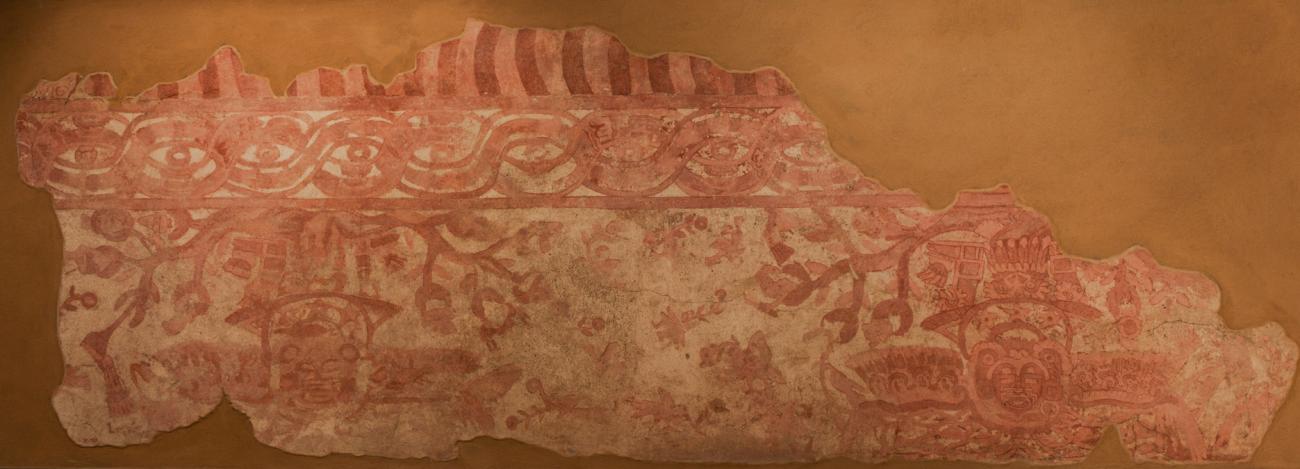
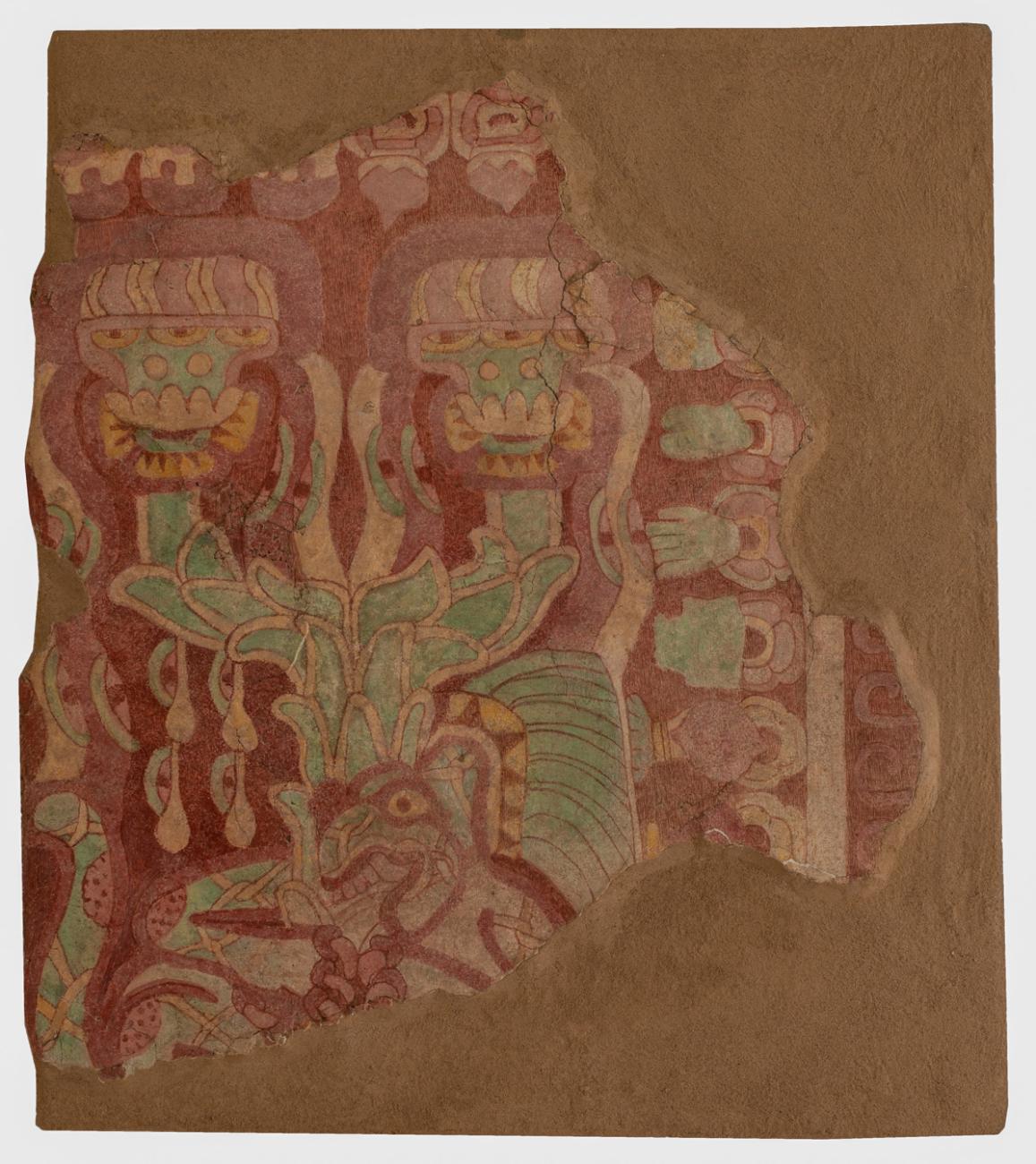
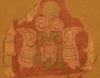
Large murals of descending winged figures: It is a descending character with extended wings that end with small bird heads that have a strong and hooked beak and a crest of small feathers; below his face there is a kind of garland -formed by what seems to be maguey leaves- that extends below the wings.
This personage carries a skirt or feathered cape on whose sides appear again the heads of birds, his left foot can also be seen wearing a sandal; his face is framed by a helmet in the shape of a frontal zoomorphic figure, the beak is directed to the center, both in the upper and lower part, his nostrils look more like a feline than a bird, the eyes of the helmet are crowned by feathers. The character's mouth is trapezoidal in shape and shows its teeth; it wears rectangular blinkers and a stepped mouth mask.
Above the helmet and the ends of the eyes there is a half circle that shows in its interior five-pointed stars; downwards is his right hand, from which a stream flows; above his body sprouts a plant that extends towards the ends, the leaves are pointed and are the same in each stem except for those that have flowers, in them appear different elements of auction: a rectangular figure from which fall three drops, two parallel bars separated by an interlace and other elements that cannot be clearly appreciated.
In the space between the border, the figure and near the plant, butterflies and a bird with a long, twisted neck can be seen; the border is formed by bands of interlaces: one of them is composed of a sequence of what looks like floral elements and the other by alternating eyes and jagged rays.
Fuente, Beatriz de la (coord.), 1995, La pintura mural prehispánica en México Teotihuacán, volume I, Mexico, UNAM/IIE.
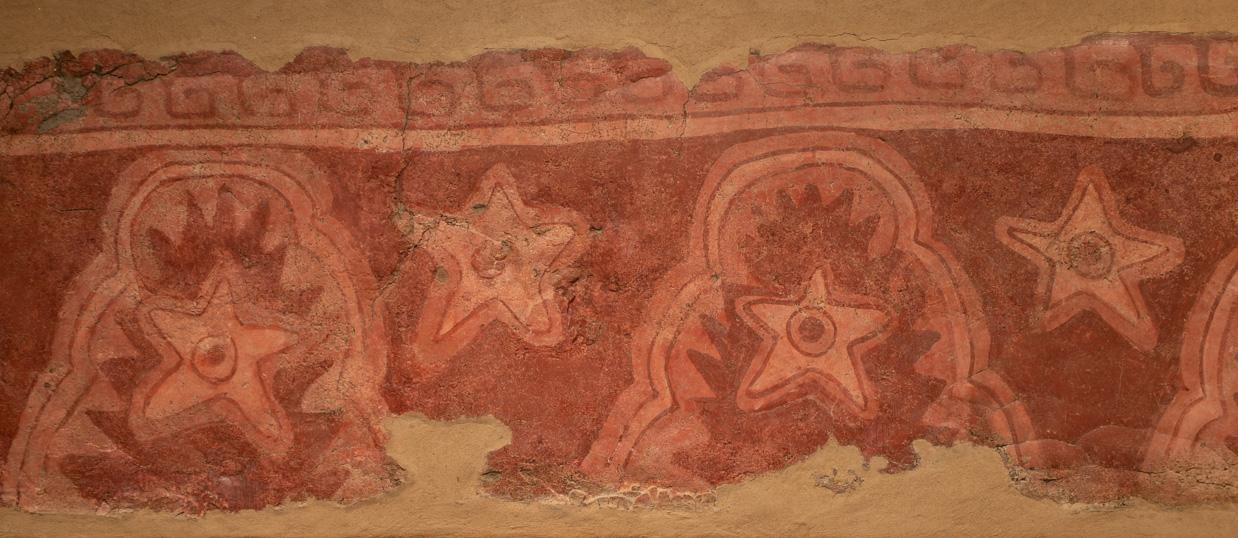
Design with poly-lobed forms alternating with five-pointed stars: It is a border limited in its external perimeter by a band of scrolls whose inward curves are found in the center. On the inner surface, on a dark red background, there are alternating poly-lobed designs with five-pointed stars; in the inner space of these designs, the five-pointed stars are repeated, some of which have pointed and radial shapes in dark red.
Fuente, Beatriz de la (coord.), 1995, La pintura mural prehispánica en México Teotihuacán, volume I, Mexico, UNAM/IIE.
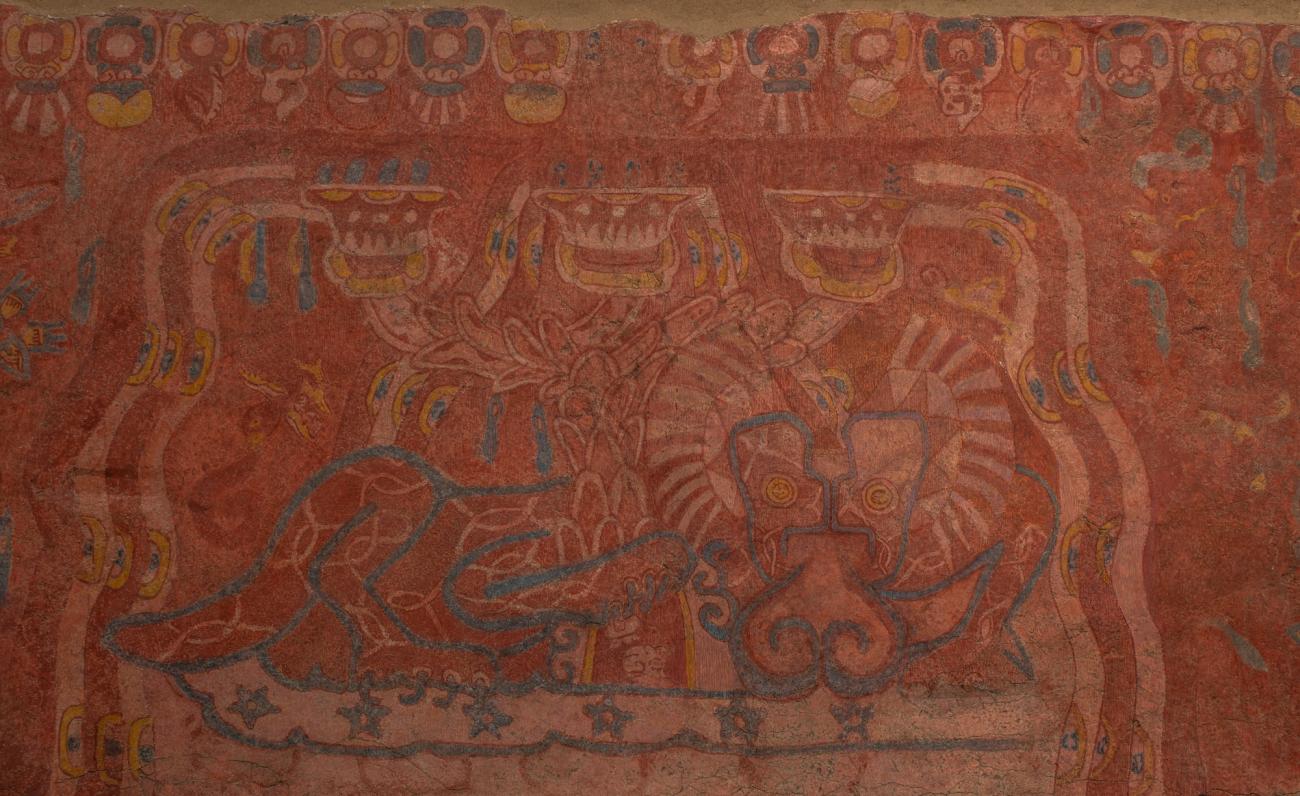
Jaguar outlined in blue with a frontal face, maguey plant, butterflies, birds and flowers: The center of the mural and of the composition is marked by the stem of a maguey that overlaps the body of the jaguar, whose head is composed of two profiles, has round eyes, open jaws showing fangs on the upper gum and a forked tongue with inward curved ends; two sections compose its headdress -each one corresponds to a profile of the large head- and a half fan composed of long feathers that stands from a headdress holder of found triangles.
The surface of the feline's body is decorated with interlaces, the front left paw is positioned in front and the right one is embraced to the stem of the maguey, only the back right paw is observed in profile, the tail is curved and descends on what remains of a band with stars in the interior that simulates water, where a feline poses.
The stem of the plant rises and divides in three branches: two towards the sides and one in the center, from the three ascend flowers of four petals to which are superimposed other flowers of profile that show the corolla and the petal, in their interior they take three disks and three eyes, in the high parallel wavy lines are appreciated. On the sides of these composite flowers are placed, on each side, three bands with eyes inside that snake down; in the spaces between the bands and the feline are butterflies with their wings extended and a bird in profile with a large virgula coming out of its beak.
The scene is framed by a border, formed by symbols composed of flowers with four petals in whose inner part are attached and alternate shells of different types, sectioned and complete snails.
Fuente, Beatriz de la (coord.), 1995, La pintura mural prehispánica en México Teotihuacán, volume I, Mexico, UNAM/IIE.
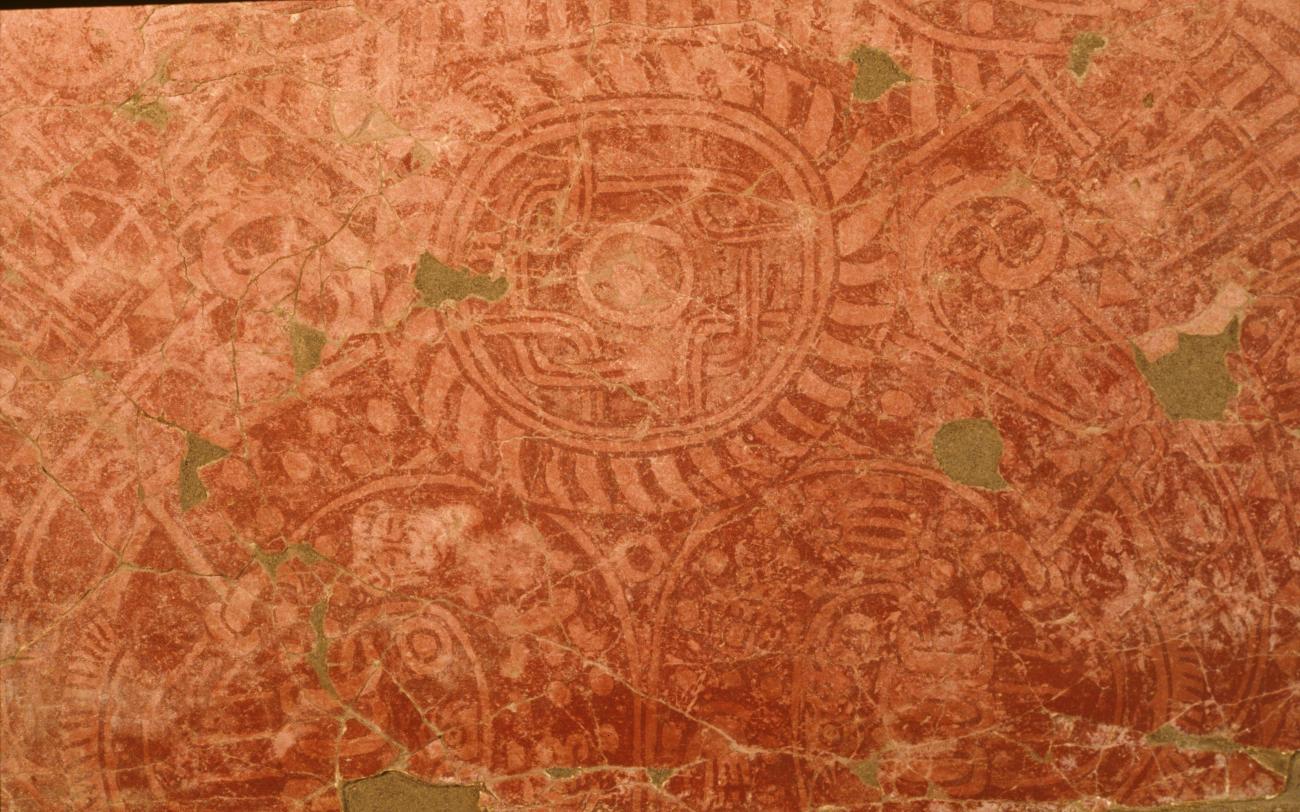
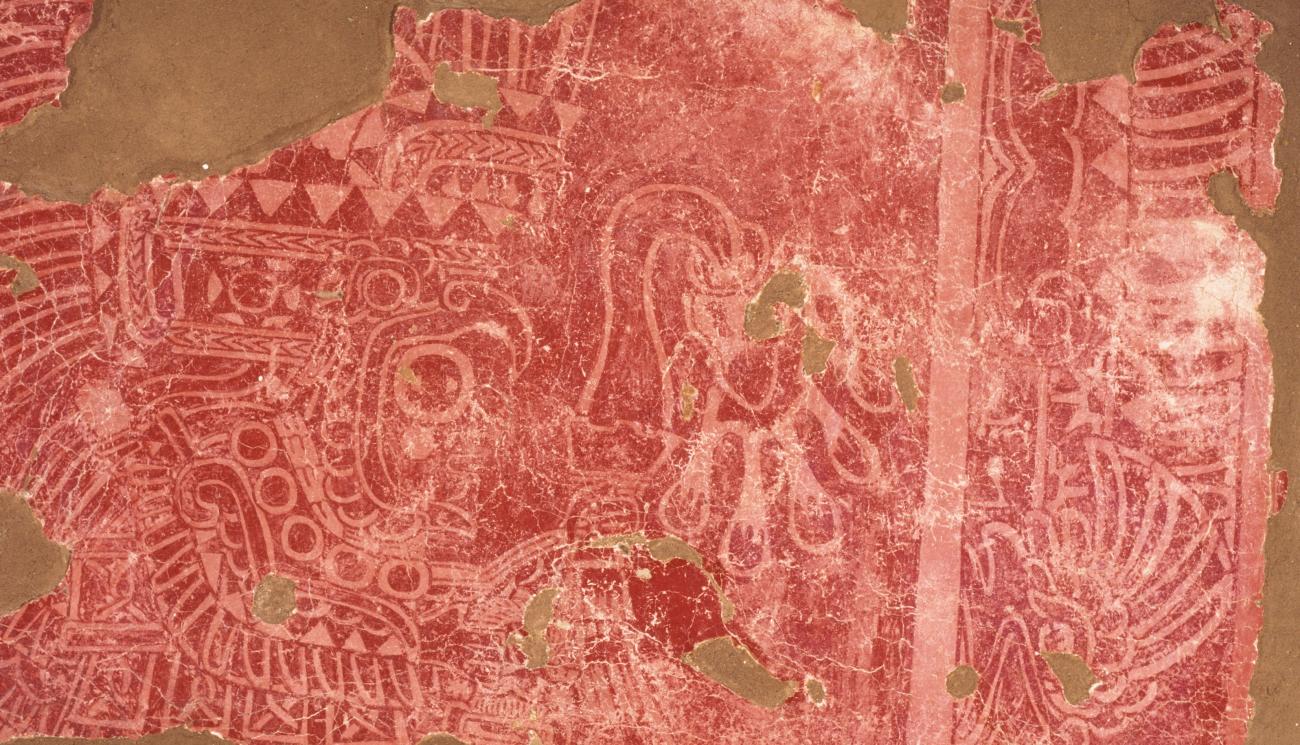
Frontal figure with interlaced claws and current: It is a large symbolic figure represented from the front, instead of a face it has a kind of shield that inside it carries concentric circles and a disk at the center framed by double and interlaced lines, surrounded by another outer ring composed of a design of feathers curved in the same direction; above the shield extends as a large fan a huge headdress that is made up of the following parts: the lowest, above the shield, is formed of a row of tabs pointing downward; above it extends a band that curves at the ends and inside of which is noted, horizontally, a row of discs; at a higher level a wider band than the lower one is observed, follows the same curvature and is decorated inside with a row of drops; another narrow band repeats the shape and design, with a series of discs in a horizontal direction.
In the center and at the top of the aforementioned bands, there is a kind of square in whose interior there are discs, a silhouette in the form of a stool from which four appendages that simulate fangs are raised and curved outward. The square is limited at the top by two curved bands: the inner one has discs and the outer one has triangles in two shades of red. On the sides of the lower part, which resemble the open jaws of an animal, extends on each side and horizontally, a plate with pointed appendages.
Framing the sections of the headdress mentioned above, there are diagonal bands with discs and triangles inside them, from which three drops fall on each side; two plumes of feathers, one on the sides of the lower sections and the other at the top, enhance a magnificent headdress.
Fuente, Beatriz de la (coord.), 1995, La pintura mural prehispánica en México Teotihuacán, volume I, Mexico, UNAM/IIE.
Jaguar embracing stylized maguey branches: In the fragment a feline image is appreciated whose head is in profile and looking to the right side; the arms and legs with their respective claws, seem to be in front embracing the plant stem that has been identified as maguey, while its erect tail curves to the right in a convex way.
The face of the feline has an elliptical eye, the erect ear, the flat nose showing the nostril and the half-open jaws with teeth and fangs in the upper gum; the head, extremities, body and tail of the jaguar have intertwined bands or nets; in the extremities and tail there are semioval forms with dots in its interior.
It wears a fan-shaped headdress, its base or “portatocado” is a band of triangles that holds long green feathers; above the feline's head rises the stem with maguey leaves, at the top it bifurcates with two branches, one on each side of its center, and from each of these, a stem rises that holds a flower of four petals -the upper one is hidden- with triangles inside, and another flower seen in profile, with corolla and petals inside which are two discs and three eyes directed upwards, above the petals are parallel wavy lines and a wide red band in the form of a fan; as if forming part of this section of the maguey plant, on both sides, wavy bands with eyes descend inside, from the right branch four drops with their respective eyes descend.
The fragment is framed by a border composed of bivalve shells and snails, which hide the lower petal of the four-petal flower in its upper part; on the left side of the border there are remains of shells, snails and a hand that comes out of the flowers of four petals, in the external part there are remains of a fringe with volutes.
Fuente, Beatriz de la (coord.), 1995, La pintura mural prehispánica en México Teotihuacán, volume I, Mexico, UNAM/IIE.
Human figures in profile with bird costume and holding a curved knife: Two human figures seen in profile, both with one foot behind the other and holding in their hand a curved knife that slits through the center of an image resembling a sectioned heart, from which hang five drops.
Few elements of the human figure are visible: a necklace of circular beads, feet that go one behind the other, and shod with sandals, of the face large rings are appreciated around the eyes and the left hand rises to take a curved knife; the headdress or helmet, that frames the face in profile, is the beak of a bird with eye and feathers, has a horizontal section with stars in its interior, limited by a band of petalillo and straight triangles in two tones of red.
Above it rises a plume of long feathers that form the silhouette of a half fan; below and to the back of the head of the human figure, another bundle of four feathers extends from which descends a kind of band or stream with symbolic designs in its interior.
From the costume of the character we can appreciate a kind of cloak composed of different sections: an extended scroll that looks like the articulation of the wing of a bird; below this last one a band with circular designs; then another band of triangles found in two tones of red; of greater amplitude than the previous ones a band formed by feathers; and finally in the bottom, another band of bangs in the form of X.
The border that limits the design is different on the two vertical sides, on the extreme right it is made up of five straight bands that move vertically and at the top they bend in a horizontal direction: one of these bands, on the inside, is a plain band of light red color, the following one, towards the outside, is a band with a row of footprints that follow the same direction; another on the outside is similar to a band of five-pointed stars and a central disk; another band is made up of pointed triangles in two shades of red.
Finally a band formed by a row of feathers; a rectangular form -in the lowest part- from which four curved and long feathers descend, gathers the bands described above. At the other end of the border the bands vary in their interior design: vertical water waves, footprints and feathers ending in a zoomorphic head looking down.
Fuente, Beatriz de la (coord.), 1995, La pintura mural prehispánica en México Teotihuacán, volume I, Mexico, UNAM/IIE.
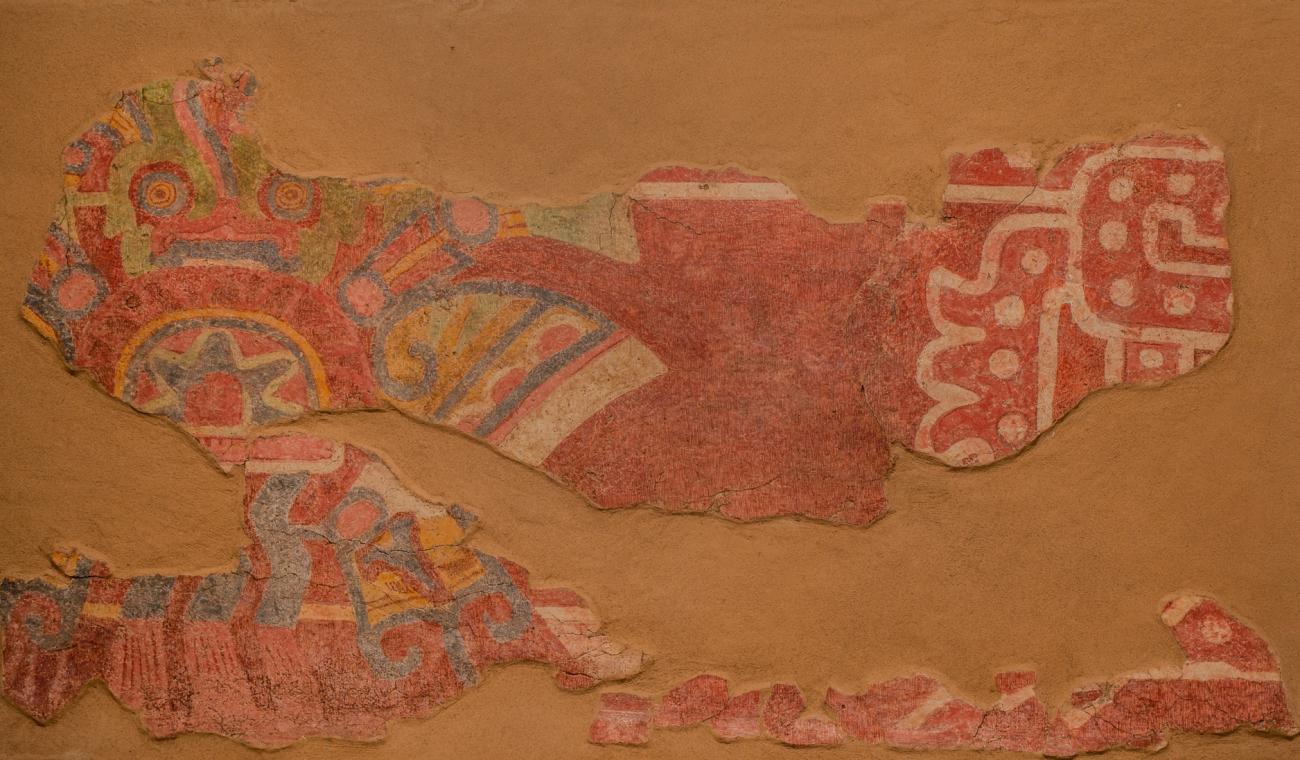
Figure of a bird seen from the front on a shield with a five-pointed star: In the fragment of this mural, in addition to the straight bands folded in a spiral with the rows of disks inside, the figure of a bird seen from the front can be recognized; its eyes are concentric circles, composed of bands of different colors, the bird is seen above a disk .shield or buckler?- in whose center is placed a five-pointed star, and narrow blue and yellow bands surround it, another wider band with feathers inside forms the outer band of the disk.
Fuente, Beatriz de la (coord.), 1995, La pintura mural prehispánica en México Teotihuacán, volume I, Mexico, UNAM/IIE.
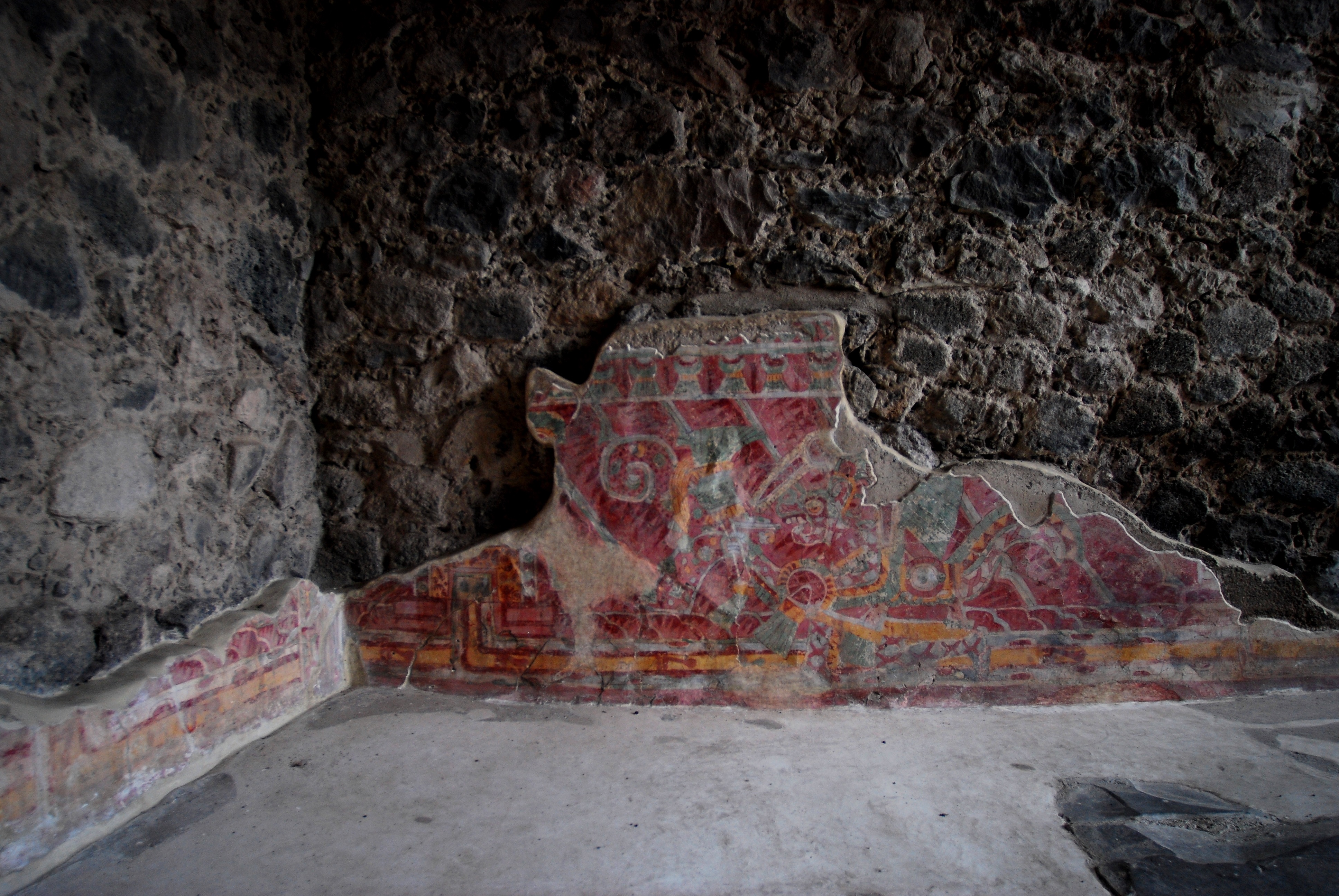
Mural del puma
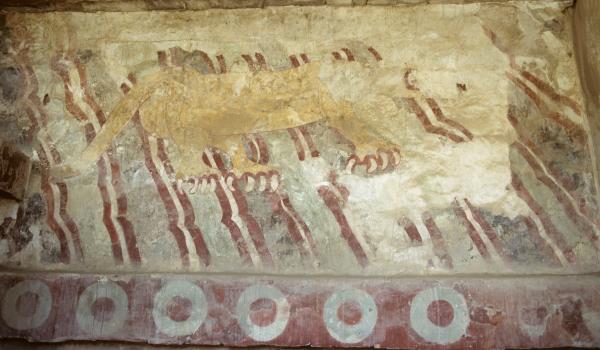
It is found on the walls of one of the buildings located on the Calzada de los Muertos at its northern end, and presents a large painted puma on the platform board.
Mural del puma
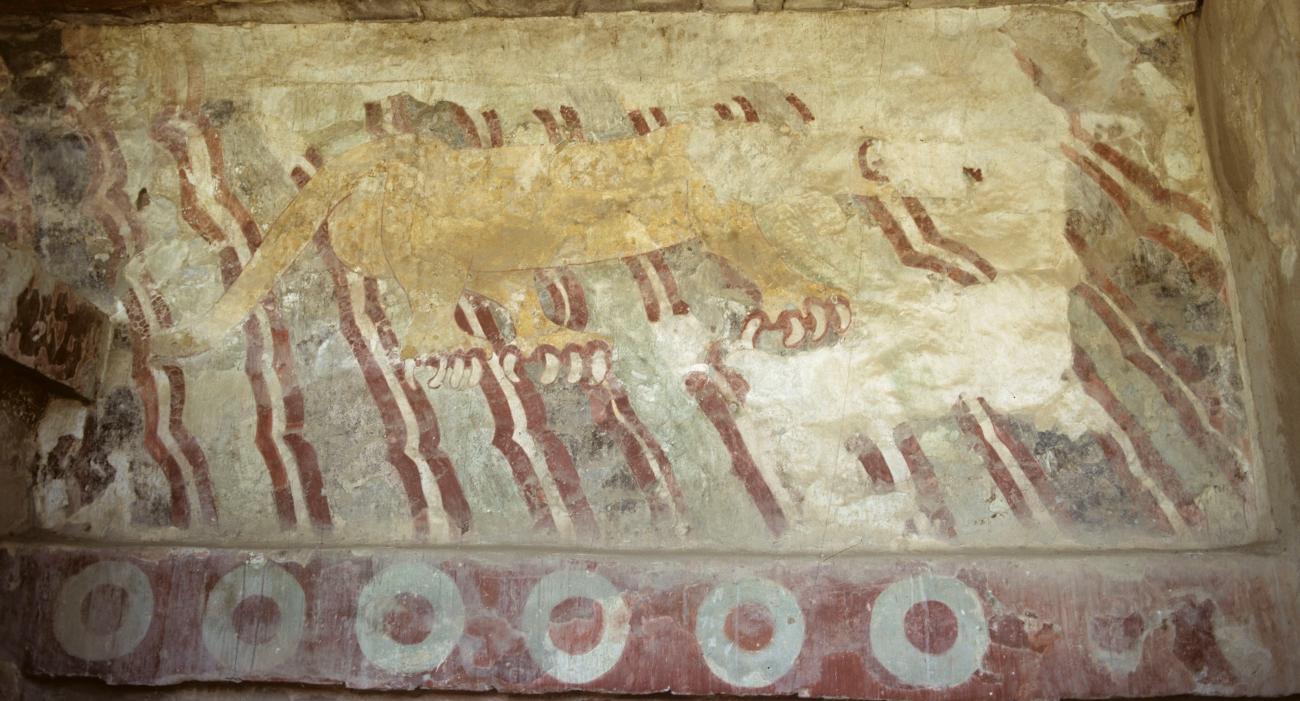
It is found on the walls of one of the buildings located on the Calzada de los Muertos at its northern end, and presents a large painted puma on the platform board.
It is the monumental image of a feline seen in profile that simulates walking on wide undulating and transversal bands; it seems to move its body horizontally, the head is not seen, the back and the belly are outlined by an extensive slightly undulating line, the narrow tail descends and curves smoothly, the paw is short and in each paw four claws are shown.
The image of the feline seems to be superimposed on a background composed of undulating bands, the frame is formed by thick green rings -chalchihuites- rhythmically repeated at regular intervals, on a dark red background.
Fuente, Beatriz de la (coord.), 1995, La pintura mural prehispánica en México Teotihuacán, volume I, Mexico, UNAM/IIE.
Edificio de los Animales mitológicos
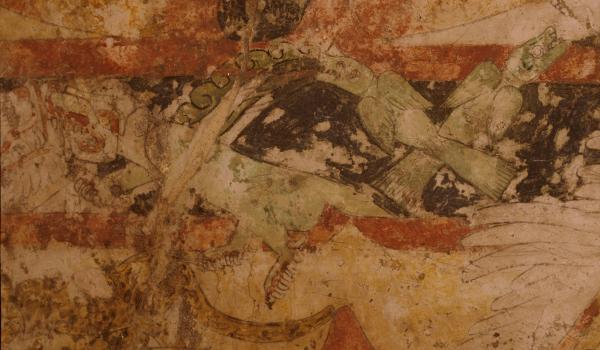
Very close to the Plaza de la Luna, on the west side, extraordinary polychrome murals called “Mythological Animals” were discovered.
Edificio de los Animales mitológicos
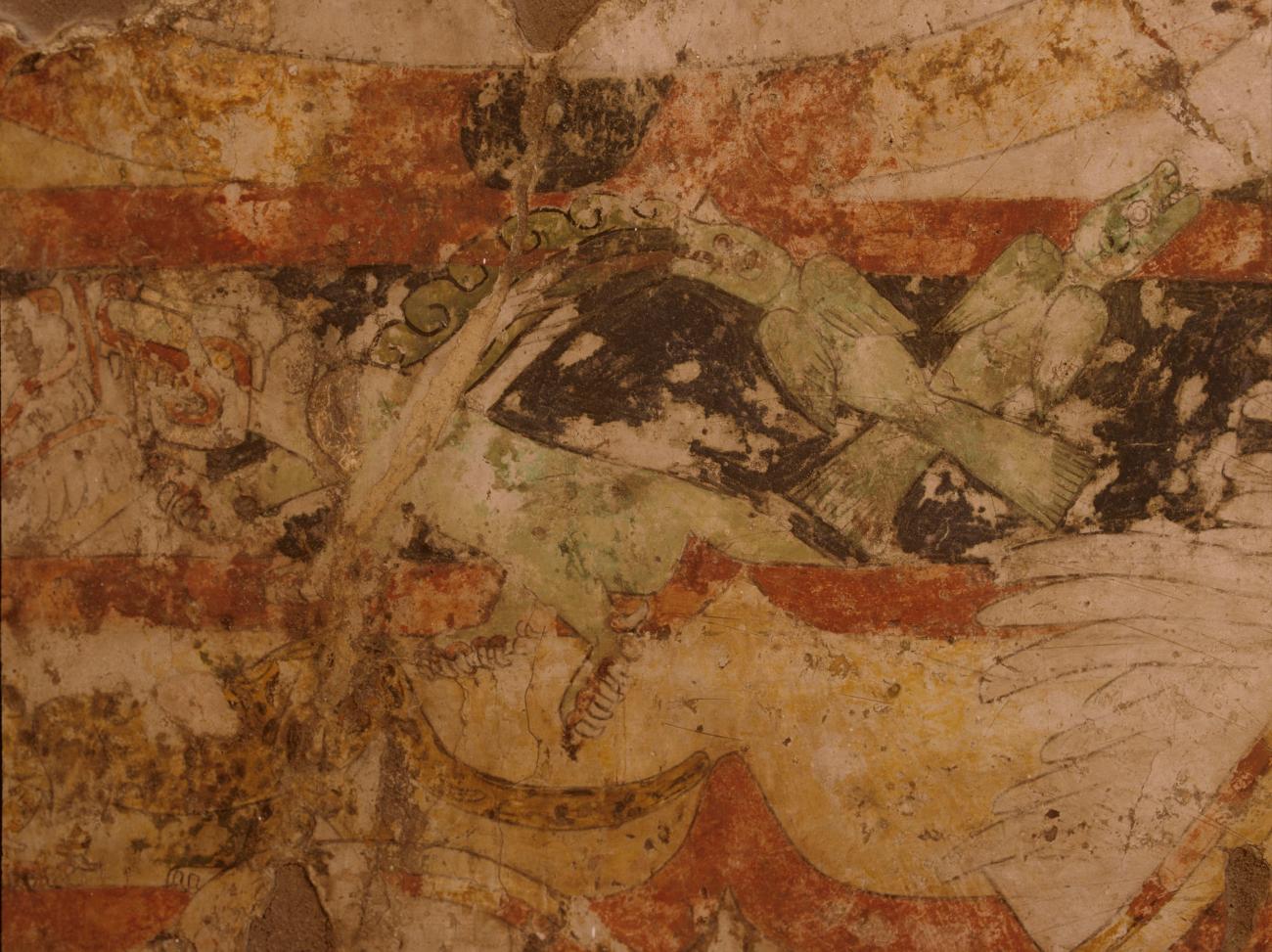
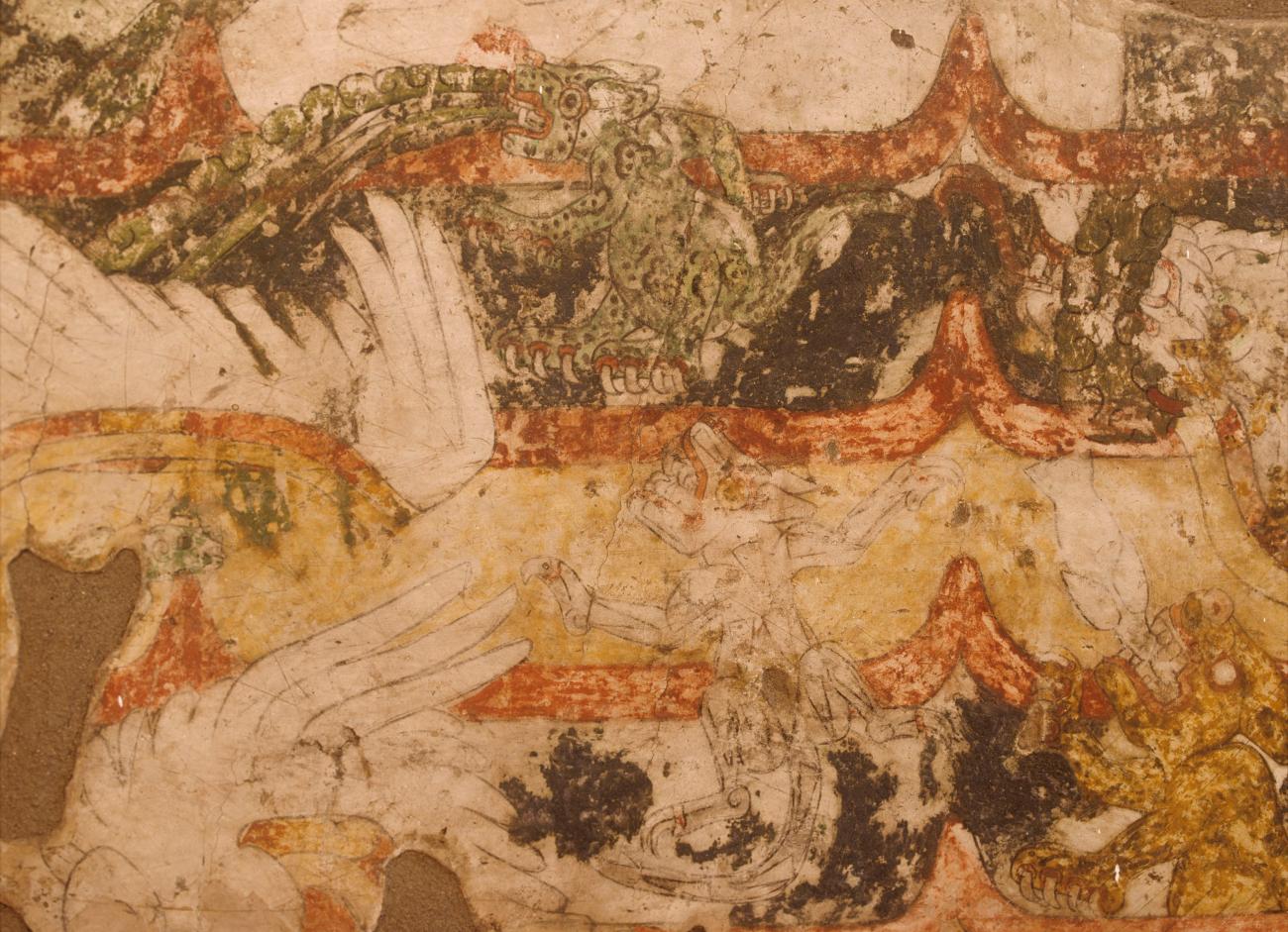
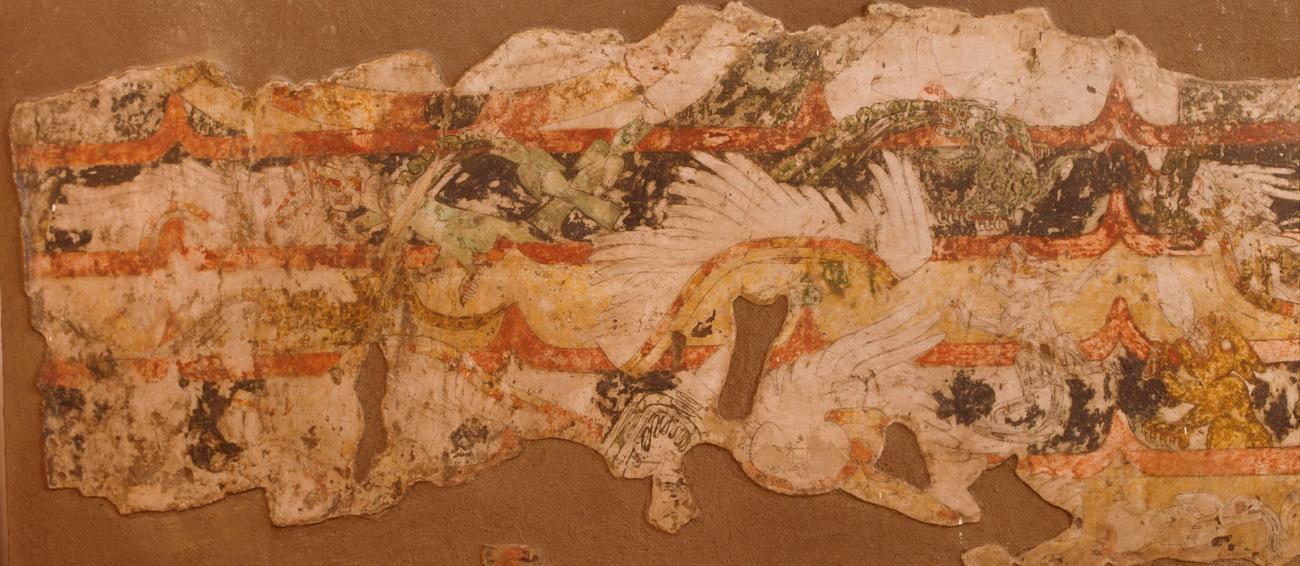
Very close to the Plaza de la Luna, on the west side, extraordinary polychrome murals called “Mythological Animals” were discovered. The theme in general refers to the confrontation between animals that hide or alter their natural image, they move to the rhythm of the water waves, represented by wide horizontal bands, yellow and blue or green that alternate among themselves, limited by narrow red bands that are pointed upwards in regular intervals; in some portion up to five bands are appreciated, considering the superposition of the yellow, blue and red ones; the pictorial structure is determined by this solid scaffolding of bands, rhythmic, horizontal and firmly stable.
Supporting, emerging, crossing and enveloping this scaffolding are three kinds of zoomorphic creatures: quadrupeds, reptiles and fish whose postures, enormously dynamic and varied, give the scene dramatic movement. It is probable that in its original state, covering the walls of chamber 1, the scene had a kind of thematic and symbolic continuity of which only isolated portions are visible.
Fuente, Beatriz de la (coord.), 1995, La pintura mural prehispánica en México Teotihuacán, volume I, Mexico, UNAM/IIE.

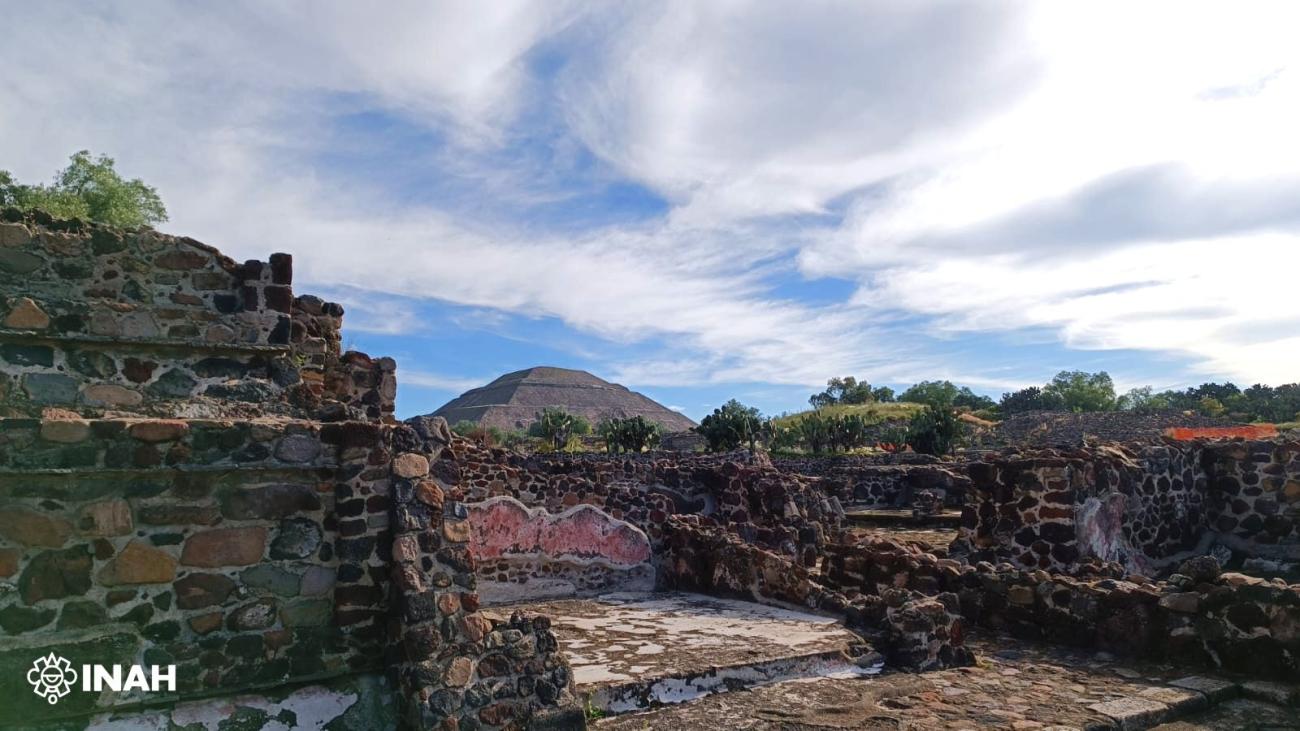
Investigation and preservation of Structure A, Plaza of the Pyramid of the Moon, Teotihuacan

Contact
- Dirección de la Zona Arqueológica y Museo de SitioRogelio Rivero Chongrogelio_rivero@inah.gob.com+52 (594) 956 0276, ext. 19850