

Name
Gulf Cultural Region
This cultural region is bordered to the west by Laguna de Alvarado, Veracruz, and to the east by Barra de Tupilco, Tabasco. To the north, the Gulf of Mexico forms a natural barrier, and to the south it extends for nearly 100 km. Most of this region lies less than 100 meters above sea level, except for the Los Tuxtlas mountain range.
The first settlers of the Gulf began to arrive around 7,000 years ago. These groups were hunters, gatherers, and fishermen who settled near water sources such as rivers and lagoons, such as the Tecolutla-Nautla rivers and the lower Pánuco basin. The first culture to develop was the Olmec, of which more than thirty sites have been identified, including San Lorenzo, Tres Zapotes, and La Venta. The Olmecs reached their peak between 1200 and 400 BC. and its influence spread throughout various regions of Mesoamerica, such as Chalcatzingo (Morelos) and Teopantecuantitlan (Guerrero).
Olmec art is characterized by the creation of monumental heads and altars, as well as the depiction of figures with deformed heads and jaguar-like mouths. Some are depicted as plump, asexual, seated beings with childlike features, giving them the name "baby face." Another emblematic aspect of Olmec art is the cult of the jaguar, whose features can also be found in isolation, such as the flaming eyebrows, gums, claws, and the "V"-shaped cleft in the head. In some cases, feline elements can be mixed with serpentine and human features.
The Gulf region reached its peak development in the Classic Period (200-900 AD), when the Central Veracruz and Huasteca cultures emerged. In the artistic production of this period, some links with Teotihuacan can be observed, both technically and symbolically. Clay work was also mastered, as evidenced by the creation of female figures, the creation of smiling faces, and the manufacture of wheeled toys. Meanwhile, in stone, the yoke-palm-axe complex (attributes of ballplayers) was developed. The axes represented human or monkey faces; the yokes represented the earth monster; and the palms represented complete people or allegorical themes. During the Classic Period, the greatest exponent of the Gulf region was Tajín, located in the center of what is now Veracruz, with its characteristic architecture based on niches and projecting cornices, as well as bas-relief sculpture.
Between 750 and 800, the first Totonac groups began to arrive in the area. These groups reoccupied some sites and intervened in some constructions, as was the case at El Tajín Chico. At its peak, the Totonac region (also known as Totonacapan) was home to a huge population in large cities such as Xiuhtetelco, Quiahuiztlan, and Cempoala. The Totonac political organization consisted of lordships headed by a chief, as was the case at Cempoala, Misantla, and Zacatlán. The rulers were assisted by advisors, and the priests held a privileged position, as they were responsible not only for organizing rituals and festivals dedicated to the gods, but also for writing codices, astronomical observations, and calculating the ritual and solar calendars.
During the Postclassic Period (900-1500) in Central Veracruz the Totonac culture stood out, inhabiting the area from the mouth of the Tuxpan River to the Antigua River and a large strip of the Sierra Madre Oriental. Meanwhile, in northern Veracruz the Huastec culture continued, occupying the area from the mouth of the Cazones River to the Pánuco River and the mountainous area near the coastal plain. The Huastecs had sporadic contact with the inhabitants of the Southeastern United States. Huastec art was characterized by the stylized and linear treatment of the human body. Their sculptures often feature the attire of deities of the underworld or the Feathered Serpent; there are also double images with bodies attached to their backs, as well as phallic elements that allude to the cult of fertility. In addition to these cultures, there is evidence of the existence of other foreign groups such as the Otomi and Nahua. In the late postclassic period (1200-1521), the Mexica armies arrived in the lands of the Gulf seeking to subdue some populations and benefit from tributes, as was the case in Cempoala.
Fuentes:
- Castro-Leaspino, Marcia, 2004, Costa del Golfo. Museo Nacional de Antropología. México, México, Conaculta / INAH / Lunwerg.
- López Austin, Alfredo y Leonardo López Luján, 2009, El pasado indígena, México, Colmex / FCE.
- Ochoa, Lorenzo, 2000, "Los olmecas," en Linda Manzanilla y Leonardo López Luján, Atlas histórico de Mesoamérica, México, Larousse.
- Ochoa, Lorenzo, 2000, "El Golfo durante el Clásico," en Linda Manzanilla y Leonardo López Luján, Atlas histórico de Mesoamérica, México, Larousse.
- Ochoa, Lorenzo, 2000, "La zona del Golfo en el Posclásico," en Linda Manzanilla y Leonardo López Luján, Atlas histórico de Mesoamérica, México, Larousse.
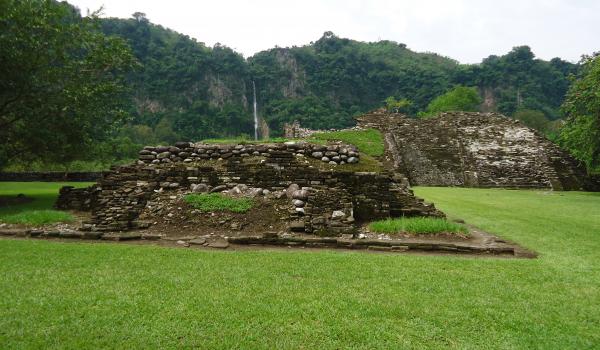
 Archeological site
