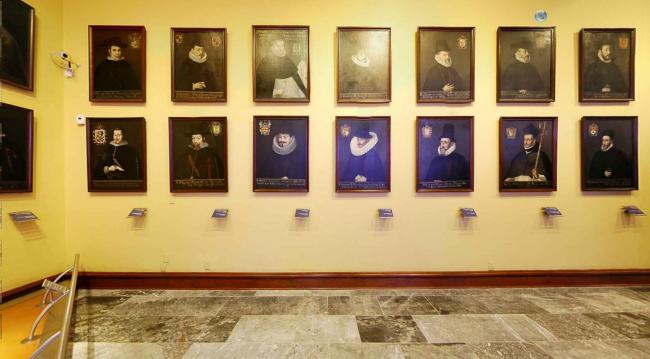
Viceroys’ Room
When the Spanish arrived, governance fell to Hernán Cortés, who ruled as captain general and chief justice. Later, the Spanish Crown attempted to administer New Spain through two successive royal courts, until finally, on April 17, 1535, Don Antonio de Mendoza took office as the first viceroy. The viceregal institution was built on a hierarchy that centralized power in the king, who was assisted by the Council of the Indies—an entity in Spain overseeing legal and judicial matters.
In New Spain, the viceroy represented the monarch directly and held multiple titles: chief administrator, captain general, governor of the Kingdom, president of the Royal Audience, vice-patron of the Church, and superintendent of the Royal Treasury. Beside the viceroy stood the Royal Audience, a court primarily responsible for judicial matters, though it also acted as an advisory body and, in some cases, could substitute for the viceroy. The Audience became so powerful that it could review and overturn government decisions.
Another Audience was established in Guadalajara, while other kingdoms and provinces within the viceroyalty were governed by officials who reported to the viceroy. Under their authority were mayors and magistrates, and at the local level, town councils governed municipalities and small cities.