

Long before football captivated the world, pre-Hispanic Mexico already had a practice that drew massive crowds: the Ballgame. Known as “pok-ta-pok” by the Maya and “tlaxtli” or “ulamaliztli” by the Mexica, this event was not just a physical competition, but a complex ritual with profound religious, political, military, and economic implications.
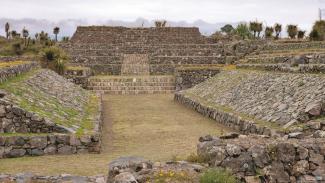
It was practiced from approximately 1400 BCE and was one of the great common denominators of Mesoamerican cultures. Its importance was such that, to this day, more than 1,500 ballcourts have been discovered, from present-day Arizona in the United States to Costa Rica, making it an invaluable cultural and architectural legacy.
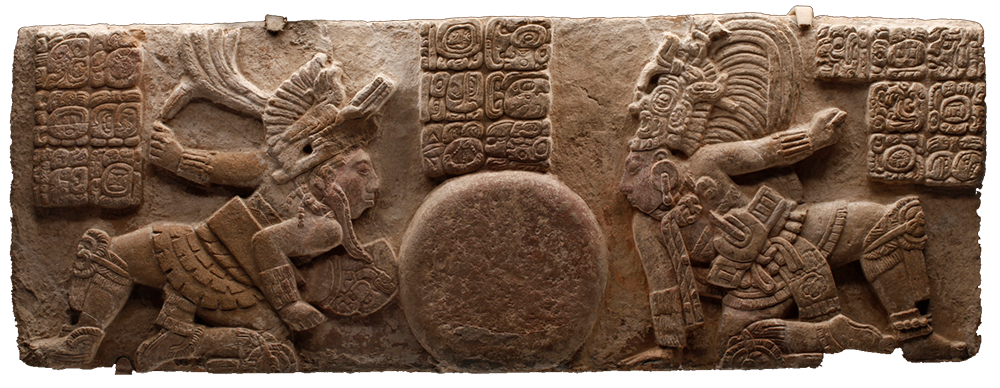
The objective was to keep a heavy, solid rubber ball (which could weigh up to 6.6 pounds) in the air. The game was a match between two opposing teams, of between one and seven players each.
Players were required to strike the ball primarily with their hips, although there are also records of the use of forearms, shoulders, and back. It was forbidden for players to touch the ball with their hands or feet, or for the ball to touch the ground.
The ball was launched to the opposite side by means of passes or direct shots, bouncing off the side walls of the court (called taludes). Over time, the game evolved to include movable markers that created angles for returning the ball with less predictable spin, making the game more dynamic and interesting. Later, stone hoops embedded in the high walls, known as “tlachtemalácat”, were added.
Points were scored when the ball touched the wall or crossed the opponent's end line. If a team managed the feat of passing the heavy ball through the center of the hoop, they automatically won the game.
Although there are up to 18 architectural variations, the typical court had a rectangular shape (similar to a Latin "I" or a double "T"). It was bordered by two parallel buildings with sloping walls that ended in a cornice, allowing the ball to gain speed upon bouncing and return to the playing area. A center line, called the "tlécotl," divided the space between the teams.
The ball was made of latex extracted from the Castilla elastica tree, mixed with the juice of an Ipomoea alba vine. This mixture gave it the necessary rigidity and bounce, but also made it dangerous due to the force and speed it could achieve.
The participants generally belonged to the elite: nobles, distinguished warriors, or, in some cases, prisoners of war. To protect themselves from the impact of the ball and from the constant falls on the stone court, they wore thick leather protectors around their waists and hips (yokes), knee pads, and hand protectors, complemented by ceremonial headdresses that were symbols of power, such as jaguars, snakes, or birds.